



 26.87°C Kathmandu
Tue, Oct 27, 2026
Editorial
Why the government must be stopped from chaining the central bank governor
Proposed changes to the NRB Bill threaten monetary stability and regulatory independence.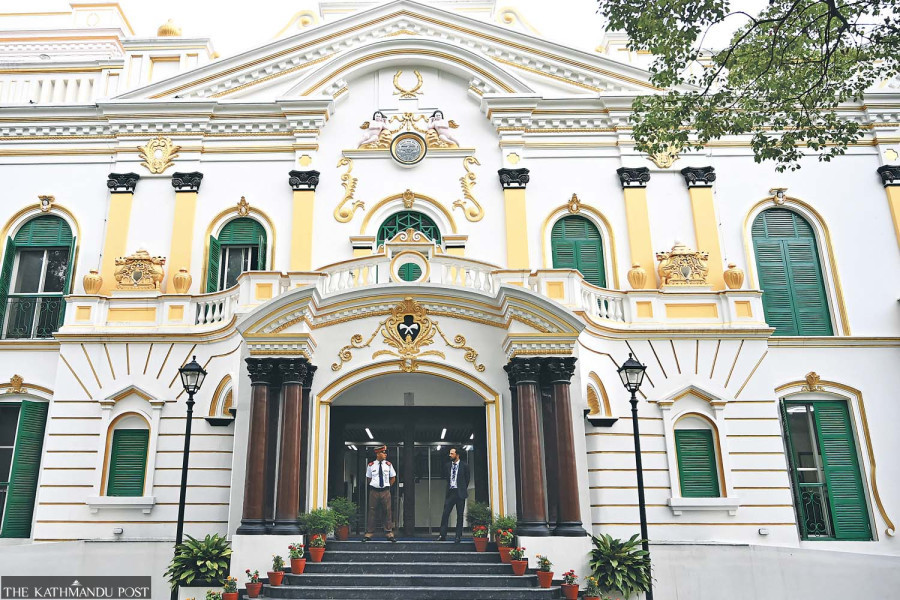
bookmark
Published at : September 14, 2026
Updated at : September 15, 2026 06:50
A central bank cannot be independent if its governor’s tenure depends on the government’s approval. Yet that is the risk posed by the amended Nepal Rastra Bank Bill now before the Parliament. The Finance Committee has proposed limiting the governor’s term to three years, with the remaining two years subject to a performance-based extension. It has also retained the government’s power to issue directives to the central bank. These provisions would give the government precisely the leverage a central bank must be protected from: the ability to make its leadership’s job security contingent on political satisfaction.
A governor who fails to perform must be subject to scrutiny and, where necessary, removal. The existing law already provides for this through a defined process. The danger lies in creating a parallel mechanism through which a governor can be kept in office only at the government’s discretion. That would discourage the governor’s independence when monetary or regulatory decisions conflict with the government’s political interests.
A central bank’s credibility rests partly on its ability to make difficult decisions without calculating their political cost. Protecting depositors may require tighter credit. Containing inflation may require higher interest rates. Safeguarding foreign-exchange reserves may demand unpopular measures. Banks and financial institutions that breach regulations may have to be penalised. None of these decisions can be made properly if the governor must first consider whether the government will approve the continuation of their term.
Governments have previously tried to remove governors who resisted political pressure. Tilak Rawal was removed in 2000 and later reinstated by the Supreme Court after due process was found wanting. In 2022, governor Maha Prasad Adhikari was suspended by the Cabinet after a confrontation with the government and returned to office following a Supreme Court ruling. These episodes should reinforce, not weaken, the case for insulating the central bank from political retaliation.
The proposed changes would also be particularly damaging in Nepal’s volatile political environment. Governments and finance ministers change frequently, while monetary policy requires continuity. One government may set a budget’s priorities, another may present it, and another may implement it. The central bank must be able to look beyond these political cycles and act according to its statutory mandate.
The governor should have a secure fixed term, with removal possible only through a transparent, evidence-based process. Performance evaluation must be insulated from political interests. The government’s power to issue direct instructions should be narrowly defined so that it cannot be used to interfere in monetary policy, banking supervision or regulatory decisions.
The International Monetary Fund and other institutions have previously recommended a longer tenure for Nepal’s governor. Whatever the precise duration, the tenure must provide sufficient security for the governor to act independently.
The proposal allowing chief executives of commercial banks to become governors also deserves reconsideration. The central bank regulates the very institutions from which such candidates would be drawn. The appointment framework must therefore guard against conflicts of interest and protect public confidence in the regulator.
Nepal has struggled with prolonged political bargaining over the appointment of governors and deputy governors. Making a governor’s continuation dependent on government approval would institutionalise that vulnerability. An independent central bank is one of the safeguards that allows governments to pursue their economic priorities without sacrificing monetary and financial stability.
The Finance Committee should therefore remove provisions that make the governor’s tenure politically contingent and strengthen the institutional autonomy of Nepal Rastra Bank. Governments come and go. A credible central bank and a stable governor must outlast them.





Most Read from Editorial




Editor's Picks

What to know about the US trial over Mamta Kafle’s disappearance

NPL returns with bigger ambitions and global recognition

What’s new in the Nepal Premier League’s third season?

After Nepal’s recent disaster, it wants to test whether COP31 can deliver climate justice

Why does an hour long flight to Dhangadhi cost more than a flight to New Delhi?
E-PAPER | October 27, 2026

×