Nepal is currently witnessing a quiet shift in the linguistic medium of education as the Sanskrit language re-emerges from decades of institutional exile. Enrollment numbers at Nepal Sanskrit University and various gurukuls across the nation are surging in a manner that defies earlier predictions that the ancient language will eventually wither. The demand for seats at Sanskrit-medium institutions now frequently exceeds available quotas. Some might trivialise this phenomenon as a nostalgic return to antiquity. But the trend actually represents a complex intersection of economic necessity, spiritual yearning and shifting political tides in South Asia. The rise in student numbers is encouraging. Now, the nation needs to critically examine if this resurgence is built upon a sustainable foundation.
The history of Sanskrit in Nepal is that of systemic marginalisation. From the Jayatu Sanskritam movement of 1947, which sought to modernise traditional learning, to the detrimental impacts of the 1971 National Education System Plan, the language was gradually pushed to the footnotes of priorities. The Maoist insurgency further stigmatised the study of Sanskrit by associating it with Brahminism. However, the current geopolitical climate in South Asia has triggered a significant reversal. The rise of the Bharatiya Janata Party in India and its emphasis on Hindu identity have influenced the appetite for Vedic studies. Recent high-profile events, such as the Vedic ceremony for the swearing-in of Prime Minister Balendra Shah and the use of Sanskrit in parliamentary oaths, signal growing acceptance of the language even in the Nepali political sphere.
A significant portion of the current interest in Sanskrit is rooted in the pursuit of livelihoods through karmakanda—the practical, action-oriented part of the Hindu scripture. The demand for ritual practitioners in Nepal and among the growing diaspora provides a clear, financially stable career path for learners. The practicality of learning the language has turned Sanskrit into a tool for financial stability. However, scholars warn that reducing a vast linguistic heritage to mere ceremonial practice is a grave error. Thus, this interest in the language often produces scriptural narrators who lack a deep or critical understanding of the Vedanta philosophy that follows through the language.
The Sanskrit resurgence is augmented by a spike in interest from foreigners. Students from China, the US, Russia and Thailand are enrolling in Sanskrit-medium institutions in Nepal to seek inner wellbeing and study the roots of yoga and naturopathy. Domestically, the attraction often stems from the provision of free education, meals and accommodation. For families from remote areas and economically disadvantaged backgrounds, gurukuls offer a viable alternative to expensive private schooling.
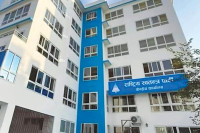
To transform this resurgence into an actual renaissance, the state and academic institutions must pivot toward a comprehensive scholarly framework. Sanskrit needs to be treated as a distinct field of rigorous inquiry encompassing linguistics, medicine, political thought and astronomy. The current budget allocation for Nepal Sanskrit University remains a pittance within the broader national education budget. With a meagre Rs1.4 billion allocated out of a total of Rs211.17 billion (or a puny 0.66 percent), the university struggles to maintain its infrastructure.
A sustainable revival of Sanskrit also requires a rejection of persistent social exclusion. Deep-rooted discrimination still prevents Dalit and indigenous students from fully accessing ritual-based studies in many areas. Nepali society cannot claim a genuine revival of Sanskrit if it continues to gatekeep the language based on caste. The state must ensure that practitioners can openly declare their identity without facing barriers to teaching or academia. To transform the resurgence into a genuine renaissance, a rejection of the binary between traditionalism and modernity is required. Sanskrit must be revitalised as a living intellectual tradition that invites critical inquiry from all sections of society, regardless of gender or caste. The current momentum must be leveraged to foster genuine research and inclusive practice. Failure to do so will result in a missed opportunity where the language remains a purely ceremonial relic.




 21.76°C Kathmandu