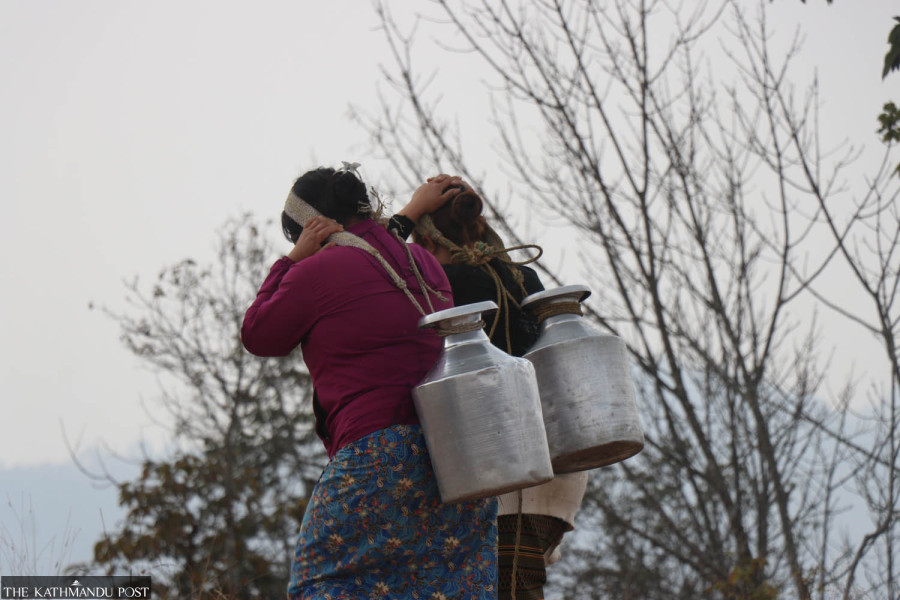
A new assessment by the Asian Development Bank (ADB) has revealed that Nepal’s springs and groundwater reserves are steadily declining, imperilling the country’s water security. The report states that despite enough water resources in the country, only about 25 percent of the population has access to a fully functioning drinking water system. The country thus faces a paradox of abundance and scarcity. The report points to infrastructure gaps, fragmented governance, and climate impacts as factors preventing reliable and equitable water distribution.
Internationally, the United Nations General Assembly Resolution 64/292 affirmed the right to water and sanitation in 2010, making it a global standard. In Nepal, access to clean drinking water and sanitation is a fundamental right enshrined by Article 36 of the 2015 Constitution, further elaborated by the Water Supply and Sanitation Act, 2022, detailing citizens’ rights to accessible, adequate, clean and quality water and sanitation, with the government responsible for implementation. It is thus the state’s responsibility to ensure access to safe drinking water, yet the budget allocation for the sector has been miserly. That is just one problem.
Deep-boring pumps have emerged as the main reason behind the water scarcity in the Valley and beyond. Experts claim that the 2025 Madhesh Water Crisis was the result of policy gaps and disregard for the rampant encroachment of water resources and unnecessarily deep boring. The latest ADB report has found that over-pumping in the Kathmandu Valley has severely depleted aquifers and dried up traditional springs. Many rural communities that rely on springs and groundwater face growing hardship, too. In a country that brags of an estimated annual surface water runoff of 225 billion cubic metres, some households are still forced to migrate as local sources dry up.
Much of Nepal’s drinking water supply projects are built with the help of international funding. According to a report by WaterAid, international donors funded around 28.1 percent of the Water, Sanitation and Hygiene budget, a category which includes water supply. Approximately, around 71.4 percent of the original estimated cost of the Melamchi Water Supply Project, the largest water supply project of the country, was international financing. The project has reported that the ADB and the Japan Bank for International Cooperation contributed $137 million and $47.5 million, respectively. The government’s interest and stake in guaranteeing access to safe drinking water is far below the desired level.
The focus must shift to building a robust drinking water supply. First, the government’s policy priority in water resource management must include measures to cut the damage dealt by overexploitation of water resources and rampant boring pumps. Second, there is a need for new projects to, at the very least, ensure an adequate supply of safe and clean drinking water in the major cities. While the financial support of international agencies for Nepal’s development projects has propelled the country’s development, the government must also look for funds internally.
Public funding, public-private partnerships and blended domestic finance mechanisms using public funds can be explored to finance drinking water supply projects. The Gen Z movement’s demand for good governance does not apply exclusively to politics and the political parties. It is, in fact, meaningless to talk of good governance without the state’s ability to guarantee the fundamental rights of its citizens. The country fails its people when it cannot guarantee their right to something as fundamental as safe drinking water.




 15.26°C Kathmandu