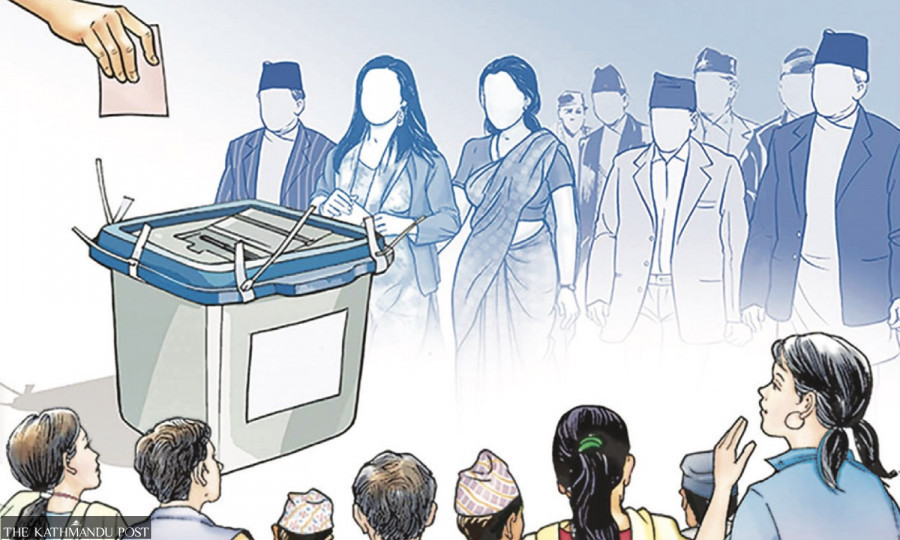
With two days to go for the March 5 snap polls, democracy is knocking on the door of Nepalis. But not everyone is answering. The festive veneer of democratic exercise in Nepal is increasingly being overshadowed by a chilling reality: The systematic, albeit perhaps unintentional, disenfranchisement of a significant portion of our citizenry. While the Election Commission touts a registered voter base of over 18.9 million, historical trends and contemporary grievances suggest that a staggering 35 percent of these individuals may remain silent on election day. This is a scathing indictment of a system that has allowed the cost of democracy to become a literal, financial barrier that the common citizen can no longer afford to scale.
The government’s primary obligation is to ensure that the right to vote is not a privilege reserved for those with geographical or financial convenience. Currently, we are witnessing a crisis of accessibility. For citizens residing in Kathmandu but registered to vote in a remote constituency, the act of voting is an economic burden that threatens the family’s monthly budget. When a single journey to a home village can cost upwards of Rs30,000, the ballot box becomes a luxury item. It is an administrative failure of the highest order that hundreds of thousands of internal migrants remain unregistered in their current locations, trapped by a rigid ‘non-listing’ bureaucracy that forces them to choose between their livelihood and their voting right.
Nepal requires more than just the opening of polling stations; Nepalis deserve a government that initiates robust efforts to ensure a fair chance for all. This calls for a radical reimagining of our electoral logistics. Why, in an era of digital advancement, are we still tethered to a system that requires a carpenter from eastern Nepal to abandon his work and spend his meagre savings on hazardous travel just to have his name found—or not found—on a roll? From the next election cycle, the government must facilitate localised registration and explore remote voting mechanisms for internal migrants to bridge this chasm. To do otherwise is to maintain a democracy that exists only for those who do not have to count their pennies before they count their votes.
However, the logistical failure of the state is only half of the tragedy. The other half lies in the profound moral bankruptcy of our political parties. The public that is not just physically distant from the polls, but also emotionally and ideologically alienated from those who seek their mandate. There is a pervasive distrust in parties that have consistently ignored the ‘bread-and-butter’ issues of the populace in favour of lofty pledges.
The main onus now rests on the political class to come up with agendas that actually resonate with the public. As it stands, most election manifestos are exercises in superficiality, failing to address the rampant inflation that gnaws at the guts of the middle and lower classes. Consumer rights activists rightly point out that while parties clamour for a majority to form a government, they remain deaf to the humiliation and danger faced by commuters on unsafe public transport or the kickbacks required for the simplest of public services. If the parties continue to ignore the everyday problems of the voters, the 35 percent absentee rate will only grow.
A vote should not be a sacrifice of one’s monthly groceries, nor a hollow gesture toward a party that views its constituents as mere statistics to be exploited. If we are to save our democracy, we must ensure that every citizen has a fair chance to vote—and, more importantly, a reason to believe that doing so actually matters.




 14.82°C Kathmandu