



 14.4°C Kathmandu
Fri, Oct 16, 2026
Columns
What Nepal actually needs from global leaders in New York
Former under-secretary-general of the UN argues Balendra Shah’s UNGA debut is a critical pulpit to demand climate justice, secure reconstruction aid and champion the fragile future of the world’s mountains..png&w=900&height=601)
bookmark
Gyan Chandra Acharya
Published at : September 24, 2026
Updated at : September 24, 2026 13:07
Prime Minister Balendra Shah is leading Nepal’s delegation to the United Nations General Assembly. This visit comes immediately after the devastating floods in the Bhotekoshi River caused by a rock-ice avalanche on the Langtang-Lirung mountain in Nepal. The massive floods led to the unprecedented loss of life of thousands of people, with thousands still missing, and destruction of property reaching almost $3 billion. Therefore, the high-level UN gathering has special significance for Nepal. We can use the highest global pulpit to not only highlight the catastrophic disaster in Nepal, but also create momentum for effective and transformative action on climate change and global support for reconstruction and rebuilding in Nepal.
The UN normally assesses the state of the world and reports its vision for the following year in the General Assembly. This year, the UN is focusing on issues, including global crises and conflicts, climate action, acceleration of efforts to meet the SDGs, technology and AI governance, and leadership transition.
As climate action is one of the major focus areas, Nepal should address the UN with a clear articulation of our negligible contributions to global GHG emissions, the high degree of climate change impacts due to the mountainous terrain, along with our multiple vulnerabilities and limited capacity to build resilience. We should also emphasise our own modest contributions to absorb or limit GHG emissions through afforestation and the drive for the development of renewable energy over the decades. Climate justice and enhanced global support and cooperation should find a strong resonance in the address.
At a time when the global order is fractured, and multilateral institutions are undermined, we should particularly stress that justice, interdependence, and global solidarity and cooperation are in the interests of all countries, big or small. We should underline that the national interests of all countries should be guided by values, and power should be tempered with principles. The UN was created to prevent wars, to promote peace, justice, human rights and dignity and to be a centre for harmonising global action and cooperation for economic and social development. These objectives are more relevant today in this highly interconnected and globalised world.
We should present our own initial findings and report on the massive scale and intensity of loss of life and destruction of infrastructure and property in the recent catastrophe. Likewise, the latest scientific report published by the World Weather Attribution on September 17, entitled ‘Rapid Warming in the Himalaya Exacerbates Geohazard Cascades Beyond Adaptation Limits’, could also be pointed out for its independent and multi-stakeholder analysis.
Similarly, the report published in 2020 by the International Centre for Integrated Mountain Development (ICIMOD) and the UNDP Nepal can be used to emphasise the dangers of glacial lake outbursts. It identified 47 potentially dangerous glacial lakes across the Koshi, Gandaki and Karnali river basins, with 21 of them falling in Nepal. Since this was based on the data and research in 2019-20, there could be many more glaciers which could be in danger.
We could also link our analysis to the findings of the Special Report on the Ocean and Cryosphere in a Changing Climate, which was released in September 2019 by the Intergovernmental Panel on Climate Change (IPCC). This was a significant report by the IPCC on melting ice and glaciers, thawing permafrost and the linkages with climate change and their impacts on water supplies and human settlements.
The UN General Assembly will help us stress the devastating climate change impacts on vulnerable countries. They are not issues for future generations; they are affecting present generations and are accelerating now.
Second, equally important are the high-level bilateral talks and pull-asides at the UNGA meetings. Nepal should make sure that there are as many bilateral talks and interactions as possible, especially with the traditional developed countries and emerging nations, whose support and cooperation are crucial for restructuring and rebuilding. No other forum brings so many world leaders together within a week at one place.
Third, due priority should be given to interactions with important mountain countries and leaders from other vulnerable groups like small island developing states, least developed countries, landlocked developing countries and other climate-vulnerable groups. We should be able to make a common cause with them and amplify the message.
Fourth, global and regional development and finance institutions are critical players in promoting sustainable development and resilience building in many countries, including in Nepal. They will be playing a very important role in the forthcoming rebuilding and reconstruction conference in Nepal. They should be clearly engaged on the sidelines of the UN meetings.
Civil society is an important part of the global advocacy efforts, especially on climate change issues. They have been the most vocal supporters for urgent and ambitious actions on emission reduction and support for vulnerable countries in general. The high-level meetings should therefore be fully utilised to garner the necessary support to make our voice louder for strengthening the cause of the mountain countries at the global forum.
It is well appreciated that the Government is hosting a high-level side event entitled ‘Sagarmatha to the Sea: A Call to Action for a Climate-Resilient Future’ on September 25. We should make sure that it is a high-level event with strong participation of all the relevant groups as well as development partners and institutions. Coming out with a clear programme of action and follow-up events would be crucial to influence the agenda in all the relevant forums.
Finally, we should also use the UN forum to turn the disaster into an opportunity to promote our leadership role in championing the mountains and climate change. After many years of efforts, it was only during COP30 in 2025 that a dedicated dialogue on the mountains and climate change was agreed to convene for the first time by the Chair of the subsidiary bodies. In June this year, the subsidiary body held a comprehensive session in Bonn addressing climate risks, adaptation gaps, and the integration of mountain ecosystems into national instruments. There is a long way to go to mainstream the issues of mountains and climate change in the global agenda under the UNFCCC process as well as in other relevant forums. Our effective articulation now could provide us with an important opportunity to pursue this agenda further.
We should also leverage the statement that UN Secretary-General António Guterres made in his remarks on the opening day when he pointed out that the glacier melt was accelerating in Nepal, with rooftops of the world caving in and those least responsible were suffering the first and worst. He also urged the world to adopt a national plan to transition away from fossil fuels with clear timelines aligned with the 1.5C limit, and called for the implementation of the polluter-pays principle.
UNGA is not a forum where specific funding pledges are announced. But it is an important forum to sensitise the global community at the highest level on some specific concerns. The issues raised before 130 global leaders and thousands of institutional heads, businesspeople, and civil society leaders could have a major impact on the relevant meetings within the UN and beyond.
Nepal has generally a good standing at the United Nations. Its peacekeeping role is well appreciated by all. So is its leadership role in the development and climate change issues in the past as well as in recent times. We should use this opportunity to enhance our leadership role on mountains and climate change-related issues with high-level commitment, robust institutional follow-up, and effective coalition building as we go forward. Besides getting strong support and cooperation for rebuilding and reconstruction, that would also be an important contribution from high-level lobbying during the UNGA meetings.
Gyan Chandra Acharya
Acharya is a former UN Under-Secretary-General.


.PNG&w=200&height=120)

Most Read from Columns
Before you take credit for Khula Manch, read its history
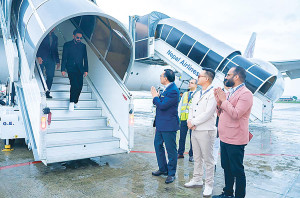
Shah went to the UN to speak for Nepal, then left before he could make the most of it

Bhotekoshi flood wasn’t a freak event. It’s the Himalaya doing what it does
Lesson learned after the death of Ronaldo
Why passive neutrality won’t take Nepal anywhere
Editor's Picks

Constitutional Bench caught in seniority, ‘pick and choose’ dispute

A Dom boy’s long road to becoming a doctor

From blankets to handmade dolls, two foreign women bring comfort to flood survivors

News Analysis: When institutional defence exposes institutional fault lines

It’s a bird … it’s a plane … it’s the Indian ambassador’s farewell tweets
E-PAPER | October 16, 2026

×