



 16.84°C Kathmandu

Thu, Oct 15, 2026
Columns
Remittances built Nepal’s economy for decades. It’s time for the next step
Upgrading data-sharing and recruitment systems can bridge the gap between Nepali workers and foreign employers.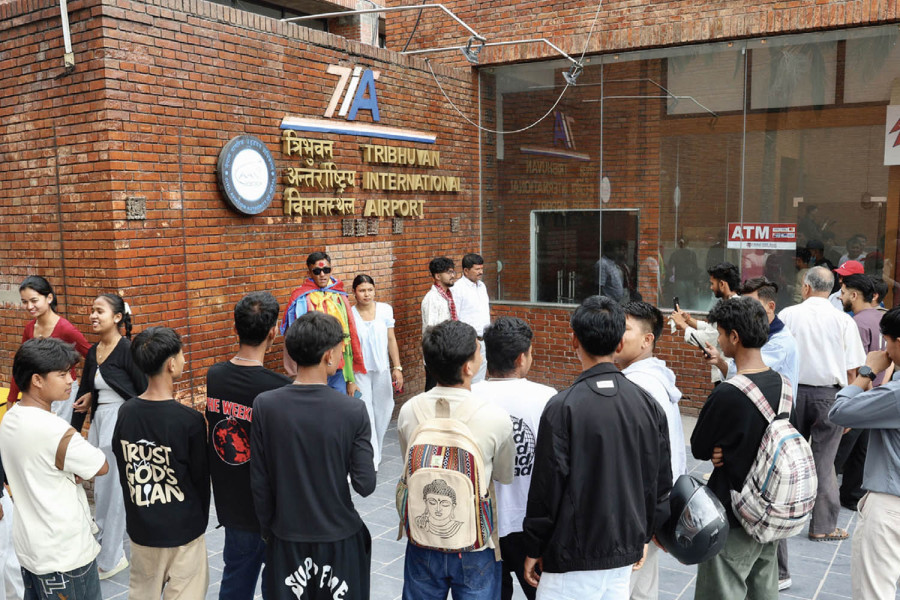
bookmark
Rashesh Shrestha
Published at : September 22, 2026
Updated at : September 23, 2026 15:16
Foreign labour migration, despite driving Nepal’s economic and social transformation over the past 30 years through remittances, has contributed little to Nepal’s long-term growth. Brain gain, the idea that foreign employment opportunities can help increase the stock of skilled workforce in sender countries, has been absent in Nepal’s case. To make this work, we need strategic policies that link our skill-building process to migration.
Effective skill development requires a strong ecosystem of institutions and policies working in close alignment to equip workers with skills that match demand. This goes beyond better education and training institutions, and requires close coordination between the demand and supply of skills. Any skilling effort, including adoption of the latest technologies, will generate limited benefits unless linked directly to the demand side.
For Nepal, foreign labour markets are an inextricable part of the skill development ecosystem. Over the past decades, foreign employment has become more attractive, and the number of destinations where a Nepali worker can work has expanded. The perceived earnings in foreign countries are so high that Nepalis spend large sums of money, financed through loans, in destination countries, just to obtain the necessary skills and qualifications over several years without any certainty of employment. Difficulties that inevitably arise due to this can be reduced if migrants had sufficient opportunities to acquire internationally recognised skills in Nepal.
One way to improve Nepal’s skill development ecosystem while reducing the skilling cost is to implement government-to-government ‘skills partnerships’ with destination countries. Such partnerships would provide a framework for implementing mutually beneficial skill development initiatives and programmes in Nepal, with technical and financial support from the destination country.
Partner countries can access well-trained, job-ready workers to address their labour shortage, reducing the time and resources foreign employers spend onboarding Nepali workers. By reducing migration costs, they can access a wider pool of Nepali talent who would otherwise be unable or unwilling to migrate due to high training costs. Skilled migrants are also more likely to easily navigate the destination country’s labour market and remain self-sufficient. Thus, skills partnership is not a development aid but an investment with high potential returns.
Skills partnerships with strategic partners can also generate spillovers across the entire ecosystem, where Nepali institutions learn from the best practices of co-invested programmes and initiatives. If done effectively, this can build global trust in Nepali workers’ skills, allowing migrants to avoid costly re-certification. Over a longer horizon, skills partnerships could generate greater domestic and foreign investment in Nepal’s economy.
To achieve maximum benefits for the domestic economy, skills partnerships have to be designed with Nepal’s domestic economic needs in mind. To do so, skills programmes and initiatives under such partnerships must be available for all Nepali workers, regardless of their migration aspirations. By concentrating our collaborative efforts on building skills for economic sectors where both partner governments and Nepali entrepreneurs have strong unmet needs, we can engineer a win-win scenario.
The skills partnerships should also improve the labour market information system. A data-sharing agreement could be included to provide real-time information for evolving skills demand in destination countries, fed directly to our education and training systems so the curriculum can be adapted accordingly. Skills partnerships could also improve the recruitment and placement services system.
The promise of skills partnerships can only be realised with sufficient preparation and cross-ministry coordination. First, skills partnerships need to be part of our foreign labour migration policy at the highest level. ‘Exploration of skills partnerships with destination countries’ could be included as one of the implementation steps in our migration policy document, ‘Nepal Labour Migration Policy 2025’. This would provide a legal basis for the incorporation of such partnerships in future bilateral labour agreements. Then, relevant agencies must develop country-specific technical proposals for skills partnerships in consultation with domestic stakeholders and foreign partners. Drawing on examples from Australia, Germany and elsewhere, the proposal should define the objectives, priority sectors and occupations, skills development programmes, financing arrangements, institutional responsibilities, and mechanisms for monitoring outcomes in a way that demonstrates benefits for all parties. With an initial proposal at hand, the government should initiate consultation with relevant foreign government agencies as an exercise in labour and economic diplomacy. The consultations should seek to include skills partnership as a component of bilateral cooperation.
In the current era defined by threats to employment from technology and artificial intelligence, high youth unemployment and informal employment, and economic anxiety and political dissatisfaction among the youth, the government needs to leverage all available strengths, including Nepal’s connections with destination countries, to enhance domestic opportunities for skill development and gainful employment. Formal skills partnerships with destination countries, which would provide a framework for the partner countries to collaborate and co-invest in building skills within Nepal, can enhance foreign labour migration’s contribution to Nepal’s development.
Rashesh Shrestha
Shrestha is a Research Fellow at the Institute of Developing Economies-Japan External Trade Organisation (IDE-JETRO) based in Japan.



.PNG&w=200&height=120)

Most Read from Columns

Before you take credit for Khula Manch, read its history

Shah went to the UN to speak for Nepal, then left before he could make the most of it

Bhotekoshi flood wasn’t a freak event. It’s the Himalaya doing what it does

Lesson learned after the death of Ronaldo

What Lubra can teach Nepal about climate-induced migration and resettlement
Editor's Picks

Constitutional Bench caught in seniority, ‘pick and choose’ dispute

A Dom boy’s long road to becoming a doctor

From blankets to handmade dolls, two foreign women bring comfort to flood survivors

News Analysis: When institutional defence exposes institutional fault lines

It’s a bird … it’s a plane … it’s the Indian ambassador’s farewell tweets
E-PAPER | October 15, 2026

×