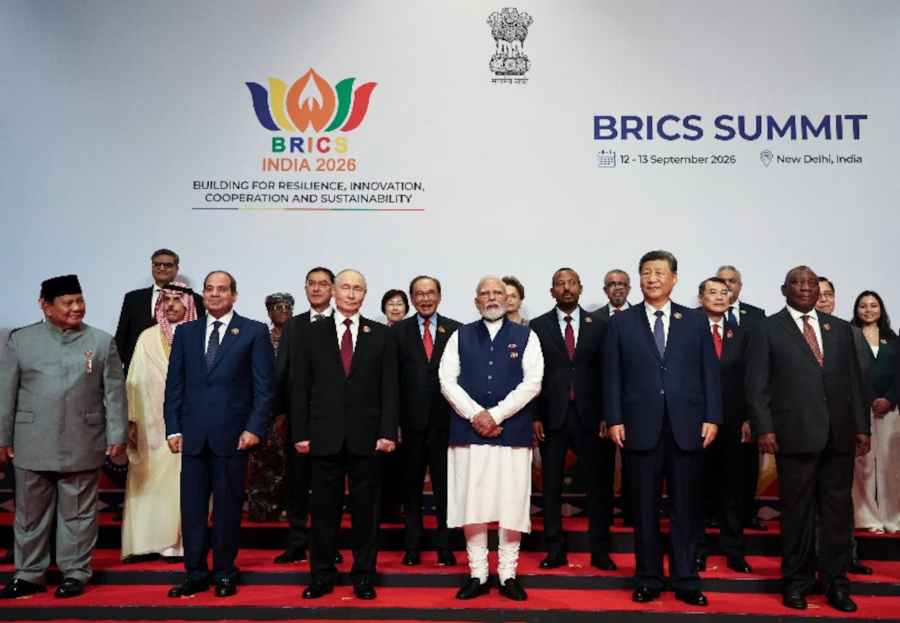
When the leaders of BRICS gathered at Bharat Mandapam on September 12 and 13, the photographs carried an argument of their own, with Vladimir Putin and Xi Jinping in New Delhi, Iran’s President seated in the same hall as the Emirati delegation, and India, a Quad partner of the United States, presiding over the proceedings. For much of the Western commentariat, such images confirm a settled reading of the grouping as an anti-Western bloc in the making. That reading is not without basis, but it rests on a conflation of the non-Western with the anti-Western. The New Delhi Declaration, a 45-page, 140-point document adopted unanimously by the 11 members, offers a good occasion to separate the two.
Two postures within one grouping
The grouping has one cohort, Russia, China and Iran, with an explicit anti-Western agenda. Russia has used BRICS since 2022 as evidence that sanctions have not isolated it; China sees the forum as one instrument among many for diluting American primacy in finance and technology; and Iran now approaches it from a position of open war. Tehran wanted the grouping to condemn the US-Israeli war on Iran, accused the UAE of direct involvement in operations against it, and has struck the UAE with missiles and drones several times since the war began on February 28. At the foreign ministers' meeting in May, Abbas Araghchi told his counterparts that Iran was only hitting American military bases that happened to be on Emirati soil, which is a statement of confrontation, not of reform.
The founding members Brazil, India and South Africa, however, have a differentiated foreign policy posture rooted in genuine multilateral and multipolar ideas of the world—one that seeks a larger voice within global institutions rather than their replacement.
The Delhi test
The summit’s significance lies in whether these two postures could coexist in a single text. The UAE and Iran coming to the same table and agreeing to something is a considerable win, and it highlights the role of India not just as a swing state, but as an actor able to bridge between two major gaps: the one between the West and the non-West, and the one opening within the non-West itself. Former Indian Foreign Secretary Nirupama Rao described it as a “significant diplomatic success” secured despite sharp differences between Iran and the UAE. On the other hand, an analysis noted that the grouping anchored its position in broad principles rather than demanding uniformity on every geopolitical question. The consensus had its costs, and critics have pointed out that the Delhi text dropped mention of the Ukraine war. But the method—consensus without attribution—is precisely what a forum of normatively dissimilar members requires if it is to remain a forum at all.
What the Western reading misses
The Western reading of multilateral forums like BRICS does not take into account the return of great power politics and the possible grey zone of entente and détente between the G3, the United States, China and Russia, and its impact on emerging powers, both Western and non-Western, such as the EU, Canada, India, Brazil and Indonesia. Washington's relationship with Beijing oscillated in 18 months from tariff escalation to a Beijing summit in May at which Xi said the two sides had agreed to constructive “strategic stability” as a framework for the next three years, with a return state visit scheduled for later this month. A great power arrangement of this kind, however unstable, leaves middle powers on both sides of the old divide exposed to bargains made over their heads.
Why would sabotage not serve India
Hardline realists in India have advocated sabotaging BRICS from within. A recent column in ThePrint argued that an effective BRICS would likely become one that China uses to promote its interests, isolate India, and undermine its Indo-Pacific partners, and in 2023, economists Arvind Subramanian and Josh Felman made the case for exit altogether, asking why India should belong to a China-centric club.
The concern about Chinese weight is legitimate, but sabotage may not yield any good results, given that BRICS would have longer repercussions for the multipolar world it has imagined for itself. A hollowed-out BRICS would not become a neutral space; it would become a smaller one in which Beijing and Moscow set the terms with fewer moderating voices. India would forfeit the credibility with Brazil, South Africa, Indonesia and the Gulf states that allowed it to broker the Delhi consensus. Remaining inside as a brake, as India has done on expansion criteria and on currency, and treating the grouping as non-Western rather than anti-Western, is the more realistic choice.
The constraint
The Delhi text records no endorsement of a common BRICS currency, with India in particular favouring interoperable national-currency settlement over a shared unit, and, as one reading of Clause 90 notes, the declaration stresses divergent national priorities and rejects a “one-size-fits-all” approach. New Delhi has drawn a line between reducing exposure to the dollar and seeking to replace it, a line it has not crossed as of now.
The Delhi summit gave us a clearer picture of how much the non-West is against the West than most people are willing to admit. It revealed a core of three strong members, a majority that is open to change and a chair who can manage both. Whether this balance will last will be seen in 2027, when China will take over the chairmanship. India’s ability to bridge divides will depend less on hosting the meeting and more on staying involved.




 24.89°C Kathmandu
.PNG&w=200&height=120)