



 14.4°C Kathmandu
Fri, Oct 16, 2026
Columns
The case for transparency in Nepal flood rescue flights
When the flood washed away the roads, helicopters were the only way out. So why were politicians and camera crews hogging them?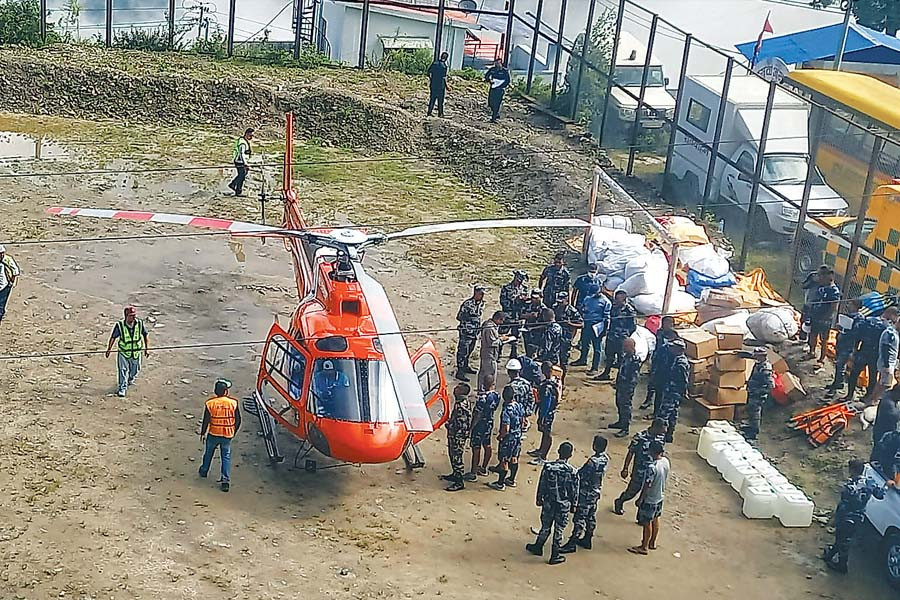
bookmark
Biken K Dawadi
Published at : September 1, 2026
Updated at : September 2, 2026 09:11
Last weekend, I came across a video on social media that has been pricking my brain ever since.
The video showed a reporter standing in front of a helicopter at Tribhuvan International Airport in Kathmandu, his boom mic raised. The rotors had already started turning, their noise swallowing the conversation. The pilot kept glancing at his watch; perhaps he was in a hurry. The reporter, however, kept asking questions to the pilot, trying to hold him there for one more quote.
Perhaps the reporter had booked a chartered flight. Perhaps it is okay to take such an interview during times of normalcy. But these are not ordinary times. The country is still looking desperately for thousands missing since last week’s deadly floods.
Now consider this: My classmate for eight years was stranded in a high-altitude location in Rasuwa after the floods. He was in constant communication with me, and on the day I saw this particular video, he told me that his food supplies were almost exhausted. On one hand, my friend was running out of supplies; on the other, this reporter was stalling a helicopter flight that could have potentially rescued my friend.
The floods have produced a familiar kind of political theatre in Nepal. Ministers and lawmakers, in addition to media people, travelled to the areas devastated by the deluge, often surrounded by security personnel and cameras. They looked down from helicopter windows at villages cut off by water, conversed with a few, then returned to Kathmandu. Photographs of these visits circulated quickly: a minister surrounded by survivors, a solemn expression, a damaged bridge behind them.
In Nuwakot and Rasuwa, along the Bhotekoshi and Trishuli rivers, roads have disappeared beneath landslides and floodwater. Security personnel, volunteers and families are still searching through mud and sludge with their bare hands. Some are looking for survivors. Others are looking for bodies or even just body parts. In places where bridges and highways have been washed away, the sky is the last road left.
That is why every unnecessary flight matters.
An advisor to Nepal’s foreign minister told me that the dearth of landing sites in the flood-affected districts propelled the government to refuse some foreign states’ requests to send their own choppers to assist rescue efforts. Let’s face the facts: Helicopter operations in the high Himalayas do not allow much room for chances. The air is thin. Weather changes quickly. Mountain winds can turn unstable without warning, and the flying window may close by the middle of the afternoon. Landing sites are already few, and when disasters of this scale take place, they grow fewer. Fuel is limited, and every aircraft has to be weighed against what it can carry and where it can go.
Therefore, at a small helipad near Rasuwa or Dhunche, one aircraft can delay everything behind it. A helicopter carrying a political delegation or a television crew may force rescue flights to circle, burn fuel, or wait. Soldiers who should be recovering the dead or carrying supplies may instead be asked to control the crowd around a visiting official. Rotor wash can unsettle already weakened slopes. Even a short visit from the air can create work—and risk—for the people on the ground.
The public has a right to know how these decisions are being made. My Kantipur colleague Suraj Kunwar tells me that Nepal has more than thirty helicopters available for emergency work, including army and privately owned aircraft. The private helicopters have not been able to operate independently during the floods. As is the norm during crises, the army has controlled who flies, where they fly, and when they fly. The flight records, however, have not been made public.
That secrecy invites suspicion. If helicopters are being assigned according to need, there should be no reason to hide the logs. If political leaders, officials, or well-connected visitors have received priority, the public should be able to see that too. In a disaster, transparency is an integral part of the rescue effort.
Sometimes a minister’s visit is useful. It can bring attention to an overlooked area or help an official understand what local authorities need. But visibility is not the same as assistance. A person looking down at a flooded valley cannot necessarily see the shortage of pumps, the lack of drinking water, or the equipment trapped inside a collapsed tunnel. The image of concern may travel farther than the help itself.
The media has its own responsibility. Television channels and online outlets need images from disaster zones, and aerial footage can show the scale of destruction in a way that ground-level reporting cannot. But a helicopter hovering above an active rescue site is not simply collecting pictures. When a news crew occupies a narrow mountain corridor to film the disaster, someone else may have to wait. That does not mean the media should be kept away. It means access should be organised. News organisations can share pool footage while sending reporters to the ground to investigate what is failing: Where the supplies are stuck, which offices are not responding, and why evacuation requests are being delayed. Not everything is about social media monetisation.
Not all ministers have to be physically present at every disaster site to show solidarity. During the first hours of a crisis, an official may be more useful in a command centre—releasing funds, coordinating aid, speaking with local governments, and removing bureaucratic obstacles. A helicopter visit can create the appearance of action while taking an official away from the work only they can do.
Nepal needs clear rules for the first days of a major disaster. A temporary airspace lockdown over the worst-affected areas could keep the sky open for rescue, evacuation, medical transport and essential supply flights. Political inspections and commercial media charters could wait until rescue operations are over.
The principle is simple: In an emergency, aircraft should be assigned according to need, not status.
A trapped hydropower worker does not care which minister has arrived. A child waiting for evacuation does not benefit from another photograph taken from above. What matters is whether the helicopter can land, whether the survivor can be lifted out, and whether the next flight is carrying relief materials, a rescue team, or a minister’s entourage.
High up in the Himalayas, especially after disasters strike as they so often have, helicopters are the only connection left between an isolated community and the rest of the country. The people who control that connection owe the public accountability.
Biken K Dawadi
Dawadi is an Op-Ed Editor at the Post.


.PNG&w=200&height=120)

Most Read from Columns
Before you take credit for Khula Manch, read its history
Shah went to the UN to speak for Nepal, then left before he could make the most of it

Bhotekoshi flood wasn’t a freak event. It’s the Himalaya doing what it does
Lesson learned after the death of Ronaldo
Why passive neutrality won’t take Nepal anywhere
Editor's Picks

Constitutional Bench caught in seniority, ‘pick and choose’ dispute

A Dom boy’s long road to becoming a doctor

From blankets to handmade dolls, two foreign women bring comfort to flood survivors

News Analysis: When institutional defence exposes institutional fault lines

It’s a bird … it’s a plane … it’s the Indian ambassador’s farewell tweets
E-PAPER | October 16, 2026

×