



 21.46°C Kathmandu

Sat, Oct 17, 2026
Columns
With climate risks looming, are we ready to face the new disaster together?
Nepal, India and China share a mountain ecosystem and face increasing effects of climate change.
bookmark
Vanshika Shah
Published at : August 31, 2026
Updated at : August 31, 2026 23:59
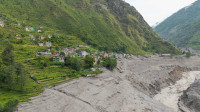
As we mourn the loss of more than 900 people and the disappearance of over 2,000 individuals after the catastrophic flash floods that swept through the region along the Nepal-Tibet border on August 26, I cannot help but question whether this loss was truly unexpected and sudden. Just a year ago, a massive flood struck Rasuwagadhi along the same Bhotekoshi River, triggered by the sudden bursting of a supraglacial lake. It swept away the Nepal-China Friendship Bridge, killed at least nine people, and left 19 others missing, along with significant infrastructure damage.
The warning bells have been ringing for a decade and more. For instance, the 2017 monsoon floods drowned roughly 80 percent of the Tarai, killed more than 160 people and displaced nearly half a million people. Last year, rain and debris buried Melamchi Bazaar and crippled Kathmandu Valley’s pipeline. In 2022, Nepal saw a dengue outbreak with more than 50,000 cases reported, even in cooler towns where these mosquitoes had never previously survived. We have faced the brunt of the cascading effects of climate change, and now it is impossible to ignore.
Disasters know no borders, and neither should our approach to understanding them. The mountain and riverine ecosystems across China, Nepal and India are interconnected. On humanitarian grounds, real-time meteorological data-sharing should be institutionalised, which in the long run also builds regional trust needed for broader collaboration on early warning systems, climate finance and eventually loss and damage.
The precedent already exists. China now shares its data year-round through the Lancang-Mekong Water Resources Cooperation Information Sharing Platform with Laos, Myanmar, Thailand, Vietnam and Cambodia to support downstream flood and drought management. Nepal’s northern border presents a similar case. Following the 2025 Bhotekoshi GLOF, Nepal and China committed to strengthening early-warning cooperation, creating momentum for a formal data-sharing mechanism across shared river basins such as the Bhotekoshi and Trishuli/Keyrung corridors. Similarly, with India, real-time hydro-meteorological data-sharing (agreed in principle in 2019 but never formalised into an MoU) offers a starting point to formalise climate cooperation while also protecting shared hydropower investments.
Nepal must formally initiate a standing mechanism for real-time meteorological data-sharing, joint monitoring and coordinated early warning across India, Nepal and China. This may have its own political challenges, but there is a need for resources to be pooled strategically to safeguard the human rights of affected communities and develop stronger technologies that can save lives by ensuring that warnings and communication reach people in time. Various international NGOs can support such collaboration, but the first level of coordination needs to happen at the government-to-government level and at the highest level. Nepal has high stakes here, and it has to boldly propose such a mechanism. India and China are not bystanders to the crisis either. In a 2020 report, the International Centre for Integrated Mountain Development (ICIMOD) and the United Nations Development Programme (UNDP) in Nepal identified 47 potentially dangerous glacial lakes within the Koshi, Gandaki and Karnali river basins across Nepal, the Tibet Autonomous Region of China and India. Disasters in Nepal, including floods and other transboundary hazards, often have consequences beyond its borders.
Even during the Rasuwagadhi flash floods, hundreds of Indian nationals are among those reported missing, while the downstream states of Bihar and Uttar Pradesh have been placed on high alert. Similarly, for China, not only was the Rasuwagadhi Friendship (Miteri) Bridge completely washed away (for the second time), but 554 Chinese nationals have also been missing, including Chinese construction labourers, hydro workers and tourists. Cooperation, therefore, is not merely an act of solidarity towards Nepal but a moral and practical responsibility. It is an act of self-preservation.
Nepal’s negotiation strategy also needs to reflect these realities. Its positionality has often rested almost entirely on its vulnerability and the harm inflicted on a country that has contributed so little to the problem. That message is accurate and worth retaining, but on its own, it risks casting Nepal simply as a ‘victim’. To strengthen its stance, Nepal needs to approach such negotiations not as a victim seeking aid, but as a custodian of the ‘Third Pole’ and the ‘Water Tower of Asia’. This framing strengthens the case for cooperation by placing responsibility not only on Nepal but also on the countries that share the mountain ecosystem. This reinforces the idea of a shared duty to cooperate, giving Nepal a stronger position to demand and facilitate such cooperation.
The data clearly shows a pattern, and the climate risks are well documented. Nepal, India and China share a mountain ecosystem and face the increasing effects of climate change. The question is no longer whether another flood, another GLOF, or another earthquake is coming. It is. The real question is whether we, at the regional level, have the courage to compartmentalise our differences and build shared mechanisms that can actively mitigate their effects, preventing the next disaster from becoming another tragedy we claim we never saw coming. Condolences cannot become a climate strategy. Emergency relief cannot substitute for cooperation. Reconstruction cannot be our only form of preparedness.
Vanshika Shah
Shah is a fellow at the Institute of Foreign Affairs.




Most Read from Columns

Before you take credit for Khula Manch, read its history

Shah went to the UN to speak for Nepal, then left before he could make the most of it

Bhotekoshi flood wasn’t a freak event. It’s the Himalaya doing what it does
Lesson learned after the death of Ronaldo
Why passive neutrality won’t take Nepal anywhere
Editor's Picks

Constitutional Bench caught in seniority, ‘pick and choose’ dispute

A Dom boy’s long road to becoming a doctor

From blankets to handmade dolls, two foreign women bring comfort to flood survivors

News Analysis: When institutional defence exposes institutional fault lines

It’s a bird … it’s a plane … it’s the Indian ambassador’s farewell tweets
E-PAPER | October 17, 2026

×