Track II diplomacy: Time to rethink Nepal’s diaspora
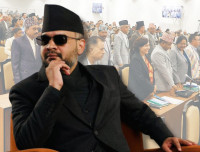
Nepal’s diaspora is more than a source of funds; it is an instrument of foreign policy. For more than 15 years, Kathmandu has confused the two. AI Generated Image
‘Supreme organic investor’ sounds more like a high-grade crop fertiliser. Rather it is a prestigious status for the Nepali Diaspora community under the National Commitment. The 18-point governing plan was released by Prime Minister Balendra Shah’s Cabinet weeks after assuming office. A promising gesture of annual investment bonds, guaranteed ancestral property, a path to the ballot, and protection and continuity of citizenship were listed in the commitment.
The instinct is understandable, as remittances equal roughly a quarter of Nepal’s GDP—among the highest ratios in the world. More than 2.1 million Nepalis live outside the country, and closer to 4.5 million counting people of Nepali descent. The Non-Resident Nepali Association reaches into almost 90 countries. A reforming government is eager to translate patriotic feeling into hard capital, and a diaspora seated on decades of savings is a reasonable place to look at. But this reflects a consistent pattern of misunderstanding of what diaspora is actually worth and how to mobilise it for statecraft.
Nepal’s first integrated foreign policy adopted in 2020 explicitly lists ‘Track II diplomacy’ among the country’s instruments of statecraft. The phrase sits in the doctrine, unused like a treadmill in a spare room. American diplomat Joseph Montville coined the term ‘Track II diplomacy’ for the low-key, unofficial work by which private citizens and other non-state actors pry open channels that formal Track I diplomacy cannot. Nepal maintains roughly 40 missions for a diaspora spread across more than twice as many countries. This is where Track II diplomacy naturally steps in.
Diaspora networks do not replace state diplomacy. They lower the cost of access and improve the odds. For a country that cannot afford access at all, Nepal is badly in need of one.
Two decades ago, India faced the same issue: A constitution that would not permit dual citizenship and a diaspora that wanted one. Delhi’s answer was to invent a substitute, the Overseas Citizen of India (OCI) card, codified in the Citizenship Act. But its smarter move came in 2016 when the diaspora portfolio was folded into the Ministry of External Affairs, and diaspora work stopped being classified as welfare and became part of foreign policy.
Nepal does not need the constitution to plot the move. India could not grant dual citizenship either, so it built a formidable institution to house it where foreign policy is mandated. Nepal has the same constraint, and half the answer already exists: A Labour Migration and Diaspora Coordination Division sitting well within the foreign ministry. It needs coordination rather than convening.
Ireland managed to get the diaspora relationship right but the politics wrong. It lets the grandchild of an Irish-born citizen claim dual citizenship, keeping the second and third generations legally attached rather than merely sentimental. Since 2004, its Emigrant Support Programme has spent over 170 million euro funding some 600 Irish organisations abroad, paying into the diaspora’s own institutions. Dublin promised a referendum on presidential voting rights in 2013 and never held one. Kathmandu has made the same promise. Ireland shows the relationship can be built regardless. It did not wait for the franchise, and neither should Nepal.
Armenia is a cautionary tale. It got the law right with a 2005 referendum lifting the constitutional ban on dual citizenship and a 2007 amendment to the Law on Citizenship. But it suffered institutionally. The Ministry of Diaspora, established in 2008, concluded disastrously 11 years later. The Armenian journal EVN Report’s assessment mentions it as a bureaucratic fiefdom that cold-shouldered investors without connections, duplicated the foreign ministry and forfeited the trust of the people it served. Its replacement is small by design; an office under the prime minister mandated to map diaspora expertise. The technology sector has since reached roughly 7 percent of GDP on that expertise. The lesson is that the wrong kind of diaspora institution shadows the foreign ministry and spends down trust a generation in the making. This brings us back to the Brain Gain Centre that sits under the Ministry of Foreign Affairs. Reviving it as a bigger registry would repeat Yerevan’s mistake. It certainly needs a different stance, drawing on examples from the three countries above.
First, Nepal needs to keep the diaspora establishment small, accountable and housed inside the foreign ministry. Second, it needs to map the diaspora by institution and jurisdiction rather than by name and profession. This allows the state to know who sits where, on which board and how to revise lobbying. Lastly, we could borrow Dublin’s patience: build the relationship and let it percolate while the constitutional questions follow, because none of this waits on an amendment, a referendum, or a two-thirds majority.
Track II advises; it certainly does not govern. The Diaspora Community is powerful to influence and inform Nepal’s positions, not to vote on them. That is also why it fits the constitution rather than straining it. The charter binds the state to an independent, non-aligned foreign policy in the national interest and says nothing about who may help pursue one. Three nations have paid for three distinct lessons along the way.
The takeaways are entirely free. But whether Nepal learns from these nations and builds a real strategy is entirely up to Kathmandu. If executed correctly, it could yield actual leverage for the state. Executed incorrectly, the Supreme Organic Investor remains nothing more than the expensive fertiliser it sounds like.




 15.26°C Kathmandu

.png&w=900&height=601)