



 14.4°C Kathmandu

Fri, Oct 16, 2026
Columns
Between Delhi and Beijing, Nepal forgets Kathmandu
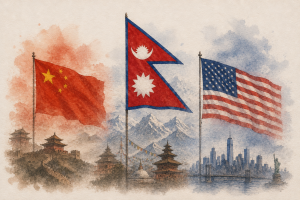
A state that struggles to govern effectively at home will also struggle to negotiate and deliver abroad..png&w=900&height=601)
bookmark
Kanchan Jha
Published at : July 17, 2026
Updated at : July 17, 2026 01:35
Every few years, Nepal rediscovers its neighbourhood. A new government promises a reset with India, a fresh understanding with China and a development-driven foreign policy. Yet, the debate always ends where it began. Nepal’s greatest foreign policy problem is not Delhi or Beijing. It is the weakness of the Nepali state. The real divide is no longer between India and China but between ambition and implementation.
Rabi Lamichhane’s op-ed, published as the chairman of the Rastriya Swatantra Party visited New Delhi to meet Prime Minister Narendra Modi, identified several real problems. He wrote about the gap between Nepal’s potential and its performance, the need to move beyond grievance politics and the untapped promise of hydropower. On each of these points, he is broadly correct.
But none of this is new. Since 1990, every major government has framed its neighborhood policy around development cooperation. Madhav Kumar Nepal spoke of balanced engagement; Baburam Bhattarai emphasised infrastructure; KP Sharma Oli mixed connectivity with confrontation; and Nepali Congress governments pursued the same agenda. The vocabulary rotated, not the implementation.
The past month illustrated this pattern. Within nine days, Foreign Minister Shishir Khanal visited New Delhi and Beijing. In Delhi, he assured India that the new government carried ‘no old baggage’ and gave bilateral ties the highest priority. In Beijing, he reaffirmed the One-China policy, pledged that Nepali soil would not be used against Chinese interests and proposed new trans-Himalayan connectivity. While both visits produced warm declarations, neither produced a single new agreement.
This is not an exception. Nepal promises the Raxaul-Kathmandu railway to India and a trans-Himalayan railway to China. The 2017 Belt and Road framework remains largely on paper. The Pancheswor Project has awaited implementation since 1996. The problem is not which neighbour Nepal chooses. It is that Nepal struggles to deliver either.
The border episode revealed the same weakness. In his first address to Parliament, Prime Minister Balendra Shah said Nepal had also encroached on Indian territory and proposed a third-party involvement in resolving the dispute. Within days, Nepal’s position shifted from internationalisation to clarification and back to bilateralism. A state that cannot speak with one voice cannot negotiate from a position of strength.
And the ‘no old baggage’ formula deserves examination, not applause. A country does not carry the baggage of its parties. It carries the weight of its treaties, its disputes and its diplomatic record. The 1950 Treaty is not the Rana regime’s treaty. Kalapani and Lipulekh are not any party’s baggage. The Eminent Persons Group report, unimplemented since 2018, belongs to Nepal as a state. The baggage Khanal disclaimed in Delhi included baggage his own prime minister had produced days earlier. Governments do not only inherit history. They produce it.
These recurring failures point to a deeper structural problem: Foreign policy is ultimately implemented not by speeches, but by institutions.
Political theorist Benjamin Barber argued that modern states are pulled apart by domestic fragmentation and pushed together by global economic integration. Nepal lives in that tension. The Gen Z protest that reshaped the country’s politics demanded accountability from a state perceived as captured, while remittances, payment systems, power grids and connectivity corridors pull the country into deeper integration with both neighbours. A state that struggles to govern effectively at home will also struggle to negotiate and deliver abroad. External ambition depends on domestic capability.
Integration is no longer a question but a fact. Cross-border power trade has become structural, with Nepali electricity flowing into the Indian grid and onward to Bangladesh. The linkage of India’s UPI with Nepal’s payments system is more than a banking arrangement, marking a shared economic space where payments, tourism and remittances move through common platforms. The old debate was dependence versus sovereignty. The real question is whether Nepal can convert integration into leverage.
Nepal’s neighbours have changed faster than Nepal has. India is now a major economic and digital power, central to global supply chains. China courts Nepal through the Belt and Road, a family of global initiatives and party-to-party channels, while reminding Kathmandu that ‘distant relatives matter less than close neighbours’. Nepal is negotiating today with two states that treat connectivity, security and digital integration as strategic priorities. Pretending otherwise only weakens Nepal’s hand with both.
Yet, responsibility does not lie with Nepal alone. As Kautilya observed, lasting influence rests more on mutual benefit than coercion, and that principle applies to larger powers as much as to smaller ones. A neighbour constantly reminded of its smallness rarely becomes a more reliable partner. Strategic competition between India and China has increased Nepal’s relevance, but geography rewards only those states capable of using it. Otherwise, location becomes a source of pressure rather than a source of leverage.
India has known Nepal’s hydropower since the 1950s, and China has discussed Himalayan connectivity for decades. What has held Nepal back was never only Indian indifference or Chinese hesitation. It was the absence of regulatory certainty, administrative competence and political continuity needed to turn opportunity into power. Winning an election and governing are different things. Electoral mandates remove excuses, but they do not create capability. Nepal’s recent history is a procession of governments that entered office with political capital and left without strengthening the institutions that translate ambition into achievement.
BP Koirala understood this long before ‘state capability’ became the language of modern political science. Remembered as a democrat, he was equally a strategist. During the 1954 Koshi negotiations, he opposed not Indian investment but Nepal’s inability to negotiate from a position of internal coherence. The negotiation was revised 12 years later, but the political cost fell on Nepal. His lesson remains relevant today: Sovereignty is measured not by rhetoric but by capability. A weak state can speak the language of independence while remaining dependent in practice. A capable state can negotiate confidently with powers far larger than itself.
That is why Nepal’s neighbourhood debate keeps missing the point. The decisive question is no longer whether Nepal leans towards Delhi or Beijing, nationalism or pragmatism, old parties or new. It is whether the Nepali state can negotiate, implement, regulate and sustain what it signs. Nepal has never lacked opportunities. What it has lacked, too often, is the institutional capability to turn these opportunities into national power.
Kanchan Jha
Jha is a leader of the Nepali Congress and an Emmy-nominated former journalist.



.PNG&w=200&height=120)

Most Read from Columns

Before you take credit for Khula Manch, read its history

Shah went to the UN to speak for Nepal, then left before he could make the most of it

Bhotekoshi flood wasn’t a freak event. It’s the Himalaya doing what it does

Lesson learned after the death of Ronaldo
Why passive neutrality won’t take Nepal anywhere
Editor's Picks

Constitutional Bench caught in seniority, ‘pick and choose’ dispute

A Dom boy’s long road to becoming a doctor

From blankets to handmade dolls, two foreign women bring comfort to flood survivors

News Analysis: When institutional defence exposes institutional fault lines

It’s a bird … it’s a plane … it’s the Indian ambassador’s farewell tweets
E-PAPER | October 16, 2026

×