



 23.73°C Kathmandu
Sun, Oct 18, 2026
Columns
From ‘dopamine government’ to ‘departure democracy’
The country is not built by any ‘Desh banaune toli’. It is built by the collective structure of the people, the constitution, parliament, dissent and accountability..png&w=900&height=601)
bookmark
Chandrakishore
Published at : June 29, 2026
Updated at : June 29, 2026 22:45
In politics, words or phrases are sometimes born before events. First, they are metaphors, then they become concepts, and eventually, they define an era. I believe two words are particularly useful for understanding Nepal’s current politics: ‘dopamine government’ and ‘departure democracy’. The first explains the psychology of the people, and the second explains the working style of power.
Departure democracy is not limited to a style of governance. Gradually, it begins to redefine the structure of the state itself. This is why the Rastriya Swatantra Party has initiated a debate on state restructuring in its general convention. Questions about the necessity of provincial assemblies, the concept of direct election of the chief minister and proposals to reinterpret the federal structure are not merely issues of administrative reform. They are questions that challenge the basic understanding of Nepal’s federal democracy.
Federalism in Nepal was not merely a project of administrative decentralisation. It was also a political response to decades of exclusion, crises of representation and identity-based struggles. Madheshi, Janajati, Tharu, Dalit and other marginalised communities accepted federalism not just as a constitutional arrangement, but also as a promise of dignified participation. Therefore, when debates that label provincial assemblies as unnecessary or seek to weaken the federal structure gain momentum, they cease to remain merely as proposals for institutional reorganisation. They also risk trivialising the memory of those historic struggles.
This sense of unease is clearly audible at ground level. The political struggle people waged for federal democracy, the price they paid and the dream with which they imagined a new Nepal have now been staked like a gamble in an election. They fear that if institutions of representation are progressively weakened, the book of the constitution may survive, but the promise of inclusive democracy it contains will gradually fade.
A departure democracy is a situation in which a government tries to prove its uniqueness by distancing itself from established parliamentary traditions, institutional dialogue and public accountability. It is called innovation, but it slowly becomes another name for moving away from democratic practice. Parliament continues to function, the Cabinet remains, the constitution stays the same, but what changes is the functioning of democracy itself.
A recent photograph has become a symbol of this change. While sharing a picture with his two trusted colleagues, Prime Minister Balendra Shah wrote “Desh banaune toli”. At first glance, it seems like an ordinary caption, but in politics, words are never just words. They are also public evidence of the mindset of power.
When the prime minister himself presents three people as the “Desh banaune toli”, a question naturally arises: Where are the rest of the council of ministers? Where is parliament? Where is the opposition? Where are the provincial and local governments? Will democracy now be run not through collective responsibility but through a limited political circle? This is how a dopamine government begins to practice departure democracy.
In Nepali political history, Shree Teen was more than just a title. It was also a symbol of the centralisation of power. In a democracy, every minister is constitutionally equal, but politics also runs on symbols. When an ‘inner group’ is publicly presented as the decisive force, an informal ‘inner Cabinet’ is born. The remaining ministers handle their ministries, but the real centre of gravity of power shifts elsewhere.
This is an actual departure—changing democratic culture without changing the constitution. Departure democracy does not directly oppose democracy. It presents itself as the most modern version of democracy. It says that old parliamentary traditions are slow, institutional debates are a waste of time, and results are more important than political dialogue. Gradually, efficiency is made an alternative to legitimacy. Citizens are told to let the government work in its own way, and the results will speak for themselves. Thus, an artificial conflict is created between the soul of democracy and the speed of administration.
In reality, the value of democracy lies beyond making good decisions. How those decisions are made is just as vital. Democracy is also the name of a process. Parliament, parliamentary committees, questions from the media, criticism from civil society and the collective responsibility of the cabinet are not obstacles to development but the protective shield of democracy. When any government begins to consider these institutions unnecessary, it is not just changing the system but also the political culture of governance.
The relationship between dopamine government and departure democracy can be understood in the same way. A dopamine government continuously gives people the experience of being extraordinary. Departure democracy, riding on that experience, normalises institutional extraordinariness. First, citizens are convinced that this government is different from all others. Then, gradually, it is established that it has the right to work outside normal democratic rules. This is when popularity begins to outweigh accountability.
History shows that the erosion of democracy often does not begin with a major constitutional crisis. It starts with small, symbolic events such as reduced dialogue, distancing from difficult questions, decisions being confined to a limited circle and individuals appearing bigger than institutions. Therefore, in any democracy, citizens must keep an equally vigilant eye on both policies and on the style of power. Because the future of democracy is often determined less by laws and more by political behaviour.
A villager from Bajhang once told me: “We gave our vote, we did not cut off our hand and give it. We gave representation, we did not surrender”. This sentence captures the entire philosophy of democracy. A mandate gives the government authority for five years, not the people’s conscience.
In a democracy, accountability is not born only on election day. It is built every day. Parliament, media and civil society are the means of that accountability. If power wants to leave them behind by calling them ‘traditional institutions’, then the question naturally arises: Is this really moving forward from democracy, or is it a departure from democratic practice?
Democracy does not die suddenly. It first abandons dialogue. Then it avoids questions. Then it starts considering accountability unnecessary. Eventually, it begins to believe that winning an election is permanent public approval. From here, popularity begins to serve as an alternative to democracy. But popularity alone doesn’t make a government democratic. A democratic government, despite its popularity, respects institutions. When popularity replaces accountability, a dopamine government turns into a departure democracy.
Nepal’s democracy is still a work in progress. Its greatest strength is not just the constitution but democratic practice. If that very practice gradually shrinks into performance, symbols and limited power centres, then the structure of democracy may survive, but its soul will slowly weaken. Therefore, the debate today is: Are we moving from politics driven by dopamine to departure democracy? And if the answer is yes, then this is not just a change in working style, but also a change in the culture of democracy.
And remember, the country is not built by any “Desh banaune toli”. It is built by the collective structure of the people, the constitution, parliament, dissent and accountability. The most beautiful picture of democracy is not of three faces standing in front of a camera but of the prime minister standing in parliament, answering the questions of the people.
Chandrakishore
The author is a veteran journalist.




Most Read from Columns
Before you take credit for Khula Manch, read its history
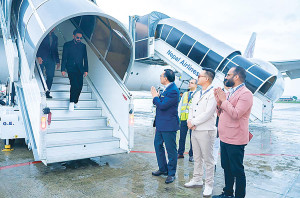
Shah went to the UN to speak for Nepal, then left before he could make the most of it

Bhotekoshi flood wasn’t a freak event. It’s the Himalaya doing what it does
Lesson learned after the death of Ronaldo
Why passive neutrality won’t take Nepal anywhere
Editor's Picks

Dashain paints the country in festive colours

Buying a goat for Dashain? Look for the green mark

Explained: Why does an hour long flight to Dhangadhi cost more than a flight to New Delhi?
Bhotekoshi flood wasn’t a freak event. It’s the Himalaya doing what it does

How Tenzing Sherpa became Nepal’s breakout star at the Asian Games
E-PAPER | October 18, 2026

×