



 20.77°C Kathmandu

Tue, Sep 29, 2026
Columns
No more ‘masu bhat’
As demand for masu bhat grew, political parties turned it into an election strategy.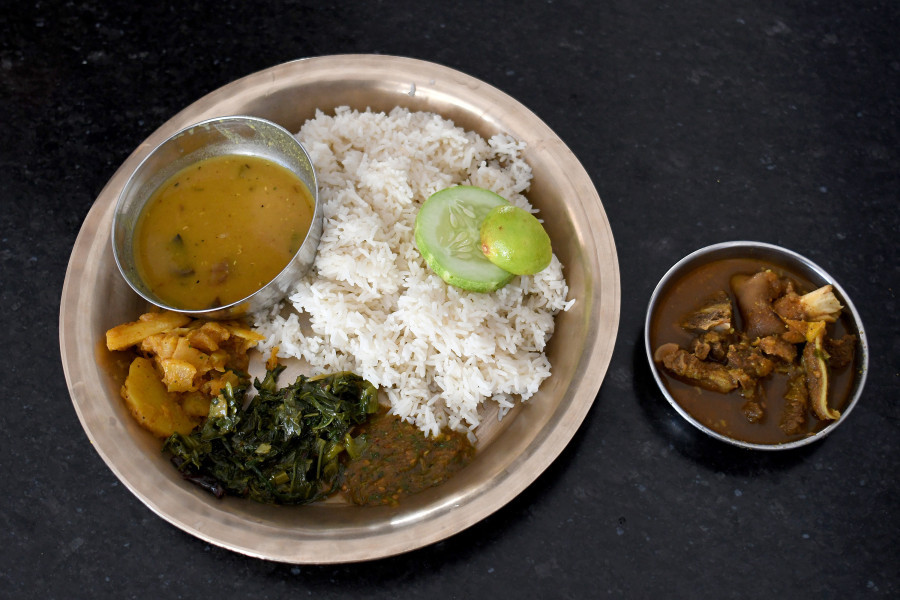
bookmark
Santosh Chhetri
Published at : March 22, 2026
Updated at : March 22, 2026 19:44
Across the entire 885-kilometre length of the country (from east to west), the election results are all the buzz. A vast majority of the country’s 29.6 million people are engaged in this discussion, whether offline (in person) or online. From chowk, galli (alleyways), chautaro (a resting spot), chiya pasal (tea shops) or any place where people gather, the talk revolves around different aspects of the elections, including the results. As the dust slowly settles after the elections, we can read, watch and listen to poll reviews, analyses and stories of success and failure from many angles by people from all walks of life, be it in mainstream media or social media. What we don’t see much is the discussion about the long-continuing and deeply ingrained political culture of eating masu bhat (meat and rice).
On election day, after casting their vote, many voters, received an open invitation to eat masu bhat near polling booths. A little away from polling booths, unlike in city areas and some places, there were food arrangements made by various political parties. Even as offers for masu bhat came, there were many voters who declined the invitation, mostly on ethical grounds. The funny thing was that such arrangements were in separate places, as different political parties, mostly old ones, designated the house of their party cadres as the places where masu bhat was offered.
This practice is not new. It has been practised during elections in the past. Since the elections of 2013, 2017, 2022 and the present one, many questions have emerged: Even for something as important as voting, why do people go after masu bhat offered by political parties? What drives this behaviour? Why do innocent voters agree to eat masu bhat during elections? The closest answer to these could be that, in all elections, masu bhat has become a political strategy to woo cadres and voters, and get their favour. Although it might be on a slightly smaller scale this time, there was a continuation of the masu bhat culture.
Had any independent researcher interacted with the voters not affiliated with any political party who ate masu bhat, one unanimous response would have been that they found this practice uncomfortable, even as they went for it. Most accepted the offers due to personal connections. This discomfort is increasingly linked to growing political awareness, as people across the country now follow current affairs more closely and have a fair understanding of which practices are appropriate and which are not.
It is safe to say that masu bhat, which existed even during the Panchayat era, has become one of the most frequently used terms in election conversations. This continued as an election strategy after the restoration of democracy in 1990 as well. To understand how it became institutionalised and gained such prominence in politics, it is necessary to look at food scarcity and social norms in the past.
Scarcity in those days
Eating masu bhat, mostly goat meat, has been a historical practice. In the past, rice itself was rare. Meat was also a rare treat, usually reserved for special occasions. Non-vegetarian people could hardly resist the temptation of meat and rice. At weddings, people would talk about eating meat gravy. Anyone who attended weddings or parties would later be asked by family members back home whether they had meat and rice.
There was a time when poverty was prevalent. Thirty years ago, as many as 42 percent of the population was poor in Nepal. At that time, it was a custom to eat rice only during Dashain. Eating rice was mostly reserved for festivals. Many people would go to a handful of rich people and ask for rice, or work as labourers to earn, save up, and eat it during special occasions.
The practice of eating masu bhat during elections dates all the way to the Panchayat era. Accounts from older generations suggest that politicians would slaughter goats and buffalo at that time. The common belief was that it would help them secure more votes. This trend became a crowd-pleasing move in every election after the restoration of democracy in 1990. For party workers, meat became their daily diet during campaigning. Leaders also prioritised masu bhat for their workers over the country and the people. Money was distributed, and masu bhat and alcohol were used to mobilise workers. For instance, masu and chiura (beaten rice) would be given for breakfast, followed by masu bhat for lunch, and finally masu and alcohol in the evening. This is how leaders used meat to influence their workers and common people alike. During door-to-door election campaigns, party cadres were often instructed by their top brass to organise such feasts. History has it that masu bhat feasts were mostly organised in houses and hotels, where huge quantities of masu and bhat were prepared in large pots. After voting, voters would be given a small piece of paper, like a chit, bearing the signature of a person authorised by the candidate, that needed to be produced at the designated locations where masu bhat was served.
A changed time
The interesting thing this time is that even before the election, there were numerous spontaneous campaigns by people. Whether on social media, physical meetings or in discussions, people were openly discarding masu bhat. One such spontaneous social media video campaign that went viral before election day carried this message: “I will eat masu bhat offered by the Congress. I will also eat masu bhat offered by the UML. But I will give my vote to ghanti,” in which people from the young to the elderly took part.
Those personal posts, some of them quite creative, triggered strong emotions and were easy to understand. Such posts quickly became viral, and social media algorithms pushed them to even wider audiences. To promote the trend further, some social media influencers and celebrities with huge followings also joined in.
When some social media users were publicly admitting that they would eat masu bhat offered by the Congress and the UML, they were also giving a reason why they would be willing to do so. One common narrative was that the money spent on offering masu bhat was not the ‘real earning’, but was earned through ‘illegal means’. Therefore, the mindset of 'if they offer masu bhat, we will gladly eat it' has deeply penetrated down to the grassroots level. As a result, the practice has not been well-received in public discourse.
It would not be an exaggeration to say that masu bhat has now become almost synonymous with corruption. The term now carries a strongly negative meaning. Perhaps, beginning this election, the scale of the masu bhat culture before and during elections may decline. Hopefully, politicians have now realised that there’s a wide public disapproval of this practice. One can only hope that, in the next local elections, masu bhat will completely disappear.
Santosh Chhetri
Chhetri is a development practitioner.

.jpg&w=200&height=120)
Most Read from Columns
Editor's Picks

What triggered the Rasuwa flood? Scientists piece together a complex chain of events

The floods keep coming. Nepal keeps starting over

In a settlement destroyed by the Bhotekoshi flood, a disabled couple offer strangers the little they have

Nepal working on detailed assessment as Bhotekoshi flood reconstruction could cost up to $5 billion

Rabindra Dhant gave Nepal a reason to smile. Now his camp wants real action behind the praise
E-PAPER | September 29, 2026

×