



 14.69°C Kathmandu

Sat, Oct 24, 2026
Columns
Will the election deliver federalism?
Tomorrow’s ballot may change centre’s faces, but federalism is not ensured by electoral arithmetic alone.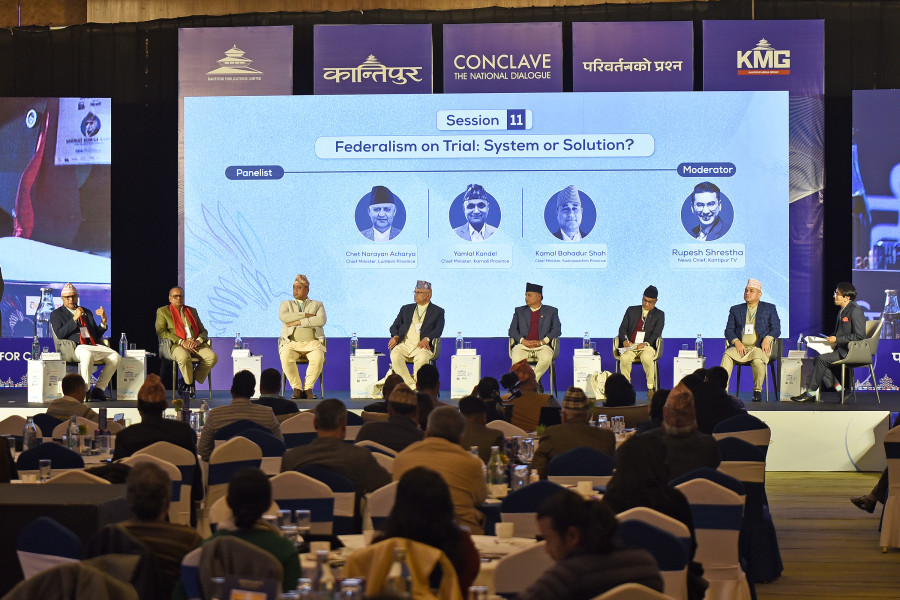
bookmark
Khim Lal Devkota
Published at : March 3, 2026
Updated at : March 4, 2026 06:59
For the past few years, Kantipur Media Group has been organising dialogue programmes on a wide range of political, economic and social issues. These forums have included sessions with the Chief Ministers (CMs) of provinces. In one such session, a metaphor was used: The provinces lack both the sanduk and the banduk. Sanduk, a money box, symbolises adequate fiscal resources, while banduk, a gun, represents police authority. Although the Constitution grants provinces the authority over policing, the federal government has yet to operationalise the provincial police structure fully.
The same concern resurfaced recently at the Kantipur Conclave session titled “Federalism on Trial: System or Solution?” The message from chief ministers across party lines was unmistakable: Provinces may enjoy constitutional recognition, but they exercise limited operational control. The institutional framework exists, yet the practical experience of governing remains constrained. As one participant aptly put it, the body may be in the province, but the mind still resides at the centre.
This concern is not new. CMs raised it during the initial five-year term of federal implementation. Despite changes in governments at the centre, the structural complaints have remained largely the same. If the government formed after tomorrow’s election fails to address these long-standing concerns, the grievances are unlikely to fade.
At the heart of the frustration lies fiscal imbalance. CMs argue that while functions have been devolved, financial resources have not followed proportionately. The criteria and pool for fiscal equalisation grants, revenue sharing and natural resource distribution remain contested. The combined budget of all seven provinces barely equals that of a single federal ministry. The majority of civil servants remain concentrated at the federal level, even as development responsibilities are increasingly expected to be delivered closer to citizens. While fiscal tensions are not uncommon in federal systems, the persistent perception of structural imbalance continues to fuel provincial discontent.
Equally significant is the question of security authority. Without operational control over provincial police, the credibility of a provincial government remains weakened. The missing banduk reflects incomplete administrative federalism. The Constitution envisions shared state power, yet in practice, security authority remains centralised.
Control over civil servants remains another structural fault line. CMs argue that without authority over senior bureaucrats, delivery becomes difficult. At the Conclave, CMs emphasised that administrative federalism remains unfinished, particularly due to the long-delayed Federal Civil Service Act. Officials posted to provinces are often seen as temporary representatives of the centre rather than accountable provincial administrators. The perception that postings to provinces amount to ‘punishment transfers’ has further weakened morale and institutional ownership.
Political instability compounds these institutional weaknesses. CMs argue that frequent changes in provincial governments are consequences of systemic design: Electoral fragmentation, coalition politics and excessive central party control in selecting provincial leadership. Decisions regarding provincial leadership are often influenced more by central party negotiations than by provincial legislative dynamics. Instability, therefore, cannot be resolved solely through elections unless deeper institutional reforms are undertaken.
Jurisdictional encroachment is another recurring complaint. CMs repeatedly argue that the federal government overstepped provincial authority through centrally designed projects and federal offices operating within provincial domains. In some provinces, federal offices reportedly outnumber provincial ones. Even when intergovernmental forums such as the National Coordination Council reach agreements to reduce duplication or clarify responsibilities, implementation frequently stalls.
Land acquisition has emerged as a critical bottleneck for development. Provinces claim they struggle to attract investment and implement infrastructure projects due to cumbersome approval processes requiring federal clearance. Even routine issues, such as forest clearance, can take years. This not only delays development but also undermines investor confidence. CMs argue that development cannot proceed efficiently when decision-making authority remains centralised.
Other concerns include delays in enacting laws related to exclusive and concurrent powers, periodic reductions in fiscal equalisation grants, inadequate sharing of natural resource revenues, and limited capacity-building opportunities for provincial institutions. At the same time, CMs contend that the narrative portraying provinces as expensive or ineffective overlooks tangible improvements in infrastructure, irrigation coverage, drinking water access, education facilities and health services over the past eight years. During the Covid-19 pandemic, provincial and local governments played a critical role in service delivery and crisis response, an experience many cite as evidence that federalism brought the state closer to citizens.
Taken together, these concerns point to a deeper structural imbalance in the implementation of federalism. The question is not whether provinces should exist, but whether they are being allowed to function as constitutionally envisioned.
Among the major political parties, the Congress’s manifesto appears comparatively more detailed in addressing federalism. It includes a dedicated section on strengthening the federal system and proposes policy, institutional and structural reforms to clarify the division of powers among the three tiers of government. It commits to revising the Functional Unbundling Report, unconditionally devolving constitutional rights to subnational levels, strengthening intergovernmental coordination mechanisms, and conducting a ten-year evaluation of federalism implementation. It also pledges not to reduce fiscal equalisation grants, to limit the number of ministries at both federal and provincial levels, and to enact all necessary federalism-related laws within one year. The proposal to form a high-level Federalism Strengthening Commission to review administrative structures and human resource management directly responds to concerns regarding incomplete administrative federalism.
The Nepali Communist Party has pledged to clarify power-sharing arrangements, reduce duplication, downsize federal ministries, and enact federalism-related laws within a year. While relevant, these commitments lack detailed implementation mechanisms. The CPN-UML manifesto, despite its length, does not clearly articulate a comprehensive roadmap for completing administrative and fiscal federalism. The Rastriya Swatantra Party has promised to initiate constitutional amendment discussions within three months of forming a government, but its document offers limited clarity on fiscal transfers, police adjustment, or civil service reform. Madhesh-based parties emphasise identity-based federalism and restructuring but provide fewer operational commitments on completing administrative and fiscal devolution.
On paper, the Congress appears relatively more responsive to the concerns of CMs, particularly on fiscal transfers, administrative reform, institutional restructuring, and intergovernmental coordination. However, experience warrants caution, as earlier commitments were not fully implemented. Still, the recent change in party leadership offers some room for cautious optimism.
Ultimately, the issue is not the absence of promises but the absence of follow-through. The Federal Civil Service Act remains pending. Provincial police remain unadjusted. Intergovernmental coordination entities remain underutilised. Fiscal transfers remain contested. These are political choices.
Tomorrow’s ballot may change faces at the centre. But federalism will not be completed by electoral arithmetic alone. It requires the political will to devolve authority, the institutional discipline to respect constitutional boundaries, and administrative reform to align functions, finance and functionaries. The real question, therefore, is whether the winners of the election are prepared to implement federalism.
Khim Lal Devkota
Devkota is an expert in federalism.





Most Read from Columns





Editor's Picks





E-PAPER | October 24, 2026

×