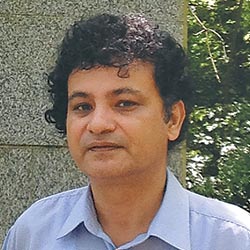
Arun Gupto’s ‘Cracks in the Wind: Memoirs from Lumbini’ weaves his personal experiences of growing up in Bahadurgunj, Kapilvastu, Nepal, with the stories of Rahamat, Baurahwa, Sukkhi, Salik, Khema, Venu, Bimala, Noori, Gopal, Kamli, Akhtar, and Sundari, among other characters inhabiting a border village suffused with multiple cultural traditions—Muslim, Hindu, and Buddhist alike.
Some of these characters blend Hindi, Bengali, and Awadhi with Nepali in their speech, while others adopt the cultural practices of communities other than their own, thereby creating a hybrid space in which the very meaning of nation and nationalism becomes liminal and unstable. Viewed from this perspective, the book opens a new avenue for reimagining Nepali nationalism from the vantage point of a border town shaped by heterogeneous cultures, languages, and mythologies.
Within this village, a postmaster composes plays, a dacoit writes poetry, a teacher sings an Indian national song to welcome a Nepali politician, and a doctor not only tends to ailing bodies but dispenses life advice on matters ranging from lawsuits to children's education. All of these are common, ordinary people—yet their stories are anything but. In Gupto’s lucid prose, their lives acquire depth, dignity, and beauty. This, one feels, is the author's greatest strength: the capacity to locate wisdom, local knowledge, and aesthetic richness within the unremarkable textures of everyday experience.
As the stories unfold, those experiences are gradually transmuted into something strange and sublime; the humble protagonists of the narrative deepen and expand until they begin to resemble mythic figures. The language is simple and rhythmically attuned to the cadences of everyday speech, yet it simultaneously expresses profound philosophical insights—about culture, about national identity, and about the ordinary moments of joy and sorrow, ecstasy and fear that together constitute the fabric of human life.
The book opens as a memoir, recounting the childhood of the narrator, Arun, known affectionately as Onu, who spent his childhood in Bahadurgunj alongside his father, Baba—simultaneously the village doctor and its most learned inhabitant—his Maa, and his brothers, Tapa and Pikun. Before long, however, the author's personal recollections give way to the stories of his older friend Rahamat, a self-styled vagrant hero from the Muslim community who claims to have encountered the goddess Durga at the moment her idol was immersed in the waters following the Dashain festivities.
Rahamat then proceeds to regale Onu with a series of tales: of Sukkhi's desire to photograph Jannat; of the robber Rafiq, who recalls a song he had once composed even as the doctor extracts a bullet from his wound; and of the village dramatist Gopal Shrestha, who brings the discussion of Bharata's ‘Natyashastra’ and Shakespeare’s ‘Hamlet’ together in the heart of Bahadurgunj, igniting in Onu a lifelong love of literature. Rahamat also recounts the story of Salik, an untouchable, lame man who falls in love with Gungi, a mute, pregnant girl who has wandered into Bahadurgunj with no apparent history or home.
Among the more haunting portraits in the book is that of Khema, a woman who lives alone in the forest and who appears at times like a "tiny Buddha" and at others like a girl dwelling in fairy-tale exile. She moves through a world of whispering leaves, tangled bushes, and wandering fields; Rahamat describes her as "a child of the night." The forest—with its impenetrable walls of shrubs and undergrowth—functions as a dark counterpoint to Bahadurgunj itself.
Where the village teems with life and narrative possibility, the forest seems a place where stories unravel and recede into an impenetrable darkness that evokes death and erasure.
Throughout the narrative, the author frequently employs what might be termed metafictional gestures, explicitly identifying his characters as storytellers and acknowledging that what they recount is, in some sense, fiction. And yet, because these stories are so deeply rooted in the vivid, sensory memories of Onu—the primary narrator—they carry an unmistakable sense of factual authenticity.
The boundary separating fact from fiction is repeatedly transgressed, such that the stories come to seem more real than the reality they ostensibly depict.
Though Rahamat functions as the principal narrator alongside Onu, other characters—some central, others peripheral—enter the narration as it progresses, each inflecting it with their distinctive personalities, idioms, and perspectives. Even Baba, Onu’s father, eventually becomes a storyteller in his own right, recounting to his granddaughter Mou the tale of how "Ravan offered Roshogulla to Ram."
‘Cracks in the Wind’ is ultimately a book about the stories that people tell one another across generations.
It is through these accumulated stories that Bahadurgunj is rendered vivid and alive, addressing the reader as though the town itself were a sentient, speaking presence. Rather than offering a grand historical sweep, Gupto’s fictional memoir makes the texture of daily life—gossip, feuds, seasons, marriages, grief, and small dignities—the central substance of the work.
For this reason, reading ‘Cracks in the Wind’ inevitably calls to mind earlier literary works of a similar disposition: RK Narayan's ‘Malgudi Days’, set in an imaginary town in Karnataka; Bibhutibhushan Bandyopadhyay's Pather Panchali, rooted in the rhythms of rural Bengal; Sherwood Anderson's Winesburg, Ohio, with its gallery of isolated, secretly impassioned souls in a small Midwestern town; and Dylan Thomas's radio play Under Milk Wood, set in the invented Welsh fishing village of Llareggub.
As with the cultural spaces conjured in those texts, Bahadurgunj itself assumes the status of a character in Gupto's book—dynamic, mutable, and possessed of an almost creaturely presence—while the ordinary people caught within the web of his storytelling accrue mythic weight precisely because no one within the narrative treats them as myths.
‘Cracks in the Wind’, like other works belonging to this tradition, exhibits a fundamental distrust of the categories through which official history operates—hero, villain, cause, effect—in favour of the messier, more faithful record of lived experience.
In this tradition, the ordinary person becomes the most truthful witness, just as Rahamat, Khema, and Sukkhi are. This book will make a significant contribution not only to the corpus of Nepali writing in English and to South Asian literature more broadly, but to the tradition of English-language literary memoir as a whole.




 28.33°C Kathmandu