Survival to drought: The shared story of the Himalayan pangolin and Macchindranatha Jatra
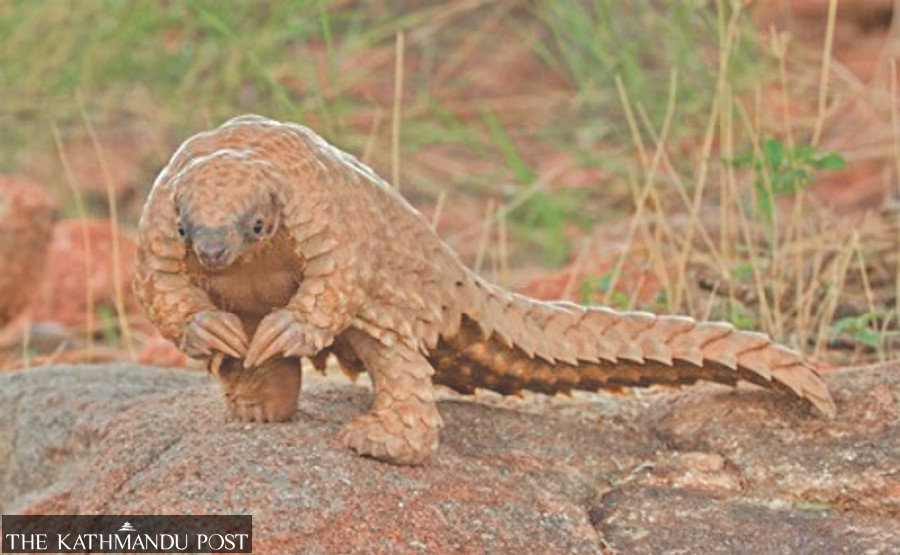
Neither the festival nor the pangolin knows of the other. Yet both share a locality, a climate, and a history of drought and recovery in a valley that has long lived at the mercy of the monsoon. Post file photo
Every spring, tens of thousands of people gather on the ancient streets of Patan to witness the Rato Machindranath Jatra, started in the 7th century. The towering chariot is hand-built from bamboo and wood, and is slowly pulled through the city by hundreds of devotees. Flowers and water sprinkles from rooftops. The people chant: “Let the rain come”.
For most visitors, the jatra is a deeply moving spectacle of faith and tradition. For a small group of scientists studying the DNA of the Himalayan pangolin, the jatra became a symbolic clue to their laboratory results about the species’ sharp decline.
An animal hard to see
The Himalayan pangolin (Manis aurita) is a seldom-seen animal. It comes out at night. It curls into a tight ball when threatened. Its body is covered in hard, overlapping scales made up of keratin. It has no teeth. Its food is ants and termites. It identifies food entirely by smell, probing the soil with a tongue longer than its own head.
Most people living in the Kathmandu Valley have never seen one, even though the animal has lived in the surrounding forests for over a million years. Until recently, scientists classified the Himalayan pangolin as a subspecies of the Chinese pangolin. This changed in 2026, when a major international study led by scientists from Nepal, China, the USA, the UK and Spain proved that it is, in fact, a completely separate species.
The story hidden in the genome
The Himalayan pangolin is a distinct new species, as proven by laboratory results. But as the scientists examined the genetic data more deeply, they found something unexpected.
The pangolin’s DNA had encoded its population history, too. It told about the fluctuating population over different time spans. This kind of analysis is known as GONE (Genetic Optimisation for Ne [Effective population size] estimation). It works by reading tiny molecular patterns left behind by every generation of breeding.
The population of the Kathmandu Valley experienced a sharp decline around 190 to 195 generations ago, dating back roughly 1,330 to 1,365 years (660–695 AD). The population then fell to its lowest recorded level about 700 years ago. The few animals that survived became isolated, with increasing levels of inbreeding.
The Himalayan pangolin is in serious trouble again. It is heavily targeted by poachers.
What killed pangolins
To understand what caused such a population crash, we need to know what pangolins eat. Pangolins have a very specific diet, eating termites and ants. Their entire body, the long tongue, the powerful claws, and the nose fulfil the one and only purpose of finding and consuming ants and termites whose colonies are hidden beneath soil and wood.
Termites, in turn, depend on moisture. Their colonies were dried out and collapsed during drought conditions. Their mounds were quiet. Their number dropped. The Kathmandu Valley was suffering a prolonged monsoon failure; termites would retreat underground or disappear entirely from large areas of forest. A pangolin in the Kathmandu Valley and its surroundings had nothing to eat. It did not change its diet. It could not cross mountains to reach new territory. Few pangolin had waited, but many of them died.
A prolonged drought in the Kathmandu Valley during the 7th century may have affected pangolins not through hunting or habitat loss, but through starvation due to resource scarcity. The GONE analysis captured a similar pattern: a sudden and severe population decline concentrated in the valley, occurring at the same time that climate records from across the Himalayan region show evidence of a prolonged drought.
What the climate records show
The 7th century was a difficult time. The world was under a Late Antique Little Ice Age that brought significant hydroclimate stress. Tree-ring records from Nepal and western India, lake sediment cores, and glacier data all point to the same conclusion: a multi-decadal drought punctuated by irregular monsoon failures.
The Kathmandu Valley, sitting in a bowl-shaped basin at 1,300 metres, is unusually sensitive to such changes. When the monsoon weakens across the Himalayan region, the valley often suffers more than the surrounding hills. Its agriculture, entirely dependent on monsoon-fed rice, would have been devastated. Its forests would have thinned. Its streams would have slowed. The pangolin’s genome and the climate proxy records tell the same story independently of each other, but they share the timing, geography, and severity of drought.
The god summoned for rain
Now consider the legend of Rato Machindranath. According to the Newa oral tradition and the chronicles of Lalitpur, the Kathmandu Valley once suffered an agonising, year-long drought, and crops failed. The earth cracked. People cried, with no relief. According to the legend, the cause was the great yogi Gorakhnath, who had entered deep meditation in the valley. In doing so, he had trapped the Nagas, the serpent deities who carry rain beneath his body. The monsoon could not come because its guardians were captivated.
The only solution was to summon Gorakhnath’s own teacher: the rain god Rato Machindranath, also called Karunamaya. King Narendra Deva sent a delegation all the way to Assam (where the highest degree of rainfall is recorded in South Asia) in the east to bring the god’s idol back to Kathmandu. When the idol arrived in the valley, Gorakhnath rose from meditation to pay respect to his guru. The Nagas were released. The clouds gathered. The rain poured.
In gratitude, the king established the Rato Machindranath Jatra, the chariot festival. It has been performed, with very few interruptions, for over 1,300 years. The festival is an annual petition for rain.
The festival has been performed, with very few interruptions, for over 1,300 years. It is an annual petition for rain.
Why this matters today
Currently, the Himalayan pangolin (Manis aurita) is in serious trouble again. Its range is small, the southern Himalayan foothills, from Nepal through South Tibet into northeastern India. It is heavily targeted by poachers; pangolin scales are the most trafficked wildlife product on earth, used in traditional medicine markets across Asia. And the pangolins living around the Kathmandu Valley are already showing dangerously high levels of inbreeding. This is a sign that populations are too small and too isolated to sustain themselves without intervention.
The new genomic study gives conservation managers something they did not have before: a precise genetic baseline, detailed enough to identify where individual confiscated pangolin scales came from, and to map the boundaries of isolated populations that need urgent attention. Recognition of Manis aurita as a full species also means it must now be listed separately and protected under international law. As a distinct species, it qualifies for its own place under CITES Appendix I, which prohibits international commercial trade. That is not a bureaucratic formality; it is the legal foundation for enforcement.
The chariot and the genome
The Rato Machindranath Jatra will be held again next year, as it has been for over a millennium. The chariot will move through Patan's narrow streets. The Bhoto, the jewelled vest of the Serpent King, will be displayed in front of the crowd. The people will watch the sky. Somewhere in the forests of the valley, a Himalayan pangolin will emerge after dark, nose to the ground, following the faint chemical trail of a termite and ant colony through the leaf litter.
Neither the festival nor the pangolin knows about the other. But they shared a locality, climate, and a history of drought and recovery in a valley that has always lived at the mercy of the monsoon.
The pangolin survived the 7th-century drought because a few individuals held on in the remaining forest patches, inbred and diminished, until the rain returned (though its effective population fell to its lowest level until the 13th-14th century). The Rato Machindranath Jatra stands as proof of climate change and the celebration of survival after severe climate change.
In that sense, the pangolin and the festival are telling the same story. They both stand and survive the impact of climate change.




 23.24°C Kathmandu