Exhibit review: How one trip to Banaras inspired nearly 20 different artistic visions
From cremation ghats and Ganga Aarti to architecture and portraiture, Lalitkala Campus artists transform a shared study trip into distinct visual narratives.Courtesy of SAG
‘HOMAGE TO BANARAS’, running at the Kathmandu Art Gallery, brings together close to twenty emerging Nepali artists from Lalitkala Campus, each of whom travelled to Varanasi, the sacred sister city of Kathmandu, on the same educational visit and returned with a different city entirely.
Walking through the Kathmandu Art Gallery’s rooms, the show reads less like a single-artist thesis and more like a chorus: portraits, ghats, boats, cremation grounds, and flame, all rendered by hands that had never touched Varanasi before and were changed by it anyway.
The gallery has arranged the work loosely by artist, where one gets to experience the works of students and alumni of Lalitkala and how they interact with each other when remembering their time in Varanasi.
To understand why so many artists converge on the same city with such different results, it helps to understand what Varanasi actually is. Sitting on the banks of the Ganges in northern India, Varanasi, also known as Kashi and Benares, is considered one of the oldest continuously inhabited cities in the world and one of the holiest sites in Hinduism. Pilgrims travel there to bathe in the river, believing its waters purify the soul, and many Hindus consider it auspicious to die and be cremated there, since doing so is believed to grant liberation from the cycle of rebirth. That belief is made physically visible at Manikarnika Ghat, where funeral pyres burn without pause, day and night, in full public view.
A few steps away, daily life carries on around them: vendors, boatmen, worshippers, and tourists occupying the same narrow lanes and stone steps. Nowhere else does a city hold devotion and mortality this close together, in the open, as a matter of routine rather than an event.
That collision between the sacred and the ordinary is exactly what pulls the Lalitkala Campus artists towards Varanasi, and it's what the Kathmandu Art Gallery's exhibition design leans into. Arjun Basnet's work grew directly out of witnessing that collision at Manikarnika Ghat, where the continuous coexistence of cremation rituals and everyday life led him towards reflections on mortality and the fragile nature of existence.
Rather than depicting death itself, his pieces, including "Galactic Serenity-Souls" and the dry-point work "Witness to Ash I", use circular forms to represent imagined souls drifting through an infinite universe, carrying traces of memory beyond the physical body. He's careful to frame these forms as metaphors rather than literal depictions of an afterlife, images meant to invite contemplation of transformation and impermanence rather than illustrate them directly. Placed near the gallery's entrance, Basnet's work sets the emotional register for much of what follows.
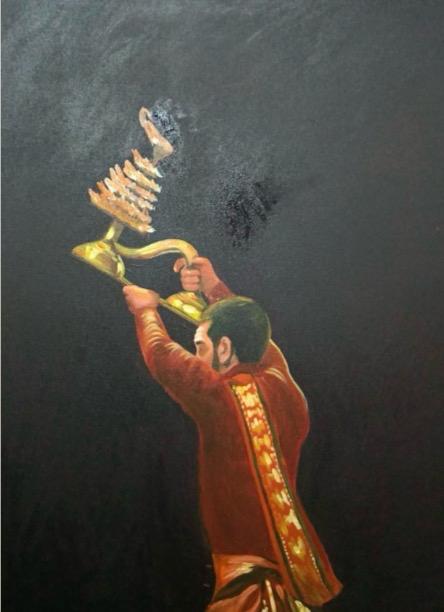
Fire recurs across the show in a gentler form as well, in the nightly ritual of the Ganga Aarti, the fire ceremony performed on the ghats as an offering to the river. Bipran Chettri's "Ganga Aarati" traces back to witnessing the ceremony during a college study tour, an experience he describes as leaving a lasting impression through its rhythm, light, and devotion, and one that deepened his interest in symbolism and narrative.
Kajal Yadav arrives at the same ritual from a different angle: her paintings "Eternal Flame of Banaras" and "Breath of the Sacred" try to capture the glowing flame and rising smoke of the Aarti as an expression of what she calls the eternal flow of the Ganga. Hung together on the same gallery wall, Chettri's and Yadav's paintings let the Kathmandu Art Gallery stage a small conversation between two artists who never planned to be in dialogue, both reaching for the same flame from different distances.
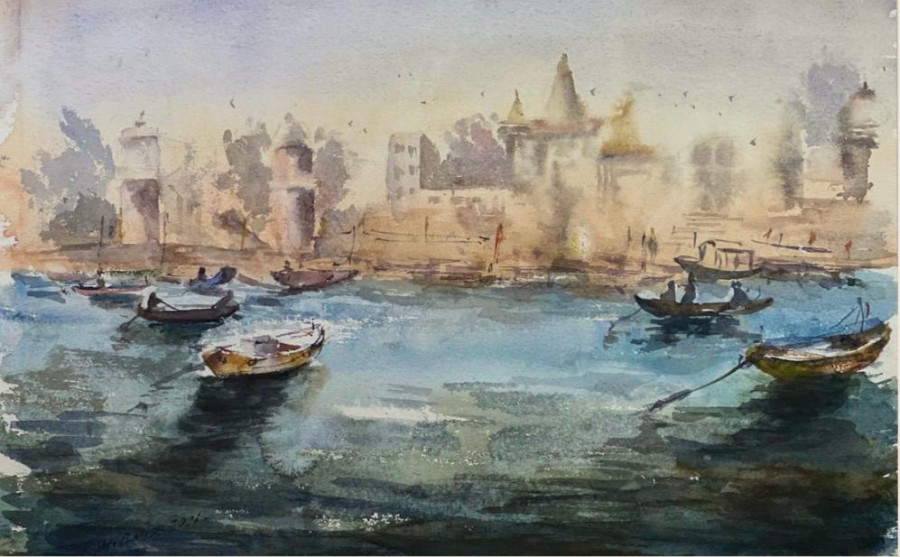
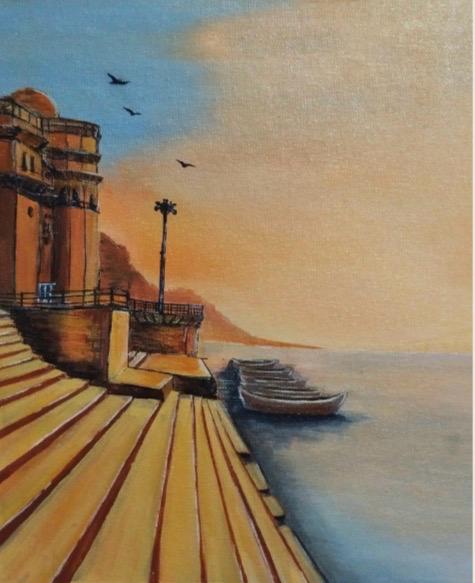
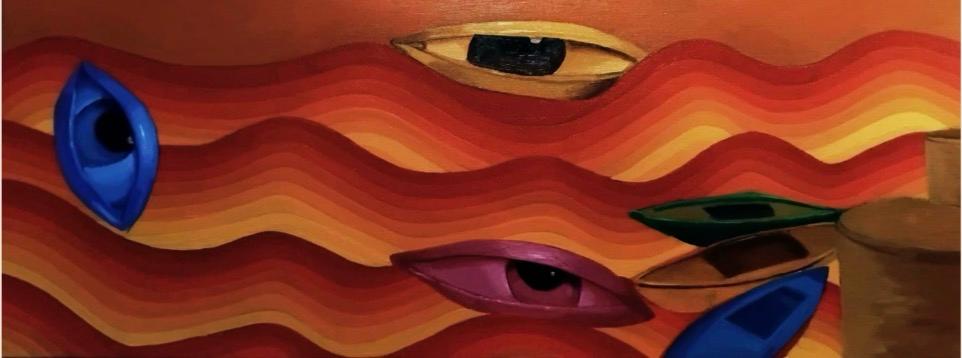
Mukti Chalise, working in transparent watercolour washes of his own, produced ‘The Ganges’ and ‘Assi Ghat’ out of a broader interest in architecture, light, and atmosphere, moving beyond literal representation to capture what he calls the essence of a place. Pratibha Tiwari takes the river's traffic as her subject instead: her piece ‘Eyes adrift’ uses eye-shaped boats as silent observers drifting through the water, witnessing rituals, grief, prayer, and cremation without judgment, each boat’s eye painted a different colour to suggest that the city remains the same while every person who visits carries away a different Banaras.
The gallery has given ‘Eyes adrift’ its own sightline down the length of the room, letting its long, narrow canvas mimic the river it depicts.
Not every artist in the show is drawn to ritual or water. Some found their Varanasi in its architecture and its people instead, and the Kathmandu Art Gallery has grouped this work in a quieter side room. Henjilee Limbu, whose practice spans painting, writing, and music, found the city itself felt like a temple to her, not only in its ghats and shrines but in its withered architecture, narrow lanes, and forgotten windows, works she titled ‘Where the city watches’ as a way of recognising holiness in the ordinary.
Tshring Tamang, whose practice centres on portraiture as a way of studying human emotion and identity, found in Varanasi’s crowds and constant movement an unexpected sense of stillness, a discovery that reshaped how she understands both life and art, expressed in pieces like ‘Shanti’ and ‘Tyag’.
Prativa Khadka turned instead toward the city’s tradition of handmade crafts, captivated by its vibrant culture and history, producing ‘Treasure I hold’ and ‘Katha’ as reflections on the relationship between personal memory and cultural craftsmanship.
Perhaps the most literal engagement with the city’s material comes from Aayush Sunar, a sculpture student whose piece ‘Living and —’ attempts to hold Banaras in clay itself: the ghats, the crowds, the horizon of the Ganga stretching further than the eye can follow.
In his own description, the work’s form is restless, cutting in multiple directions and never settling into one, a shape he calls complex and unresolved, always mid-sentence. Below that restless form, the sculpture continues downward as its own distorted, dissolving reflection, an attempt to convey that what remains after complexity ends isn't peace, but only the echo of what was restless, disappearing into the shape of what we were. Given its scale and physical weight, the gallery has placed "Living and —" at the centre of its own room, the one sculptural anchor in a show otherwise built from paintings and works on paper.
That range, from fire and water to clay and portraiture, is really the story ‘HOMAGE TO BANARAS’ tells about contemporary art’s relationship to an ancient city, and it's a story the Kathmandu Art Gallery is well positioned to host. Varanasi has stood largely unchanged in its essential rituals for thousands of years: the same river, the same ghats, the same cremation fires burning continuously regardless of who is watching. What changes is the vocabulary each new generation brings to describe it.
A city whose meaning has traditionally been carried through oral tradition, temple architecture, and unbroken ritual practice is now being filtered through watercolour washes, fibre-resin casting, dry-point printmaking, and mixed media collage, media largely unavailable to the pilgrims and priests who shaped the city's original meaning.
HOMAGE TO BANARAS
Where: Kathmandu Art Gallery, Baber Mahal Revisited, Kathmandu




 14.58°C Kathmandu