



 15.26°C Kathmandu
Tue, Oct 13, 2026
Culture & Lifestyle
At Mcube, the movement and memory of jatras come alive
Rooted in childhood experiences, Pradip Kumar Bajracharya’s paintings portray festivals as both communal celebrations and personal recollections.
bookmark![]()
At the exhibit’s centre, lies the cultural celebration of the Newa people. Photos: Courtesy of Gallery Mcube ![]()
![]()
![]()
Mokshyada Thapa
Published at : May 12, 2026
Updated at : May 12, 2026 07:21
Kathmandu
How does it feel to grow up in a culture that is full of communal celebrations, one that quite literally embodies the word ‘festive’?
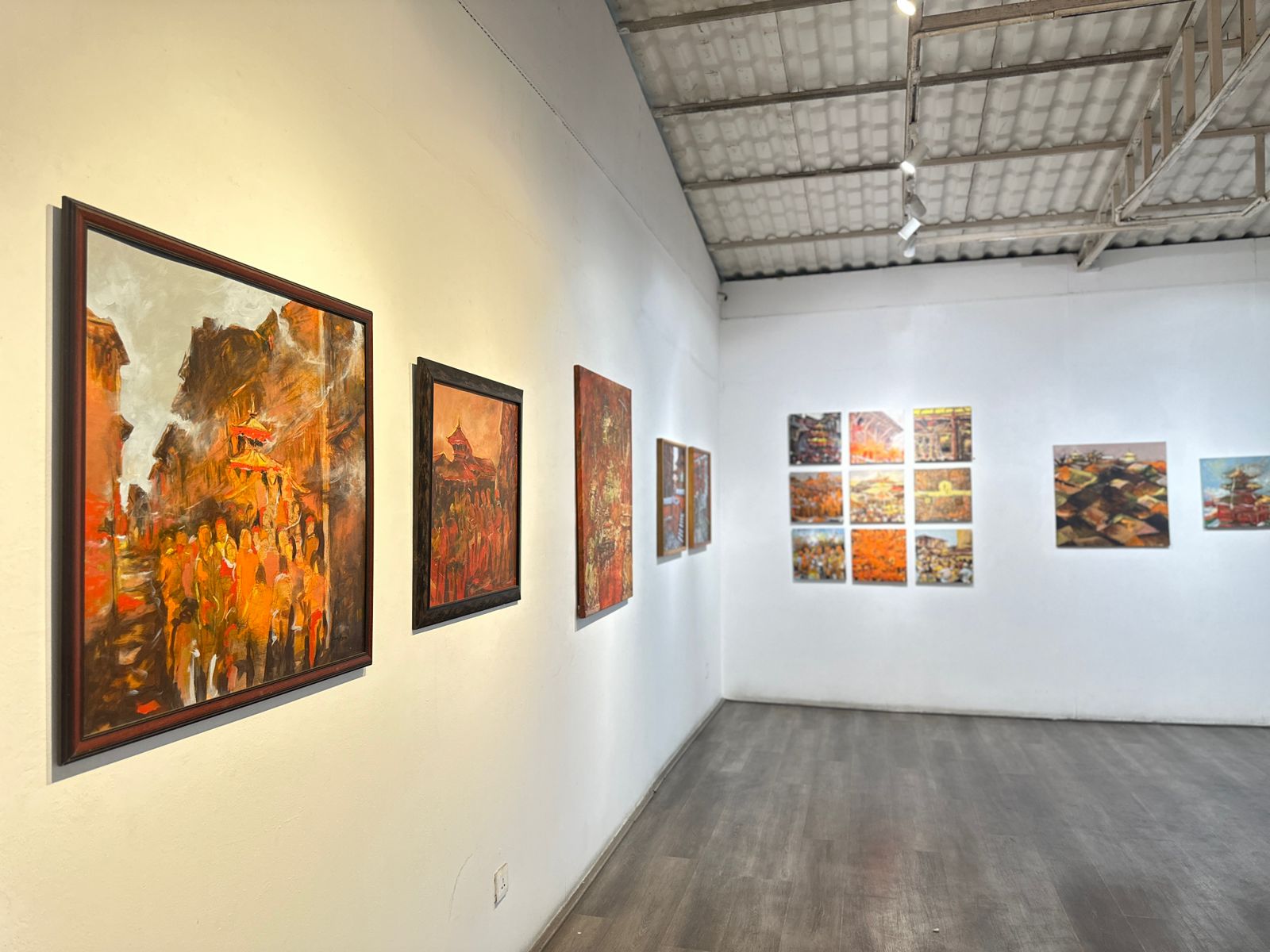
In Pradip Kumar Bajracharya’s solo art exhibition, ‘Festive Spirit’, presented at Gallery MCube, the artist captures the chaos and warmth of Nepal’s celebrations.
With over two decades of experience as an artist, ‘Festive Spirit' has emerged as the artist’s comeback solo exhibition after more than a decade. Before, ‘Festive Moods’, ‘Festive Images’ and ‘Heritage Panorama’ were some of the prequels to the current exhibition.
The artist, growing up in Makhantole, was not just a passerby at the celebrations around him; he was an active participant in them. Since his childhood, he has viewed jatras as an extension of cultural continuity, which has inspired him to tell their story through his paintings.
At the centre of the exhibit lies the cultural celebration of the Newa people. The artist tries to provide different angles on how a jatra is being held. From Bhaktapur’s Sindure Jatra to Indra Jatra, Bajracharya decentres people’s faces, instead emphasising the movement and atmosphere behind them.
For Bajracharya, art is not a lengthy process; it is a practice through which he pours his emotions.
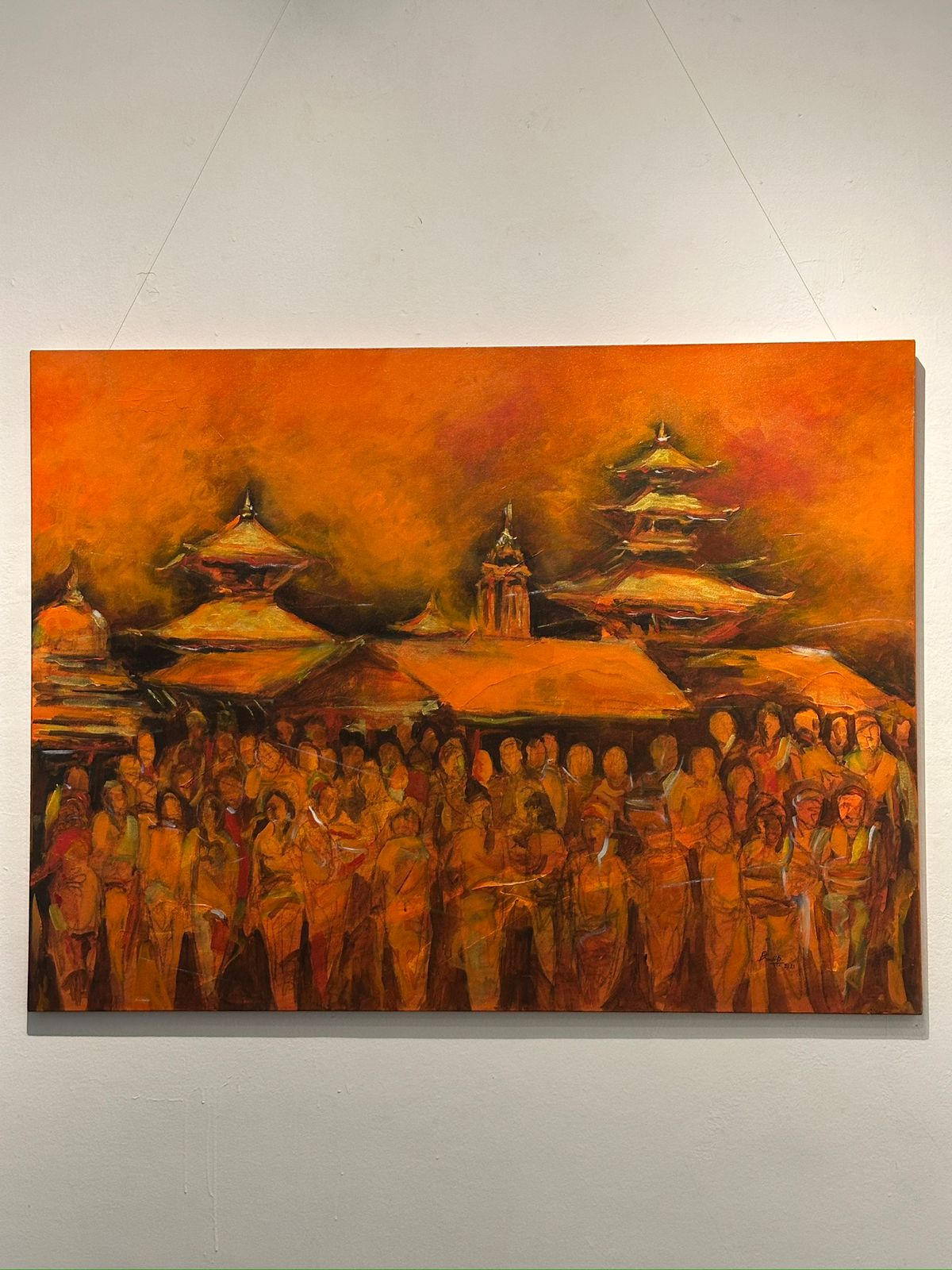
“Most of my works here have been made within 2 to 3 days. When I am imagining something, I have to let it out on my canvas instantly. If I delay the process, the emotion fades away. I want the paintings to carry the same energy and feeling that first came to my mind,” says Bajracharya.
Abstraction is prominent in his paintings. Every gentle brushstroke contributes to the vibrant ombre blend of hues such as red, orange, and yellow. Similarly, the way he has mastered the brush in this series can be considered fluid rather than definitive. The abstraction is shaped so that you can tell which elements he wants to present, but not in explicit detail.
Bajracharya primarily works with acrylic colour. Known for its use as a thick, textured medium, acrylic is mostly used in that way, with layers and opaque transparency. But in his paintings, the medium is rendered with varying degrees of fluidity and consistency. In one such work, he uses acrylic, heavily diluted with water, to make it appear very transparent on canvas, almost as if challenging the principles of media.
The continuance of festivities stays at the core of Bajracharya’s works, but a question silently arises in one of the paintings—What happens when the world shuts off? Referencing the ghastly pandemic times, when schools were closed and offices got shut down, he tried to bring culture into the conversation.
“The chariot is locked; jatras were halted out of escalating fear of the disease. Bisket Jatra, Seto Macchindranath Jatra—all of them stopped at that time,” says Bajracharya.
At the bottom of the painting, there are Dwarpals, temple guardians we often see on Durbar Squares, conveying the message that ‘we are still protected by the divines no matter the circumstances’.
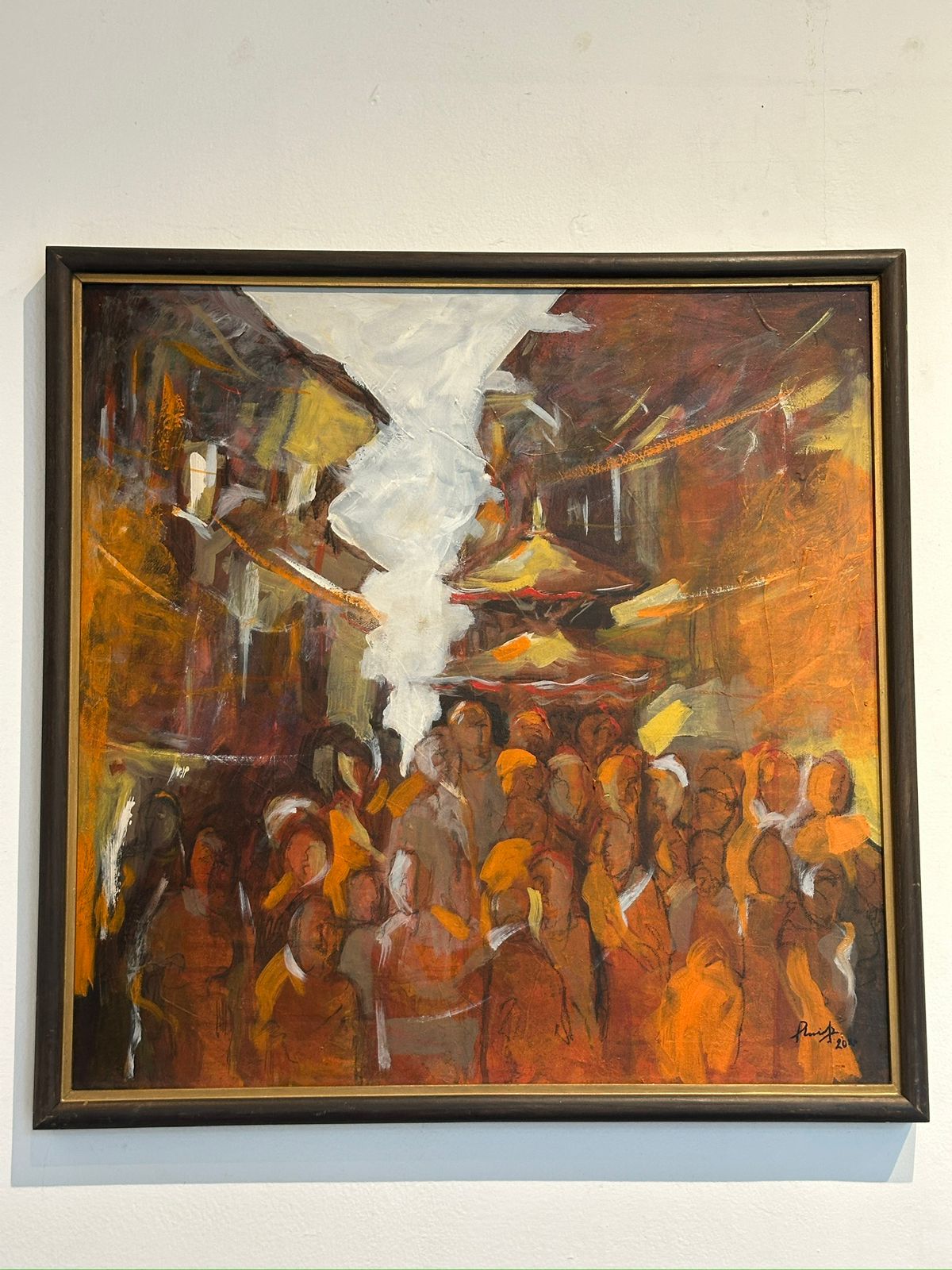
Narrating the tales of history is also what Bajracharya highlights. One of the paintings with deep reddish tones beneath, depicting just an old settlement, manages to achieve that.
“There used to be folktales of how the kings of Kathmandu used to oversee their citizens’ well-being. That is by looking from the top of their castles to the low-height homes of people to see if there is smoke coming out from their roofs, a sign for determining if they are getting to eat or not,” expresses Bajracharya.
Such stories he was told in childhood built the notion around his artworks.
Another intensely striking artwork is of the icon of Hayagriva Bhairav, a sacred horse-headed form of Lord Vishnu present in Bungamati. The fierce eyes of Bhairav give the painting life. The portrayal of the eyes is intentionally intensified through contrasting colours.
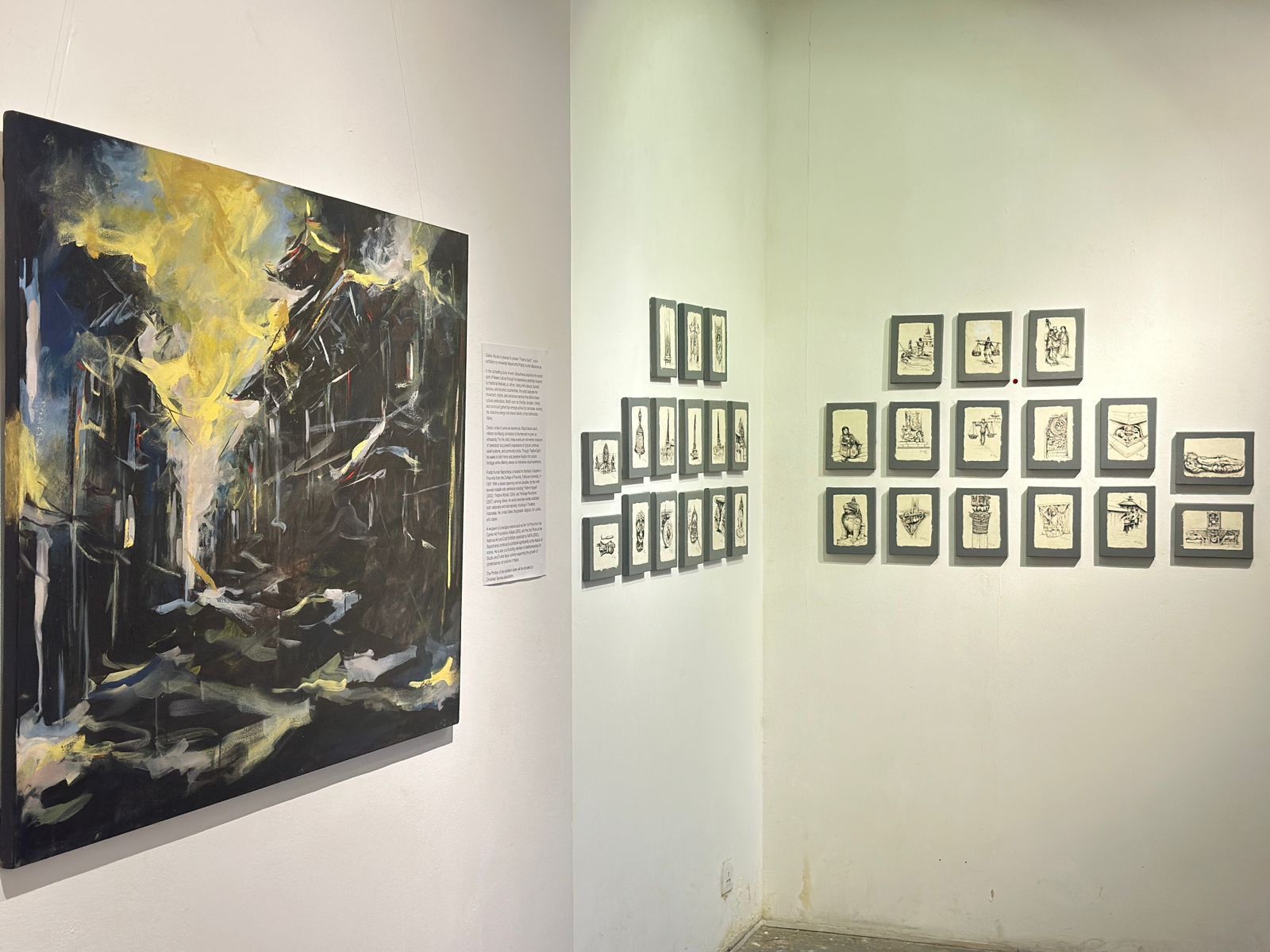
Unlike the richly coloured paintings in his series that are synonymous with his signature, he has also experimented with dotwork, also known as stippling. In it, the elements remain the same, tied to his cultural roots. But these works are very specific to what is being presented. For instance, the intricate emphasis on a temple’s pillar is one such example.
“For me, creating these dotworks was a way to focus on a single element that I find deeply appealing, rather than depicting an entire scene,” says Bajracharya.
Rather than just portraying jatras and the symbolic elements present there, the exhibit is a narration of Bajracharya’s life, more so his perception of his surroundings.
“Walking home from the streets of Asan, I just happened to see the sunset at that time,” shares Bajracharya, mentioning the inspiration behind one of his works that has a defining cool-hued tone to it.
While trying to highlight aspects of his culture in a way that feels personal and accurate, he uses both visualisation and photography as tools. Being a photographer himself, he finds this new way of referencing convenient, but at the same time, on-field art is what gives him joy.
“When I go to actual places of celebrations, there is a different type of liveliness I feel; visualising that after I come home is one of my favourite parts of working. That gives life to my paintings,” believes Bajracharya.
Bajracharya’s work is the continuity of his lived experiences and his lifelong connection to the festivals he grew up with.
Festive Spirit
Where: Gallery Mcube, Chakupat, Lalitpur
When: Until May 17
Time: 10:00 am to 7:00 pm
Entry: Free
Mokshyada Thapa
Mokshyada Thapa is a Culture & lifestyle intern at the post. She is an A-level graduate from St. Xavier’s College.
Most Read from Culture & Lifestyle

It’s a bird … it’s a plane … it’s the Indian ambassador’s farewell tweets
How should Nepal navigate a world in reorder? Rajib Upadhya on geopolitics and foreign policy
How Anup Poudel took Nepali cinema to Cannes
A Nepali photographer rediscovers Calcutta after decades

Facebook friends: What do cross-gender friendships look like in Nepal?
Editor's Picks

Constitutional Bench caught in seniority, ‘pick and choose’ dispute

A Dom boy’s long road to becoming a doctor

From blankets to handmade dolls, two foreign women bring comfort to flood survivors

News Analysis: When institutional defence exposes institutional fault lines
It’s a bird … it’s a plane … it’s the Indian ambassador’s farewell tweets
E-PAPER | October 13, 2026

×