



 21°C Kathmandu
Mon, Oct 12, 2026
Culture & Lifestyle
Kriti Mainali’s couture brings Nepali fashion to global runways
Through her label K R I T I, Mainali blends heritage craft and contemporary design.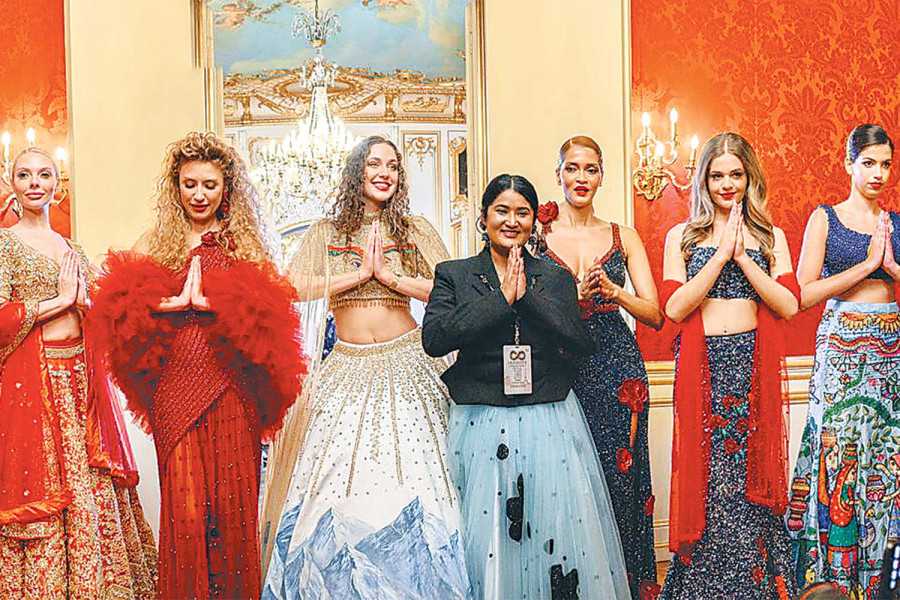
bookmark![]()
Mainali’s collections draw on a rich reservoir of Nepali symbolism and craft. ![]()
Skanda Swar
Published at : April 18, 2026
Updated at : April 18, 2026 08:34
Kathmandu
There is a quiet confidence in how Kriti Mainali talks about fashion. Not the bravado of someone chasing trend cycles or courting viral moments, but the certainty of a woman who knows exactly what she is here to say and who she is saying it for. “I don’t just design clothes,” she says. “I create pieces that carry meaning, emotion, and identity.”
For Mainali, the founder of the luxury couture label K R I T I, fashion has never been a decoration. It has always been language.
Such a belief has led her from Kathmandu to the Sony Hall in Times Square and, currently, onto the legendary stages of Paris Fashion Week. In a global fashion landscape that is increasingly, if still imperfectly, making room for South Asian voices and diasporic narratives, Mainali is not waiting to be invited to the table.
She is already seated, building something beautiful.
Mainali was brought up in Nepal and was raised in the atmosphere of South Asian fabrics, the plushness of silk, the design of embroidery, and the ability of one dupatta to change the tone of the whole outfit. Her experiments with design began with domestic ornaments: as a child, she used bits of old kurthis to sew little dresses for her dolls.
Mainali lived between two cultural worlds as her life expanded into the United States. Like many first-generation immigrants, she followed a corporate path, finding stability first and then ambition within that structure. But her creative instinct never faded. Travel sharpened it, history enriched it, and art gave it form. Every country she visited, every monument she encountered, and every piece of folk art she experienced became part of a growing design language—one that quietly developed alongside her corporate life. At heart, she still sees herself as a little girl drawn to travel, history, and culture.
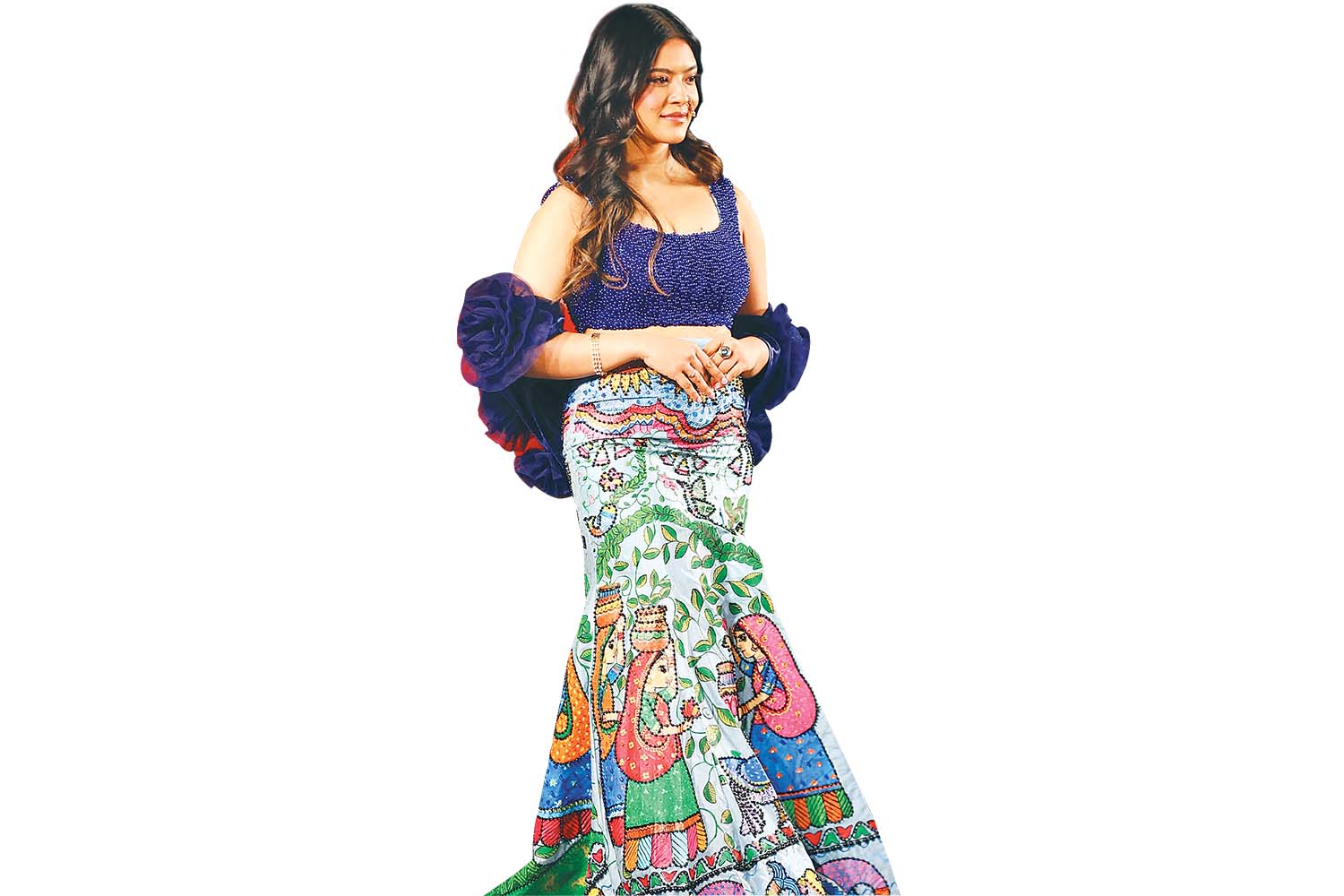
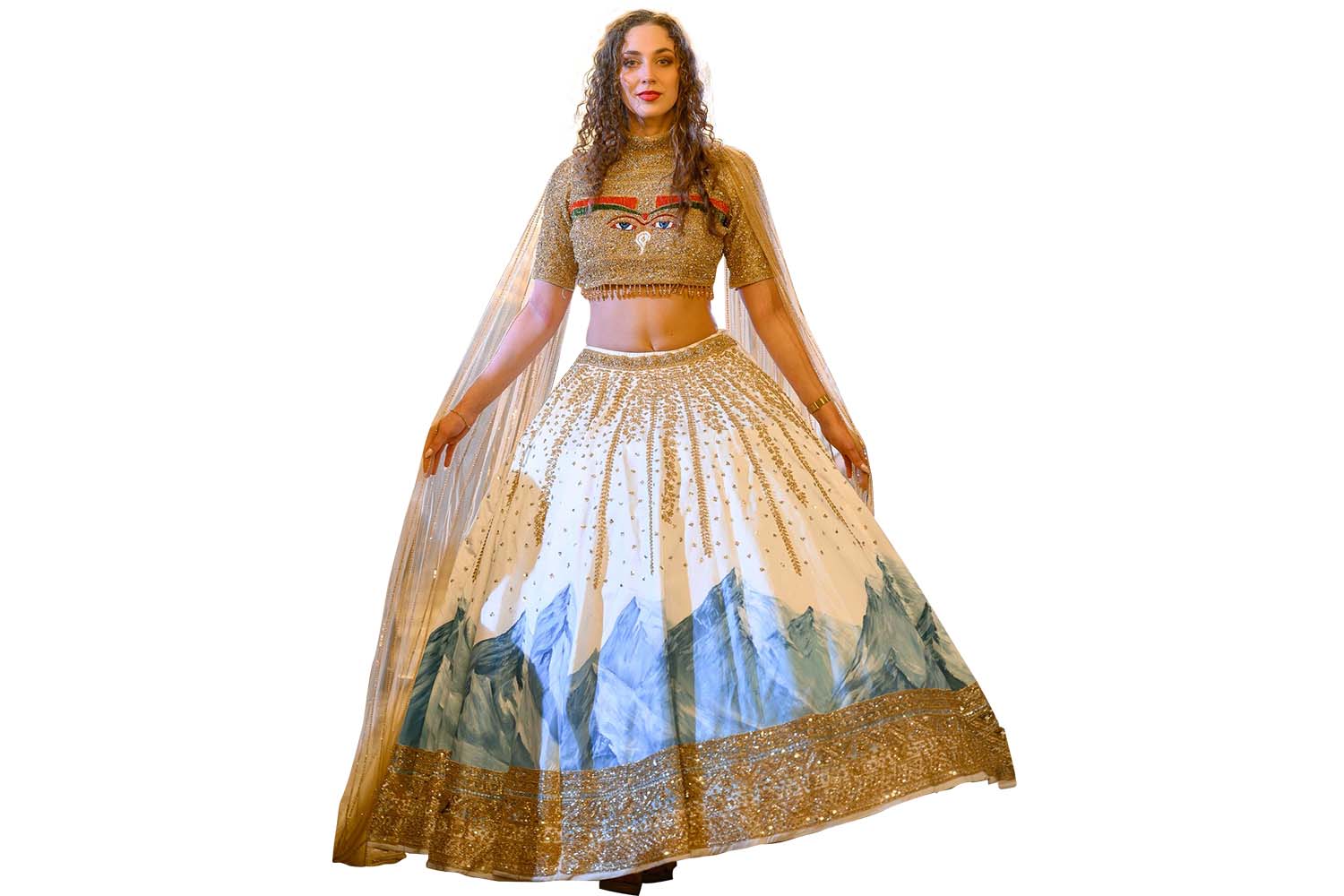
Her collections are based upon a rich reservoir of Nepali symbolism and craft. There is Dhaka textiles: hand-woven on looms in the eastern Nepal hills, and Himalayan-inspired embroidery. The Mithila artworks, with their detailed line work and mythical overtones, are relevant to the couture silhouettes. The national flower of Nepal, the rhododendron, flowers on bodices of beadwork and crystal. The traditional image of the Boudhanath Stupa, Buddha’s eyes, looks through hand-painted wooden panels. Every motif has not only aesthetic appeal but also a deeper meaning—one that Mainali conveys through her design language for people worldwide to read.
The symbols are not mere decorations. As she explains, she breaks them down into a luxurious, modern design language so that anyone, regardless of background, can relate to them. This is the key Mainali bargain: turning something particular into something universally appealing.
“I don’t just place them for decoration,” she says. “I break them down into what feels like a luxurious and modern design language so that everyone can relate to it.”
Every piece in the K R I T I collection is handcrafted by skilled artisans in Nepal and India—many of them women supporting their families through their craft. Beads, sequins, crystals, and hand-stitched motifs are layered with the patience of people who understand that quality cannot be rushed.
There comes a moment that changes everything for a designer. For Mainali, it was Dubai. Her first breakthrough came during Emirates Fashion Week, when a collection inspired by Palm Island—created in collaboration with Arni Fashion LLC and drawing on the architectural grandeur of Dubai’s most recognisable buildings—captured the audience’s attention. The response from international media was immediate. Photographs circulated. Interest followed.
It was the kind of attention that can either be lost or captured. Mainali seized it. The Dubai collection proved something significant: her ability to transform place and narrative into wearable form was not confined to her Nepali upbringing.
That breakthrough was not accidental. It was the result of years of quiet, systematic labour—communication across time zones with craftsmen back home, managing logistics without large-scale support, and learning by doing rather than observing from a distance. “Everything required patience and constant coordination,” she reflects. “But I learned to adapt and grow through it.”
In early 2026, Mainali made her international runway debut at New York Fashion Week with a 10-piece collection titled ‘Heritage of Nepal’, presented at Runway 7 in Sony Hall, Times Square, alongside 85 designers from 16 countries. The collection featured motifs from the Swayambhunath Temple and the Himalayas, accompanied by traditional Nepali music and digital visuals of Mount Everest. It created a fully immersive sensory experience, asserting fashion shows as spaces of cultural transmission rather than mere display.
For Mainali, the moment carried significance far beyond personal achievement. As one of the few Nepali designers to feature on such a platform, it was not simply about presenting garments, but about making a statement on representation and presence. “When I reached that level,” she said, “I wanted to start by telling my own story first.”
Following her NYFW debut, she was invited to showcase at the Infinity Fashion Show 2026 in Paris, yet another marker solidifying her role in the global scene. It is not only a career path between New York and Paris. It is, in a word, the tale of a diaspora speaking up in those areas that have historically been indifferent to the presence of the former.
Her collaborative efforts with Miss Nepal North America, as one of the primary creators of the 2023 and 2024 pageants, have provided another layer to that project of representation, appropriating the competitive pageantry as the set-up through which Nepali beauty, craft, and identity are previewed in front of audiences which otherwise would not be exposed to it.
The process of Mainali’s work begins with inspiration from travel, history, culture, and sometimes a single image that refuses to leave her. From that seed, a story grows. Then come the choices: which fabrics, which embroidery techniques, which artisans, how to structure each element so that the story is legible in the garment itself, even before anyone reads a label or a press release.
“I want people to understand the story just by looking at the design,” she explains. “Even without explanation, they should feel something, whether it’s curiosity, emotion, or admiration. That silent communication is very important to me.”
This is why, for her, balancing tradition and innovation is not a philosophical tension to be resolved but a creative challenge to be embraced. She honours the traditions she draws upon and is aware of their history, their art, their cultural load and precisely because she respects them, she is not afraid to push them into new territory. In her work, reverence and invention are not opposites. They are collaborators.
Getting lost in a world that is flooded with brands that are looking to embrace the next aesthetic moment, K R I T I is creating something that does not wear out within a season. Mainali is not trend-dependent in the stories she narrates about Nepal, its artisans, landscapes, symbols, and people. They are enduring.
Looking ahead, she says she wants her designs to stand out “not just visually, but emotionally.” Of wanting to show “how strong and expressive fashion can truly be.”



Most Read from Culture & Lifestyle

It’s a bird … it’s a plane … it’s the Indian ambassador’s farewell tweets

‘Tenzing’ puts the Sherpa at the centre of the Everest story
How should Nepal navigate a world in reorder? Rajib Upadhya on geopolitics and foreign policy

How Anup Poudel took Nepali cinema to Cannes
A Nepali photographer rediscovers Calcutta after decades
Editor's Picks

Constitutional Bench caught in seniority, ‘pick and choose’ dispute

A Dom boy’s long road to becoming a doctor

From blankets to handmade dolls, two foreign women bring comfort to flood survivors

News Analysis: When institutional defence exposes institutional fault lines
It’s a bird … it’s a plane … it’s the Indian ambassador’s farewell tweets
E-PAPER | October 12, 2026

×