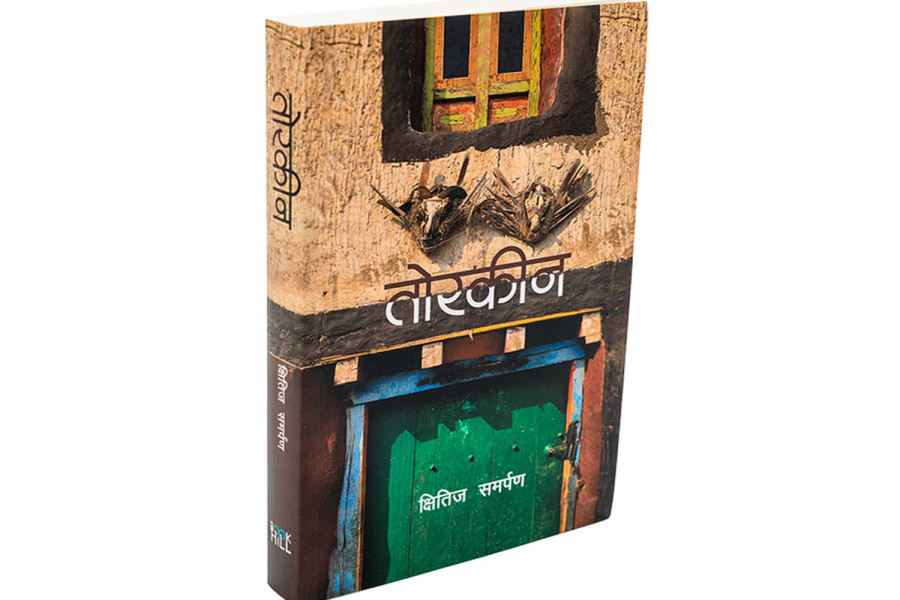
Being in the lap of the Himalayas is a subject of immense pride for us Nepali people. But the reality of surviving in the landscape rarely reaches those living far from it. Kshitiz Samarpan, with his witty and observant writing, brings the story of Charang, a village in Upper Mustang, in his debut novel ‘Torkin’.
The land beneath the mountains had been gradually sinking, forcing Charang to relocate its settlement. With exactly 52 houses built traditionally, the village wakes every day to the breathtaking landscape. Samarpan captures the daily rhythms of Charang, which slowly dissolves into the oblivion of its own residents.
The writer sure knows how to keep his readers on the edge of suspense. Each section opens with the fragments of the climax. His use of vernacular language and dialects deepens the narrative’s authenticity, adding to the ambience of the Himalayan setting.
The story follows two generations of villagers, Chewang and his father, Namgyal, underscored by Charang’s culture and traditions presented in abundance. The rituals gave recurring reasons for the people to gather and belong to a community. Namgyal met Chukki in Kaagbeni while pounding wheat. He had a charming and sturdy personality, often wrapped in the cloak of shyness. Chukki was a rebel who ran away from home in the pursuit of love. Their union projected the spirit of Charang, rooted in collectivism and shared traditions. Namgyal married Chukki, anchoring rich cultural practices in which individuals are deeply intertwined with the community. Later, their eldest son, Chewang, married Kunsang following the same traditions.
Chewang was an inquisitive child. He was often found frolicking around the village with his best friend, Pemba. Namgyal had dreamed of educating his son, an opportunity he himself had never received. He made sure to address each of Chewang’s curiosities, particularly narrating the histories of Charang’s cultural practices.
Chewang met Kunsang in Lo Manthang while celebrating Teeji, a festival carried out each year to protect the village from natural disasters and to invite tranquillity (aatmasuddha) for individual beings. During the festival, villagers gather to meet the King and watch Lamas, the Buddhist spiritual mentors, perform their traditional dance. In moments of celebration, ritual, cultural occurrence, and even unforeseen challenges, the Lamas guided the community on the way forward.
Samarpan takes the readers on a remarkable journey through Kunsang and Chewang’s marriage, describing the beauty and depth of Mustang’s cultural traditions. Yet, with the beauty and amplitude of culture come deeply unsettling practices. In some marriages, women were expected to consider the brothers of the groom as their husbands, echoing a reflection of polyandry, shaped by the scarce resources.
Describing the past events with an awareness of how they are perceived in the present is crucial. With a few narrative passages, it feels as though the novel does not sensitively acknowledge the objectification of women at the time.
Namgyal did not know who his father was. He could never question his mother either. Rather, he lived his reality quietly and with commendable emotional awareness. Chewang’s upbringing was significantly shaped by his maturity and understanding of the world.
He had accepted and reconciled the cycle of poverty. “Poverty that is struggling with itself will not listen to your whinings. So never complain about it,” he had said to his infant. Regardless of the struggle, Namgyal wanted his son to stay in Charang.
Chewang flew to Malaysia, looking for jobs and often simply passing the time. Unbearably, he could not remain far away from his family for long. He realised that to live is to be around love. Therefore, he returned. Namgyal was taking his last breath in Charang. Each passing moment of his death is narrated in the novel—a gradual diminution of life.
According to the ritual, Namgyal’s body was cut down into pieces and given to the vultures—a widely regarded cultural practice of Charang. What follows Chewang and the village of Charang is the deepening void of loneliness, with everyone gradually migrating from the landscapes.
The non-linear narrative creates a striking flow in the story. The prologue starts with Chewang talking to his dead parents and asserting to them that he will stay in Charang to give them food and Chyang (a locally produced alcohol). With a third-person omniscient point of view, the narrative’s agency accumulates the thought processes of Chewang, Namgyal, Chukki and Kunsang.
One remarkable dialogue that follows the death of the villagers who died in the snowstorm waiting for the overpowering white particles to dissolve goes, “Melting does not necessarily mean to define a way ahead, it means to be simply and utterly vacant. Melting means to be a void from within.”
Rivers, sunlight, and landscapes are personified and given human tendencies. Like other characters, they also share dialogues. Rich natural and cultural imagery make the novel sensational.
Charang emerges as a lived memory fading into silence. The resolution follows a rhetorical question: “Should I return to home or to the grave?” The novel mourns the gradual erosion of collective identity, traditions and intergenerational continuity. It also transforms the symbols of the Himalayas from grandeur into a fragile space of survival and remembrance, reminding readers that beneath the beauty of the mountains lie the stories of endurance, departure, and human longing.
With rich anthropological descriptions, readers wanting to understand the rural beauty of Upper Mustang would acknowledge ‘Torkin’ the most.




 21.43°C Kathmandu