Have you ever observed the street art in the alleys of Patan? Some of these striking street art paintings were created by Nikhil Bahadur Shakya, also known as Dotts1235. Shakya takes inspiration from the historic sites of Mangal Bazaar, Patan, to create both vibrant murals and contemplative black-and-white works in his first solo exhibition, ‘Journey to a Visionary Artworld’, at Siddhartha Art Gallery.
The exhibit showcases 50+ works that express personal discovery, ancestral influences, and his ongoing quest for renewal and transformation. This exhibition illustrates the seamless way through which the artist merges inner reflection, cultural connection, and the continually shifting energy of our modern society.
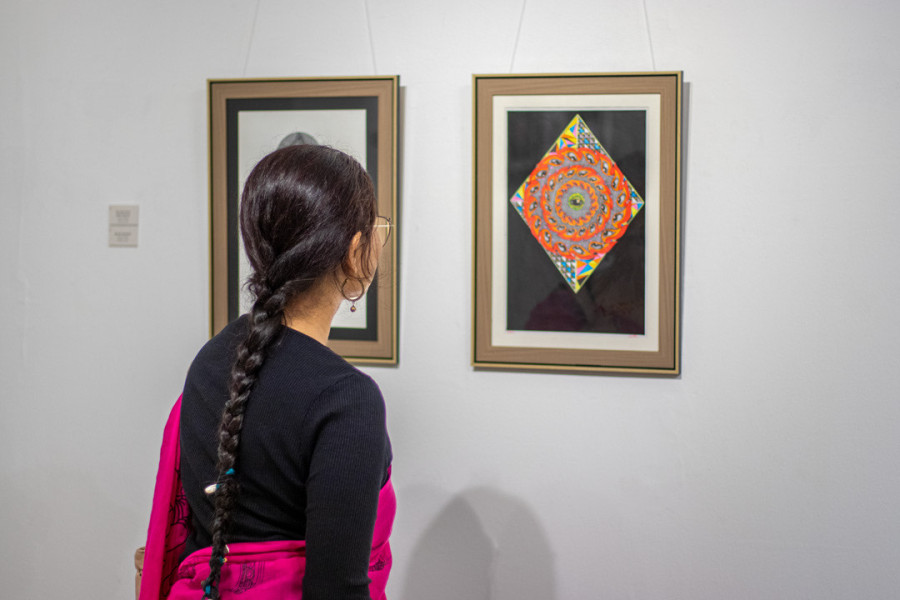
Shakya’s journey is a deeply meditative one, prompting the viewer to look closer at his work and also to look inwards. When entering Shakya’s exhibition, one is drawn to the very detailed drawings, where the all-seeing eye of the creator is present in multiple dimensions. His pen-and-ink anatomic compositions unfold as psychologically charged inner landscapes, mapping the terrain of the mind as much as the body, often invoking the presence of a “third eye”—a consciousness he believes resides within everyone.
Many celebrated artists such as Salvador Dali, Rene Magritte, MS Escher, Odilon Redon, and Pablo Picasso have used the symbol of the eye to symbolise consciousness, surveillance, focus, clarity, prophecy, awareness, and the divine. In traditional Newa or Tibetan art, the eyes are one of the most sacred and carefully painted elements. They carry deep symbolic, spiritual, and stylistic meaning.
These anatomical studies have been influenced in part by observing his sister’s medical studies as a nurse and by his fascination with the human skeletal system. He traces the body as though revealing the architecture of inner life—neural pathways, pulsating pink cerebral matter that vitalises human life through thoughts and emotions.
Shakya is also inspired by the anatomical drawings of Alex Grey. However, his anatomical drawings go beyond the study of human anatomy, subtly narrating a facet of personal and socio-cultural experience. The outcome of these drawings is an interrelated body of artwork representing an evolving inner universe that connects the conceptual mind with both the physical body and the memory of ancestors.
The artist sees the external world as part of a continuum, a singular field of existence that comprises the total lived experience of oneself and is also part of all other existing things. His drawings and paintings do not merely depict form; they suggest that thought, emotions and memory exist beneath the skin and are embedded in every cell and tissue of our bodies.
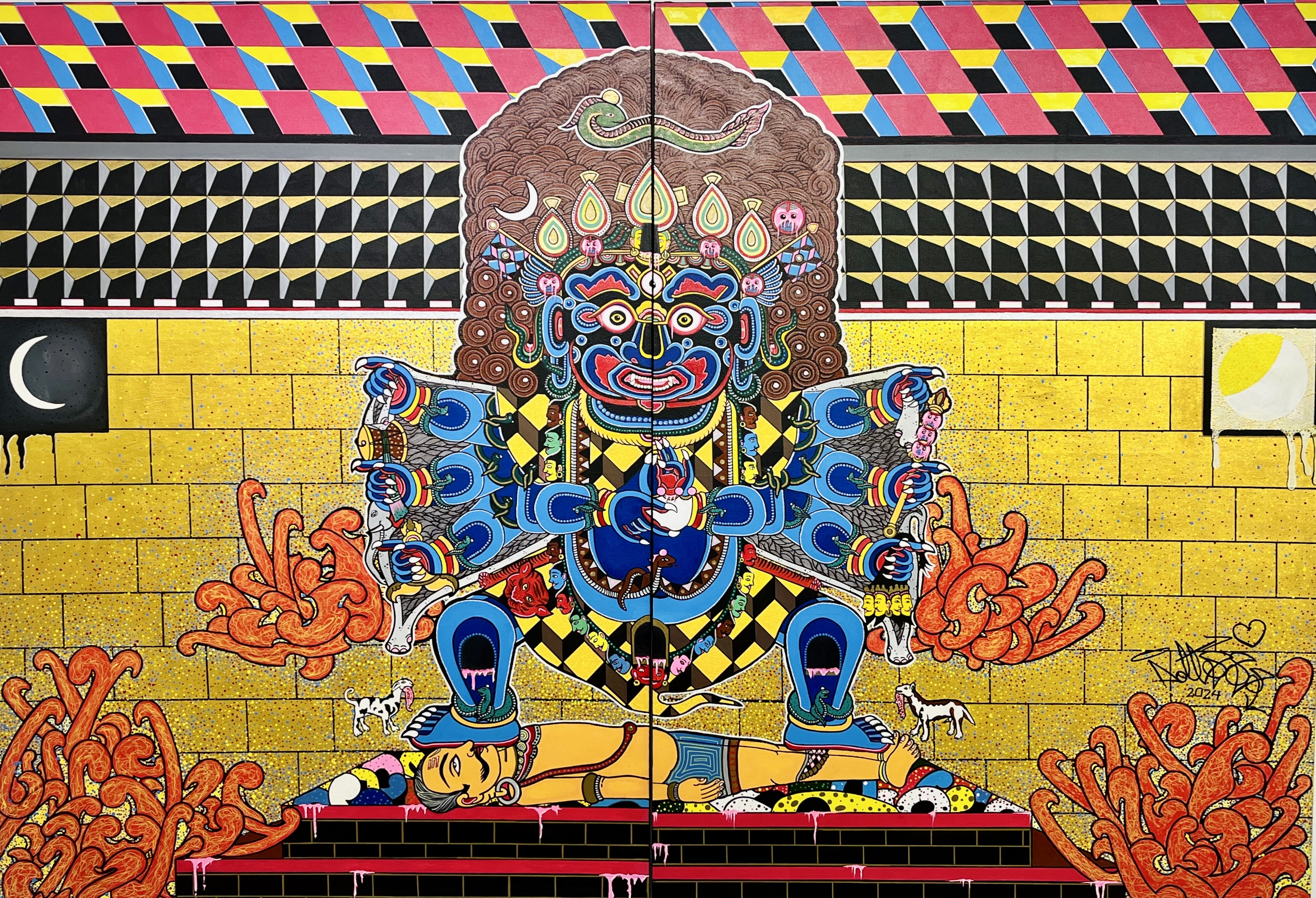
In the ‘Divine Hand’ series, detailed drawings of the hand are juxtaposed against a gold background, a pulsating web of maya—each of these hand gestures symbolically represents labour, strength, and care, thereby creating meaning within for the viewer. Shri Masaan Bhairab is a diptych in a street-art style, using a palette of neon colours to add vibrancy and a personal touch to the Kul deity of the Chitrakar clan.
The artist also explores the relationship between nature and the cycles of regeneration, which are mirrored in the cycles of night and day, the phases of the moon, and the energy cycles of human consciousness. Some of his works are surrealistic dreamscapes, colour-drenched with a neon palette. These works are a departure from his otherwise sombre meditative themes. These paintings provide respite from the unbearable heaviness of his works.
Shakya uses surreal imagery to balance the fun aspect of art with a quest for divine connection. Elements like flowers, the sun, the moon, colourful blocks and bricks, and dots add lightness amid this deeply personal search for the divine. There are varied styles and themes running through this exhibition, from tiny sketches to highly detailed works that showcase the artist’s strength as a master draftsman and reveal layers of meaning.
Shakya’s artworks are built upon a history of creation that was long established prior to the exhibitions in a gallery space. Shakya spent most of his childhood in Mangalbazaar, Patan, looking at the drawings and designs of his grandfather, Ratna Bir Shakya, who was deeply invested in jewellery-making and design.
Shakya shares, “I would take time looking at my grandfather’s deities and the art of designing/creating deities, and to me, they are a perfect representation of the rhythm and balance of life.”
Through the years, he created many of his own designs for clothing, created numerous patterns, and used different textures and mediums to create various styles/forms of his own visual language, where both meditative sketches of deities and spontaneous graffiti interact with one another to create a creative rhythm through all styles/forms of media.
Courtesy of Siddhartha Art Gallery
Shakya joined Srijana College of Fine Arts in 2017 for a few semesters. A few years later, Nepal was in the throes of the pandemic. The impact of the pandemic and the loneliness of the quarantine period affected him psychologically. Nikhil shares that he observed the cycle of life and death from his window as neighbours succumbed to Covid-19. During this period, he became increasingly aware of the fragile, continuous nature of existence by observing the transitions between life and death through his window.
Post-pandemic, Shakya decided to discontinue his studies and begin working independently, partly due to the freedom of artistic independence but mostly due to the impact of the solitude he experienced during the lockdowns. The solitude of this time led him to become more observant of daily life; various rituals and the rhythms of the city became essential resources for inspiration. He spent time exploring the city of Patan, visiting the ghats that serve as the meeting point for life and death, and stopping at temples such as Banglamukhi. It was here that he shares that he felt an overwhelming sense of calm and guiding presence, which was to lead to the contemplative tone of his works.
The energy of the urban landscape has been a source of inspiration for Shakya, and this energy morphs into eye-catching street art. His latest artworks, on the other hand, are more contemplative. Colour is chosen selectively—for Shakya each colour provides a new energy—“Orange energises me—it’s fun. Yellow energises me—it’s happy. Gold is my favourite energiser—it’s warm and provides me with strength.”
‘The Sunflower Series’, for example, contains large bursts of orange, yellow, and gold, with round, spiky star-like forms that appear to be alive; they reflect the rhythm and energy. By contrast, pieces like ‘Popping Out to Enlightenment (Unstoppable)’ explore the cycles of life and time: a baby rests within a square womb, protected by a skull, while three levitating faces hover nearby, hinting at the fragile yet continuous balance between life, death, and rebirth while remaining open to interpretation.
‘The Sunyata (Meditation)’ creates a serene environment—a skeletal form with a halo is seated on a traditional lotus seat, flames erupt on either side, and above the burning plumes of fire are the sun and moon. The work represents the space of meditative emptiness (the state of being empty). This is where stillness allows for the emergence of thought and awareness. In solitude, this is where one can come to a place of reflection.
Each of the compositions in the exhibition moves like an inner landscape and represents the stream or flow of thought, memories, and subtle energies. The configurations of forms through which the figure is demonstrated, the serene position of the figure, and the suggestion of a ‘third eye’ provide an invitation to the viewer to experience their own consciousness within themselves.
Journey to a Visionary Artworld
Where: Siddhartha Art Gallery, Babermahal Revisited
When: Until April 6
Time: Sunday to Friday, 11:00 am to 5:00 pm, Saturday 12:00 pm to 5:00 pm
Shrestha is an undergraduate student pursuing psychology and English literature. She currently works as the media coordinator at Siddhartha Art Gallery.




 26.26°C Kathmandu
.jpeg)