



 19.17°C Kathmandu
Sun, Jun 14, 2026
Culture & Lifestyle
Painting stories, one stranger at a time
Ruth is only four or five years into painting, yet she speaks about the craft as though she has always lived inside it.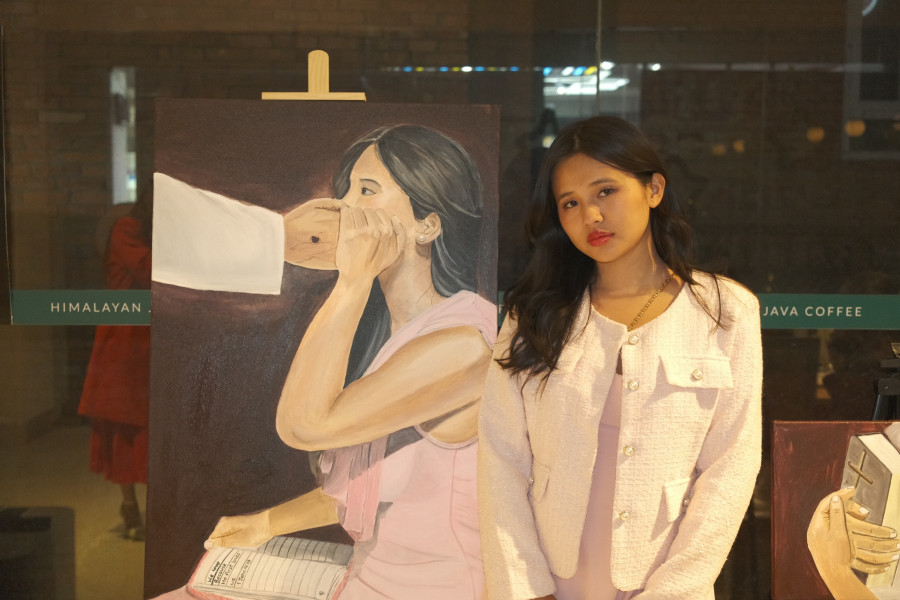
bookmark![]()
Girls apply vermillion powder during the Biska Jatra Rathpuja in Thimi. ![]()
Skanda Swar
Published at : March 15, 2026
Updated at : March 15, 2026 07:55
Kathmandu
Walking along the road, Ruth often stops to speak with strangers. She is not waiting for anyone. She simply notices a face that seems to hold a story, and for her, that is reason enough to pause. She takes out her sketchbook, and within days, she returns with a finished portrait, handing it to the stranger as a gift, freely given, with no strings attached.
This is how Ruth works. In a way, it is also how she became an artist, through an unexpected encounter, a story she could not ignore, and a sudden need to put paint to canvas before the feeling slipped away. Ruth did not grow up thinking art would shape her future. In the United States, she was studying computer science and mapping out her life through lines of code when everything changed. It began with loss.
In 2020, while she was living overseas, Ruth lost her grandfather back in Nepal. The weight of not having called him before he passed stayed with her for a long time.
About a year later, she had a dream. She was near a beach where what seemed like a contemporary art exhibition was taking place—large sculptures made of wood and black cloth, some nearly twelve feet tall, moving with the wind. When the sunlight caught the cloth just right, unexpected colours appeared.
“I remember saying in the dream, ‘I have never seen these colours before,’” she recalls.
Later in the dream, she sat beside her grandfather by the water, in front of something like a boat made of art. They did not need to speak. They simply looked at each other and laughed.
“When I woke up, I was still laughing. I felt as if my grandfather didn’t need to say anything; he simply wanted me to be happy and let go of the guilt I had been carrying.”
.jpeg)
She changed her major not long after, eventually earning a Bachelor’s degree in Studio Art from Queens College in New York. Her parents worried for her, as they did not come from a wealthy background and saw art as a gamble, but Ruth felt she had no real choice. Living in New York deepened her conviction. Gallery visits, studio conversations, and time volunteering at a local gallery pushed her towards a freer kind of expression. “Having strong technical skills can make someone a great teacher,” she says, “but what truly makes someone an artist is the courage to express themselves honestly through their work.”
After graduating, she returned to Nepal. Not to retreat, but to reconnect with her culture, her community, and the stories she felt were being lived all around her but rarely told. She started talking to strangers wherever she travelled: labourers, vendors, people she met in passing. She listened closely. “I’m fascinated by stories,” she says. “I believe stories are one of the things that last across generations.” One day, a thought arrived almost on its own: what if she painted them? So she did. And when the portraits were finished, she gave them away.
She is drawn to people who work hard, whose quiet dedication carries something worth passing on. She often finds what she describes as reflections of “love, joy, peace, patience, and kindness.” Her paintings are not realistic in the traditional sense; she paints with deliberate playfulness, sometimes a slight silliness, far more interested in catching the spirit of a moment than reproducing it exactly. One of her favourite things, she admits, is when the person she is painting mid-session quietly offers her tea or a snack. She never expects it. It always makes her smile.
Her first solo exhibition, titled ‘Back Home’, was a natural extension of all this. Although she had shown her work in group exhibitions in New York, she felt her first solo show had to take place in Nepal.
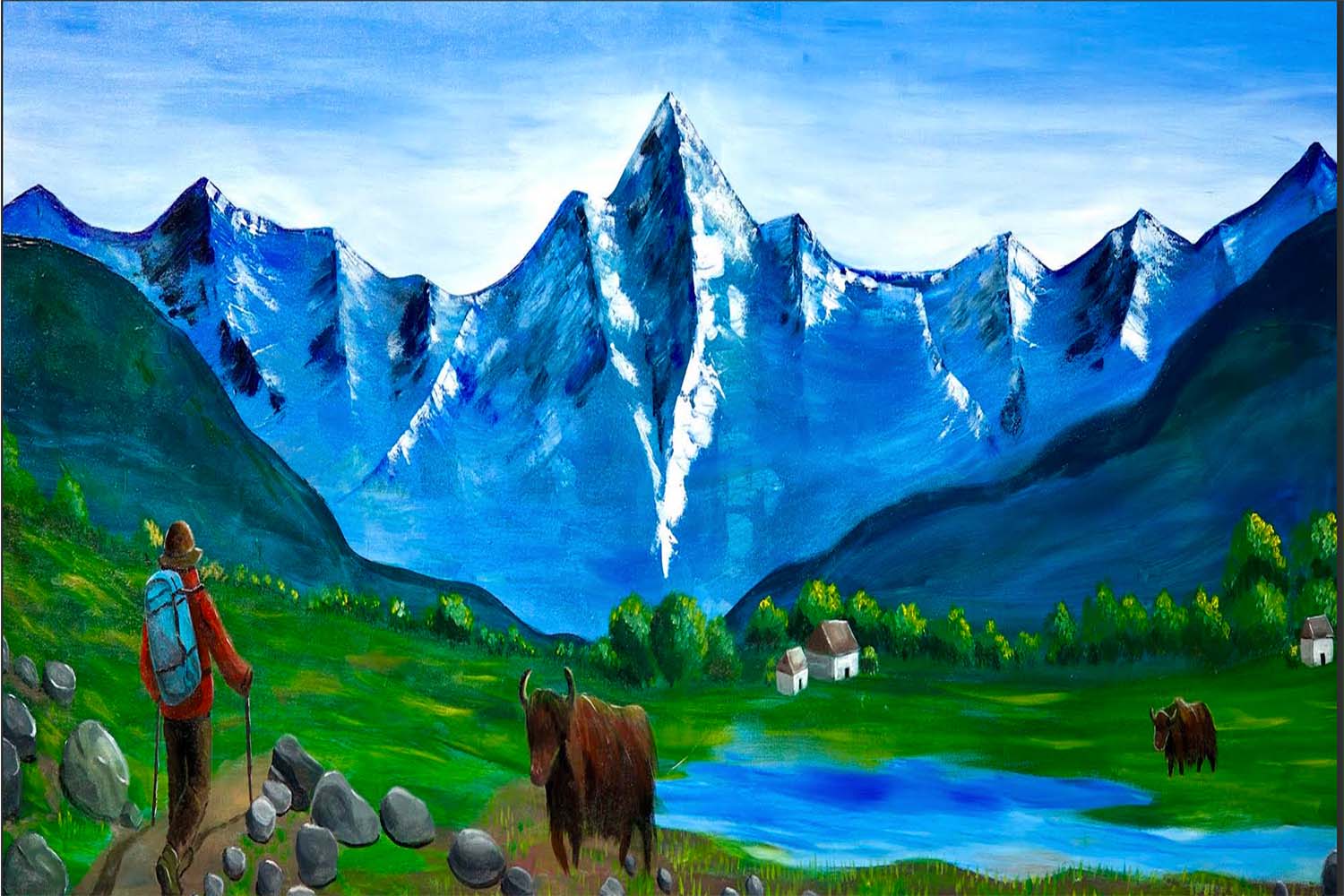
One piece invited visitors to write on a whiteboard in response to the question, “What reminds you of home?” Ruth handed out candies to everyone who participated, “because I wanted the interaction to leave them with a sweet memory.”
She had quietly prayed that around 100 people might attend and that some of the work might sell. More than 100 people came.
A second exhibition followed at Himalayan Java Coffee, titled ‘To My First Love’, more personal this time, weaving together portraits of strangers, landscapes, and works rooted in her faith. More than 130 people came in just three hours. Together, both shows confirmed something she had long believed: that people are hungry for stories, and that a painting can be the door through which a stranger’s life reaches someone it was never supposed to reach.
Ruth is only four or five years into painting, yet she speaks about art as though she has always lived inside it. “I often say that I breathe art,” she says. “Every brushstroke feels like I’m leaving a part of myself in the painting.”
She wants to create a comic one day, exhibit it around the world, and hold her next solo show in New York, a return to the city that first gave her the courage to call herself an artist. But she holds those plans loosely, trusting the timing to something beyond herself. In the meantime, she will keep stopping on dusty roads, asking strangers if she can paint them, and handing the finished portrait back as if it were theirs all along. Because it was.


Most Read from Culture & Lifestyle


Editor's Picks
Inside the mission of Everest’s first mountain rangers

Weak arbitration defence costs government billions
Nepalis making treacherous trip to Europe through the Balkan route

Women are often at the centre of Nepali films. Why are men still telling most of their stories?
What old newspapers reveal about Kathmandu’s World Cup fever in the 80s and 90s
E-PAPER | June 14, 2026

×