



 9.89°C Kathmandu
Tue, Mar 3, 2026
Culture & Lifestyle
Art exhibitions that pushed the envelope in 2019
While there was diversity in the exhibitions that happened, there’s still a need for more to happen in the art scene in Kathmandu..jpg&w=900&height=601)
bookmark ![]()
Beeju Maharjan/TKP ![]()
Anish Regmi/TKP ![]()
Elite Joshi/TKP ![]()
Srizu Bajracharya/TKP ![]()
Kiran Panday/TKP
Srizu Bajracharya
Published at : December 31, 2019
Kathmandu
This year, Kathmandu hosted at least one or two events related to art every month. With rapidly growing art galleries, many artists showcased the work that took them years to prepare, and many hoped to reach out to a larger audience by putting up art exhibitions in restaurants, and in public places.
There were discussions around art, how it serves identities, political movements and social causes. There were even discussions on what can be perceived and defined as art. Many artists tried to push this envelope in varied ways—while some achieved moderate to considerable success in doing so, others faced criticisms. There was diversity in art, but many of the artists could not break from the realm of beauty. Many works seemed to delve more around the idea of decor and art collections, rather than being critical and impactful in narratives.
2019 missed works like Sheelasha Rajbhandari’s ‘I Still See That Same Old House of Ours In My Dreams, 2017’, Hit Man Gurung’s ‘I Have to Feed Myself, My Family and My Country…’ (2016), Amrit Karki’s ‘Rectangle’, Mekh Limbu’s, ‘How I Forgot My Mother Tongue.’
The conversation around art was what kept the year propagative. Towards the end of the year, Milan Rai’s art installation took social media by storm with the allegations of plagiarism. Regardless, the year ended with a public debate on art and its constructs. Here are five art exhibitions that were able to pave the way for more promising prospects in art in the coming years.
Baadiyeko Aakash
Sunita Maharjan’s ‘Baadiyeko Aakash’ brings to the forefront the most simplistic idea of the forgotten shared terraces. The month-long exhibition that extended to January of 2019, was a promising start for art for this year. Maharjan’s terrace series in acrylic, prints and textiles included four series—Marpha, Terrace, Kiritipur and Earthquake. Terraces before the age of technology was a conjoined space where people came together, but with time they have become unused spaces. But Maharjan’s aerial view of various places in Nepal evokes a desolate nostalgia, making her work even more powerful. She makes it to the list for evoking in observers their own memories of terraces that have been overlooked with time. And for making people see that art can make connections with their observers.
.jpg)
BFA ‘Belonging’
“It’s always interesting to see the journey of an artist, how they grow with time,” says Kumudini Gurung Shrestha, co-founder of Shikshya Foundation Nepal and an avid art observer. She has marked the BFA exhibition ‘Belonging’ as one of her top five exhibitions of the year. And the BFA exhibition this year indeed was an eventful one—many art lovers praised the skills of the young artists. This year’s BFA showcased works of 16 KU graduates at Nepal Art Council, and each of them were able to show their individuality. Their works were able to show their outlooks for their future. And under the theme title ‘Belonging’, their relationships with their ideas brought the whole exhibition together. In the coming years, it will be interesting to see how these young artists pave the way forward for the art scene in Nepal. And therefore, this exhibition makes it to the list: the young artists’ journey will be something to look out for.
-online.jpg)
Nepal Through the Ages: Reviving Ancient and Medieval Culture and Architecture
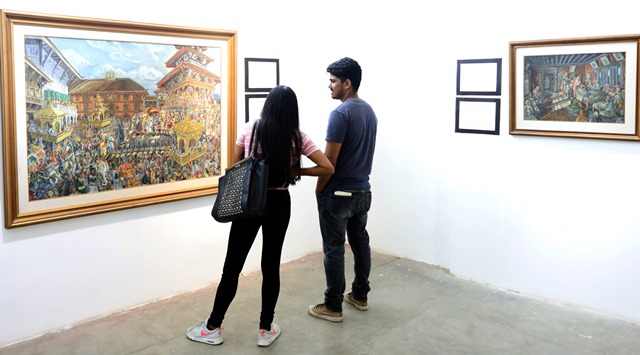
Eighty two-year-old artist, Hari Prasad Sharma carefully details his reimagination of monumental historical events of Nepal. His oil paintings that work on layers of details tell about Sharma’s passion for art.
The collection displayed at Nepal Art Council had 45 paintings that captured various times in history—from the time of Prince Siddhartha’s departure from his palace on his journey to find enlightenment to the Malla-era Kathmandu and the Shah dynasty’s overtaking of the Valley. Sharma’s work celebrated Nepal’s eventful history and transported observers to the world of his woven characters. The grandeur of his dexterous paintings was an experience in itself, and perhaps for many artists, this exhibition will remain indelible for many years.
Kathmandu International Performance Art Festival
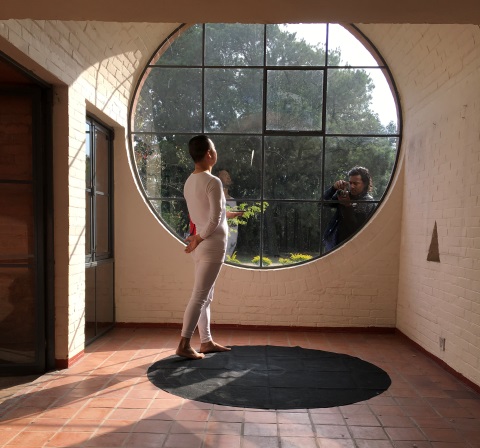
The Kathmandu International Performance Art Festival, although was chaotic in terms of how it was managed, the ideas the 14 performance artists brought to the front were quite intriguing. Their devotion demanded attention and their ideas were powerfully resonant to the issues happening around the world.
The festival makes it to this list for being different and asking for more from the audience that visited the festival. Artist Dhruba Raj Sharma’s performance art, where he enacted as bovine in a slaughterhouse to evoke in people the consciousness about meat consumption perhaps still remains fresh in people’s minds.
Masinya Dastoor
Lavkant Chaudhary’s exhibition ‘Masinya Dastoor’ is an experience in itself. His artworks focus on the details of the repressed history of the Tharus—such as the effect of the law that recognised them as a touchable enslavable alcohol-drinking group. Chaudhary takes people on a journey to understand the identities of the Tharus. And what makes it one of the best exhibitions of the year, is how it delivers its storytelling. The medium he uses enhances his narrative, and they don’t feel scattered. Chaudhary’s work make-believes that art is necessary and is influential. His attempt to discover his Tharu roots also lays emphasis on how there are more diverse narratives that are waiting to be discovered.
.jpg)
Srizu Bajracharya
Srizu Bajracharya was a Culture and Arts reporter for The Kathmandu Post.
.jpg&w=200&height=120)


Most Read from Culture & Lifestyle

Editor's Picks
Five and half decades of KP Oli in Nepali politics

How Facebook’s algorithm is amplifying one party over all others

Nepal’s IT exports near $1 billion. Can the momentum be sustained?
Parties’ lofty pledges on economy collide with hard realities
Upper house passes tourism bill with tougher Everest rules
E-PAPER | March 03, 2026

×