



 22.04°C Kathmandu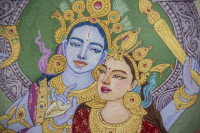
Sat, Jun 6, 2026
Culture & Lifestyle
Strengthening ties through art
With 32 pieces on display from both sides of the border, organisers hope to promote cultural exchange between the countries.
bookmark![]()
Beeju Maharjan /TKP
Post Report
Published at : November 3, 2019
Updated at : November 3, 2019 13:13
Intricate and elaborate thangkas from Nepal and China are being showcased in an effort to strengthen the countries' cultural relations.
Held at Kamaladi’s Nepal Academy from November 1 to 3, and organised by World Cultural Net in cooperation with the Chinese embassy, the exhibition is showcasing a total of 32 artworks.
The China-Nepal Thangka Arts and Works Exhibition was inaugurated by Chinese Ambassador to Nepal Hou Yanqi and Chancellor of Nepal Academy of Fine Arts Kanchha Kumar Karmacharya on Friday.
"We have 20 thangka artworks from 17 'A-class' Tibetan thangka artists from Tibet Autonomous Region,” said Dipak Sarkar, President of World Cultural Net. “From Nepal’s side, we are exhibiting 12 artworks by Lok Chitrakar, a renowned Paubha artist."
The purpose of the exhibition, says Sarkar, is to strengthen and promote the cultural relations between the two countries. "The reason we chose art is that there has not been much artistic exchange between the countries, and what better art form to do that than thangka, which is prevalent in both the countries. Let's say, thangka has a trans-Himalayan connection.”
Sarkar said the market had grown exponentially over the years in China too.
Chitrakar, the lone Nepali artist whose works are exhibited, says that exhibiting such a unique Nepali art form is crucial to spreading awareness of the country’s artistic diversity—not just internationally, but nationally.
"Even though Paubha is an art form that's unique to Nepal, not many within the country know about it. I hope exhibitions like this will serve as a catalyst to promote and preserve this unique artform," Chitrakar told the Post.

Luo Bu Si Da, who is Dean of the Tibet Academy of Thangka Painting, works can also be found at the exhibition. Si Da says that the event has turned out better than what he had expected.
"The artworks from the Nepal side are really good, and I hope that the exhibition will encourage people to learn and train in these artforms. This exhibition can become a joint platform for artists from Nepal and China," said Si Da.
Joint exhibitions with artists from different countries, says Chitrakar, are instrumental to cultural preservation, as well as innovation.
"There are a lot of similarities between Paubha and Tibetan Thangka painting," said Chitrakar. "The joint exhibition will allow artists from both sides of the border to do comparative studies between the two art forms."
Chitrakar said he hopes that the way the Chinese government encourages its artists and plays an active role in preserving different art forms will get the attention of, and be mimicked, but Nepal’s government.
"To preserve art is to preserve identity," said Chitrakar.
China-Nepal Thangka Arts and Works Exhibition is being held at Nepal Academy in Kamaladi until November 3. Entry is free, from 11 am to 4 pm.



Most Read from Culture & Lifestyle


Editor's Picks

Together, but apart: Nepal’s growing phubbing culture
Who is Nepal’s egg donation ban actually protecting?

Nepal-India relations in uncertain territory as new government charts assertive course
The sequel trend in Nepali cinema: Story continuity or commercial greed?
Crop-raiding monkeys are leaving hill farmers nothing to live on
E-PAPER | June 06, 2026

×