Narayani ‘iconic’ bridge stuck in early works as delays stretch timeline
Nearly two years after foundation stone was laid, the Rs1.68 billion project shows limited physical progress as design delays and rising costs slow construction. Post photo
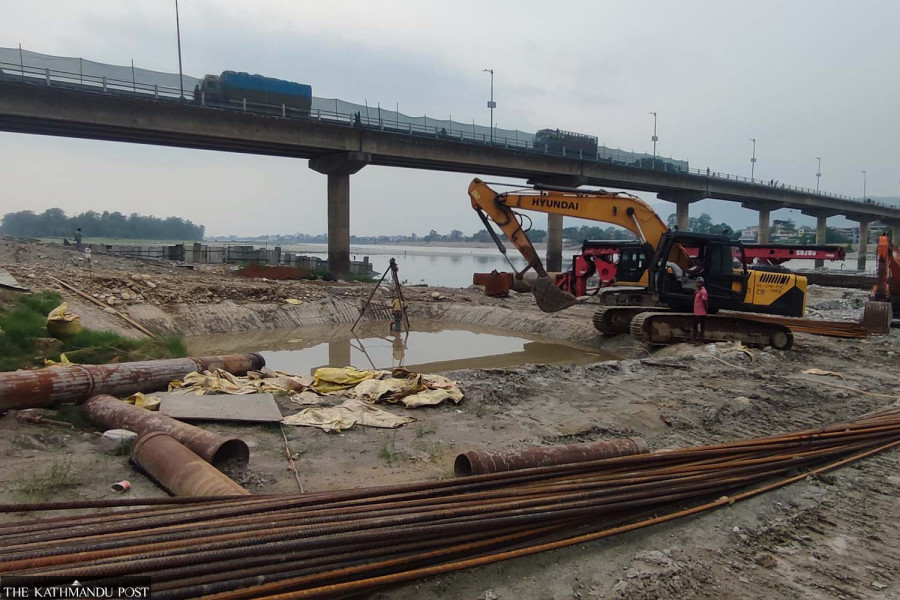
Nearly two years after its foundation stone was laid with much fanfare, the Narayani ‘iconic’ bridge is still stuck in groundwork, with only foundations and preparatory works visible even as river levels rise and the construction timeline quietly slips further.
Heavy machinery lines the riverbanks, with workers seen digging and binding steel reinforcement bars. The river has turned murky and swollen, but no major structural elements of the bridge have been built so far.
The foundation stone was laid nearly two years ago, in late April 2024, by then prime minister Pushpa Kamal Dahal. However, even at that time, the bridge design had not been finalised. The design was approved only on November 4 last year, after which equipment and workers were mobilised at the site.
“Load-bearing capacity tests for the bridge pillars have been completed. Field-level testing is now over, and structural work will begin soon,” said Santosh Bhandari, site engineer at the Bharatpur Division Road Office overseeing the project.
The bridge will feature two main towers, positioned about 100 metres from the abutments on either side. Work is currently underway on the abutment structures—the concrete sections at both ends of the bridge—as well as the foundation for the main tower on the Narayanghat side.
The distance between the two towers will be 220 metres, while the total length of the bridge will be 420 metres. The design allows for water transport beneath the structure.
Construction of the abutment on the Gaindakot side is expected to begin within the current fiscal year.
A contract for the bridge was signed on May 23, 2023, with Tundi Construction, with a four-year completion timeline. The agreement required the design to be finalised within one year and the remaining three years allocated for construction.
However, the design approval alone was delayed by about 18 months.
“While physical progress is not yet visible, various works are ongoing. Financial progress stands at around 7 to 8 percent,” said project manager Manjeel Mishra of Tundi Construction.
The project is estimated to cost Rs1.68 billion. Around 150 workers are currently engaged in preparing reinforcement bars for the pillars. According to Mishra, four excavators are deployed on each side—Narayanghat and Gaindakot—along with a 60-tonne crane and three additional heavy machines.
He said construction has continued despite rising costs and logistical challenges. “Prices of materials, from steel rods to fuel, have increased significantly. Supplies are not always available on time. The early onset of the pre-monsoon has also made work difficult, but we have not halted construction,” Mishra said.
The bridge will be Nepal’s first to feature two towers and cable systems of this type, unlike the Karnali bridge at Chisapani on the East-West Mahendra Highway, which has a single tower.
“Some have started calling it a ‘signature bridge’, but it is essentially an iconic bridge,” Mishra said.
The existing Narayani bridge in Narayanghat, whose foundation was laid in 1981, took nearly four years to complete. It has since become narrow and outdated relative to the expanded East-West Highway, causing traffic congestion.
The new bridge is being constructed adjacent to the old one. With increasing traffic pressure, there is a growing urgency to complete the replacement. However, nearly three years into a four-year contract period, even foundational work remains incomplete.




 14.82°C Kathmandu
1.jpg)