Srilanka Tapu residents living with fear of wild elephants in winter, Koshi’s flooding in monsoon
Residents are frustrated that candidates make promises during elections but forget them once the polls are over. A farmer tends to vegetable cultivation in Srilanka Tappu. Rakesh Nepali/TKP
After crossing a foot bridge over the Gideri stream from Banadanda of Belaka Municipality-22 in Udayapur district, the narrow trail opens onto Srilanka Tapu, a riverine island formed by the country’s biggest water system—the Saptakoshi.
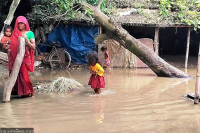
Life in Srilanka Tapu is shaped by two recurring fears—wild elephant menace in winter and flooding during the monsoon. For the residents of this river-locked settlement, survival depends on countering both threats.
Tetru Rajbanshi, originally from Prakashpur in the neighbouring Sunsari district, now lives in a bamboo-and-thatch house on the island, tending to his vegetable farm. “We spend the whole day working in the fields, but at night marauding elephants arrive and destroy everything,” he said.
Elephants not only damage crops but sometimes demolish houses and have caused human casualties as well. “You cannot sleep peacefully. The fear begins after dark,” lamented Rajbanshi.
Human-elephant conflict has long troubled settlements along the Koshi river corridor. According to conservationists, shrinking forest habitats and expanding farmland have pushed elephants closer to human settlements in eastern Nepal, leaving farmers vulnerable to crop losses and insecurity.
During the monsoon season, however, the threat shifts from wild elephants to water. When the Gideri stream swells, the suspension bridge becomes unsafe, effectively isolating the island. Residents have to stockpile food, salt and cooking oil before the rains come, knowing that travel becomes nearly impossible for weeks.
Medical emergencies are particularly risky. Suraj Mahato of Ramnagar in Srilanka Tapu said pregnant women often give birth at home because reaching the nearest health facility requires crossing the stream and walking several kilometres to Bhagalpur, which is impossible during floods.
Basic infrastructure remains limited in Srilanka Tapu. Farmers have installed electric water pumps collectively to irrigate fields, but unreliable electricity supply hinders their use. Mahato said repeated requests to local authorities for improved power supply have brought little change.
“Electricity is enough to light bulbs, but not to run irrigation pumps or mills. Farming becomes difficult,” he complained. Residents informed ward 2 Chairman Prem Dahal and Belaka Municipality mayor Ashok Karki several times about the issue but the problem remains unaddressed.
Education is another challenge in the settlement. The Ramjanaki Basic School runs classes only up to grade five. Student attendance is low. Children must walk about an hour to reach Bhagalpur Secondary School, discouraging many families from sending their children regularly. Bijay Mahato, another local, said parents often want children to help with farm and household work instead.
Communication services are also weak in the area, with only limited 2G coverage, while drinking water depends largely on hand pumps that often dry up in winter. Residents demand an alternative arrangement for drinking water supply.
Despite these hardships, more than 2,000 households live across the island, which is also known as Garai Tapu, with residents coming seasonally from Udayapur, Sunsari, Morang and Saptari for farming. Agriculture remains the primary livelihood, especially vegetable cultivation supplied to nearby markets.
No election buzz in Srilanka Tapu
As political parties and candidates intensify voter outreach ahead of the House of Representatives election scheduled for March 5, the campaign has yet to reach Srilanka Tapu. Residents of the island say they have little time to discuss politics as survival takes precedence.
Saroj Mallik of Ramnagar spends most of his time on the fields where he grows potatoes, tomatoes, carrots, radish, spinach, cabbage and cauliflower. His duty involves tending crops, applying fertiliser, irrigating fields and transporting vegetables to nearby markets. “We thus remain busy all day and have no time even for political speeches,” he said.
According to Mallik, while farming consumes the daytime, fear of wild elephants keeps residents awake at night. “What is the point of telling leaders about our problems when they do not solve them? We have to tackle these problems on our own,” he vented his ire, complaining that candidates make promises during elections but forget the island’s problems once voting is over.
Srilanka Tapu, which falls under Udayapur Constituency-1 and Sunsari Constituency-4, has yet to see candidates visiting the area. The island includes Wards 2 and 9 of Belaka Municipality in Udayapur and Wards 6, 7 and 9 of Baraha Municipality in Sunsari.
According to Ward Chief Prem Dahal of Belaka-2, more than 2,000 households exist on the island, though only around 300 citizens in Ramnagar under Undaypur Constituency-1 hold voter identity cards. Voters from the area must travel to Saptakoshi Secondary School in Belaka-2 to cast their ballots.




 15.28°C Kathmandu