



 18.34°C Kathmandu

Sat, Oct 24, 2026
Koshi Province
Monkey menace goes nowhere despite tall poll promises
Election-time leaders have promised fencing, compensation, and have even discussed exporting monkey meat, yet Dhankuta farmers still battle monkeys from dawn to dusk.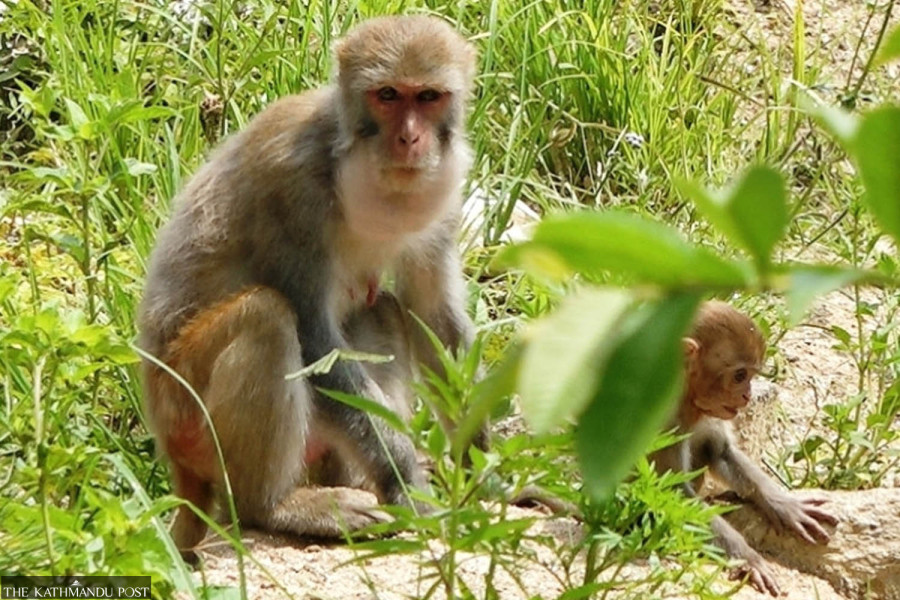
bookmark
Binod Ghimire
Published at : February 6, 2026
Updated at : February 6, 2026 20:47
Dhankuta
Before sunrise each morning, Bindramaya Rai of Panchkanya settlement in ward 3 of Pakhribas Municipality heads to her fields, not primarily to tend crops but to chase away monkeys. Armed with a catapult and stick, she spends most of her day guarding maize, potatoes and vegetables from marauding troops descending from nearby forests.
“Farming has become less about growing crops and more about protecting it from monkeys. If we leave the field even briefly, everything is destroyed in no time,” said Rai. Her struggle reflects a growing crisis across rural parts of Dhankuta, where farmers complain that monkey attacks have made agriculture increasingly unviable. Living at the edge of the settlement, her farmland is the first target as animals emerge from the forest.
In nearby Okhre village of Pakhribas, Sarita Jimi says the problem caused by wild animals, mainly by monkeys, has worsened in recent years. Once limited to maize and chayote, monkeys now damage garlic, onions and even cardamom. “It is difficult to harvest anything safely. They uproot crops before they are ripe,” she said.
Rural people, mostly the farmers, are affected due to the increasing menace of monkeys. According to them, the damage has changed daily life and agricultural patterns. Many spend hours guarding fields rather than cultivating them, while others have abandoned farming altogether.
Meghraj Khatri of Teliya village said land that once supported a family of fifteen now lies fallow. “Farming is no longer possible. Monkeys even enter homes searching for food,” he said. Labour shortages caused by youth migration have further weakened farmers’ ability to protect crops, a trend causing decline in agriculture production in rural areas.
Farmers say shrinking cultivation and expanding forest cover around abandoned land have unintentionally increased monkey habitats and worsening the human-wildlife conflict. Local production of traditional crops has declined, and some farmers have shifted to less risky crops or seasonal work outside agriculture. The growing human-wildlife conflict mirrors patterns reported in hill districts across Nepal, where wildlife conservation successes have sometimes increased pressure on farming communities without adequate mitigation measures.
As the House of Representatives polls approach, monkey menace has been a major election agenda in Dhankuta, a hill district in Koshi province. Election candidates have once again made monkey control a campaign issue, promising fencing, compensation schemes, and stronger wildlife management policies.
Nepali Communist Party’s candidate Dharma Raj Paudel recently proposed revising laws to allow commercial management of monkeys, even suggesting the export of processed monkey meat, a proposal that has sparked debate among residents. Nepali Congress candidate Dinesh Rai and CPN-UML candidate Rajendra Rai have also pledged special programmes to protect farmers’ crops.
Yet many locals remain sceptical, recalling similar commitments in previous elections. “We heard the same promises three years ago. After winning the polls, they forget the village,” said Khatiwada. Farmers complain that while party manifestos emphasise roads, bridges and buildings, everyday agricultural problems receive little attention.
The consequences of wildlife menace are increasingly visible. Fields lie barren, production continues to fall and younger generations are leaving villages where farming no longer guarantees survival. Dik Bahadur Giri, another farmer from Teliya, said agriculture now brings losses rather than income. “We are waiting to see if this issue will ever move beyond election speeches,” he said.
For farmers across Dhankuta, the conflict between people and monkeys has become more than a nuisance; it symbolises deeper neglect of rural livelihoods. As campaign rallies intensify, residents say meaningful solutions, not promises, will determine whether farming in these hills has a future.
Not only in Dhankuta, farmers across the country have been hugely affected by the monkey menace in recent years. Various studies show that monkey menace is one of the leading causes of migration in the hilly region of Nepal.
Nepal is home to three species of monkeys—the rhesus macaque (Macaca mulatta), the Assamese monkey (Macaca assamensis) and the Hanuman langur (Semnopithecus entellus).
Nepal is a signatory to the Convention on International Trade in Endangered Species of Wild Fauna and Flora (CITES), the global treaty that regulates trade in species under threat. That rhesus monkeys are listed in CITES means their international trade is restricted. It prohibits the export of wild animals and plants without government permission.
Similarly, the National Park and Wildlife Conservation Act also includes the rhesus monkey on the list of protected animals, thereby prohibiting its export without government permission. However, the act does not mention any measures for controlling protected animals that threaten people and agricultural production.





Most Read from Koshi Province


Editor's Picks





E-PAPER | October 24, 2026

×