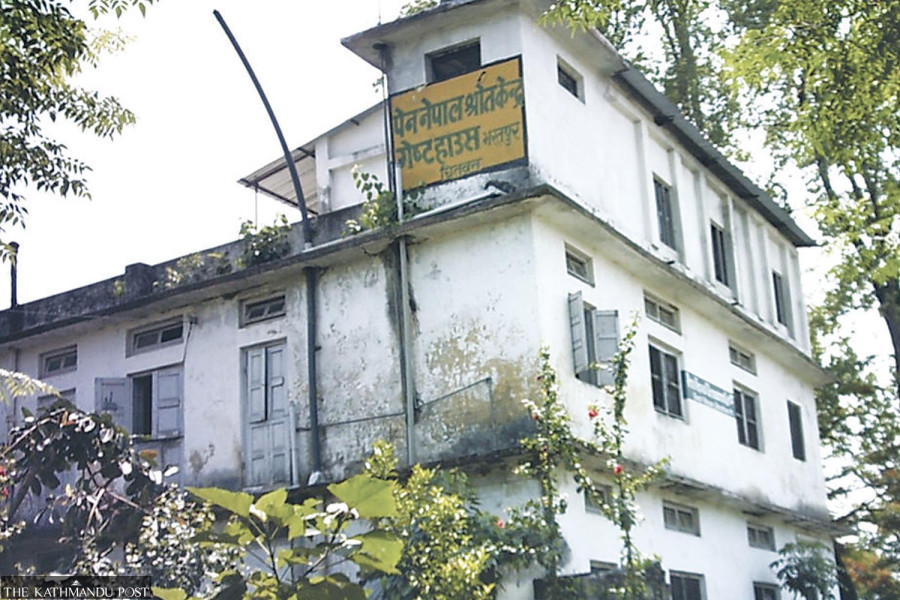
The Congress president’s remarks at the RSP general convention have renewed interest in the capture of Bharatpur and the deadly military crackdown that followed. The guest house where many prisoners were held and tortured. Post file photo
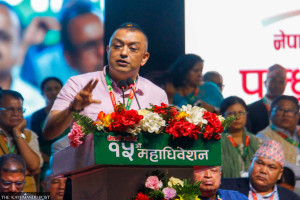
On Sunday, Nepali Congress President Gagan Thapa called attention to an obscure, violent chapter from the early days of the partyless Panchayat era. Speaking at the opening session of the Rastriya Swatantra Party’s first general convention in Chitwan, Thapa said that the sacrifices made by the Congress during the struggle for democracy should not be forgotten—and that the democratic system enjoyed today was the result of that struggle.
“Please do not say that nothing happened during those 35 years,” he said. “Please do not undermine the stories of the 30-year struggle against the Panchayat system. Beneath the very ground where you are standing lie the bodies of around 50 people buried there in 1962.”
Describing Chitwan as a historic centre of democratic resistance, Thapa continued: “The Panchayat government killed them and buried them beneath the very ground where you are standing. Today, you are able to raise your blue flag because of those sacrifices. When you raise that flag, look at the ground beneath your feet. The soil of Chitwan is stained red with the blood of those martyrs.”
Following King Mahendra’s royal coup, the Nepali Congress, under the leadership of acting party president Subarna Shumsher Rana, launched an armed insurrection demanding the release of political prisoners and the restoration of Parliament. The coup had led to the arrest of top democratic leaders, including party president BP Koirala and leader Ganesh Man Singh. The Chitwan uprising was carried out as part of that broader armed rebellion.
The Congress-led armed rebellion in Chitwan was spearheaded by Jagat Prakash Jung Shah. Following the capture of Bharatpur under his command, King Mahendra’s military forces launched a brutal crackdown, resulting in the killing of around 50 democratic insurgents, including Commander Shah himself. The episode is documented by former diplomat, politician and human rights activist Rishikesh Shah in his book Prarabdha ra Purushartha.
In the book, Shah writes: “I was investigating the plane crash that killed UN Secretary-General Dag Hammarskjöld in 1961 near Ndola, Northern Rhodesia (now Zambia), when they captured Jagat Prakash Jung Shah, father of Naveen Prakash Jung Shah (who later became the vice-chancellor of Tribhuvan University), from Chitwan and brought him to Kathmandu. Following the 1960 coup, Shah had been leading an armed rebellion against the regime. Within a few days, he was sent back there and shot dead.”
He adds: “In the context of that incident, I still remember King Mahendra saying, ‘They probably came looking for a prize, but ended up losing everything for nothing.’”
Historian Rajesh Gautam has also documented the Chitwan rebellion in his book Nepali Congress ko Itihas. Congress President Thapa told Kantipur that raising the Chitwan incident and its sacrifices was important for recalling history.
“The Chitwan incident is an important part of Congress history. It highlights the sacrifices made for democracy,” he said. “What I was trying to say is that RSP is also able to raise its flag today because of the democracy achieved through those struggles.”
Gautam said that after Congress forces captured police stations and administrative offices in Chitwan, the Royal Nepal Army was deployed from Kathmandu and carried out a massacre.
“The Congress rebels had already taken control of several police headquarters and government offices,” he said. “After that, they were staying at a guest house with the Congress flag. Then the army came and opened fire.”
Thapa’s remarks have brought renewed attention to the 65-year-old armed movement launched by the Nepali Congress against the Panchayat regime.
One of the key witnesses to that period is Topman Singh Gurung, former president of the Nepali Congress Chitwan district committee.
Born in Tanahun in 1946, Gurung was nearing 16 and serving as a courier for the party’s Mukti Sena, or Liberation Army, the Nepali Congress’ armed wing, when the incident took place. The party relied heavily on the Mukti Sena during its armed insurrections against King Mahendra’s Panchayat regime.
The Nepali Congress had announced armed resistance across the country against the Panchayat government. Preparations to launch the armed rebellion in Chitwan were made in Narkatiaganj in Bihar, India, close to the district.
The plan to capture Bharatpur was scheduled for February 8, 1962. On February 6, Topman Singh met Lal Dhwoj Gurung and Surya Bhakta Adhikari. Lal Dhwoj was from Chitwan and Surya Bhakta was from Gaindakot, Nawalparasi. Both were involved in the Bharatpur operation and handed him a letter.
The letter was addressed to Bharat Gurung by the armed fighters of the Nepali Congress regarding the planned capture of Bharatpur. It read: “We will take control of Bharatpur on February 8. You should surrender,” Topman Singh recalled.
He delivered the letter on February 6. According to him, Bharat Gurung expressed agreement after reading it. Topman then relayed the response to Lal Dhwoj and Surya Bhakta.
Bharat Gurung was Topman’s uncle. He was also the son-in-law of Congress leader Bakhan Singh and therefore supported the movement.
The armed groups reached Bharatpur through Narkatiaganj, Thori and Madi. According to Topman, the operation to capture Bharatpur was led by Pahalman Singh Rai.
As planned, Bharatpur was captured on February 8, but the control lasted less than 48 hours as the Royal Nepal Army recaptured it again.
“I went there only on February 10. I heard there was firing and returned home,” he said.
A warrant was later issued against him, and he fled to India to avoid arrest, although he continued to enter Chitwan secretly.
“I had to travel to Chitwan from time to time to plant flags and distribute pamphlets,” Topman recalled. “In 2021 BS (1964–1965), I managed to find a way inside the guest house again. Bhoj Bikram Rai, who was the district education officer in Bharatpur at the time and a Congress sympathiser, spotted me. He warned me, ‘If you keep walking around like this, you’ll get arrested.’”
Bhoj Bikram then took him into the same guest house in Bharatpur where he was residing. It was during that visit that Topman noticed signs of violence in a ground-floor room on the eastern side of the building.
“There were cobwebs on the walls, no cleaning or maintenance,” he said. “Bloodstains were still visible on the walls. The floor still had traces of dried blood.”
He added that leaders including Jagat Prakash Jung Shah, Hari Prasad Gurung and Buddha Singh Rana Magar were tortured and killed there. According to him, the Royal Nepal Army was deployed from Kathmandu to recapture Bharatpur from the Congress fighters.
“Many people were killed,” Topman said. “Some were tortured inside the guest house itself. But where they were buried remains disputed. As far as I know, many were buried near Nagarban under the Narayani bridge area.”
He also recalled the participation of Tamang and Chepang communities from eastern Chitwan areas such as Piple and Lothar, saying their involvement was significant but has remained largely undocumented. He believes many of them were executed.
Bamdev Khanal was a school student at the time. His brother, Shreeharsh Khanal, was a landlord and Congress leader in Narayangadh. He participated in the uprising, was arrested and went missing after his release.
Bamdev later published a book, Smritika Jwarbhataharu (Tides of Memory), recalling the Bharatpur incident. He writes that Congress leaders placed a photograph of Subarna Shamsher inside the Bharatpur guest house on February 8, 1962, to signal that the town had been taken over.
On February 10, Royal Nepal Army troops from Kathmandu reportedly shot down the photograph and began arresting suspected individuals.
His book describes arrests across villages, with soldiers opening fire on people attempting to flee. Farmers working in fields were also killed, it states. Prisoners held in the guest house were interrogated throughout the day, tortured and later taken to forests for execution. Their bodies were allegedly disposed of in the Majhuwa forest area along the Narayani River or tied to stones and dumped into the water.
In the Jay Nepal Smarika, a commemorative souvenir published by the Nepali Congress Regional Committee No. 2 in 2057 BS (2000–2001), Gyanendra Malla compiled details of those affected by the 1962 Bharatpur uprising. His records document the names of 19 individuals executed by the Panchayat regime and 15 others who went missing.
Historian Gautam writes that Jagat Prakash was spared immediate execution because of his royal family connection. He was later executed after approval from King Mahendra.
According to Gautam’s book, around 26 people were killed in total, including Hari Prasad Gurung, Buddha Singh Rana, Khem Bahadur Gurung, Shamsher Bahadur Gurung, Traffic Tamang, Jagat Prakash Jung Shah, Panche Gurung and Hasta Bahadur Gurung. Buddha Singh Rana, aged 27, was among the youngest victims.
Gautam further writes that during the final clearance operation, soldiers surrounded the guest house grounds. Unaware of the military presence, Liberation Army fighters celebrating their victory arrived in vehicles displaying the Congress four-star flag and were immediately captured.
Eleven fighters were tied together with a single rope and dragged to Chaubiskothi. Eight were taken further to Tikauli forest, where seven were killed with bayonets.
Around 66 individuals were reportedly sentenced to prison or other punishments and labelled “anti-national elements”. Arrests and torture continued, while rewards were announced for the capture of key leaders such as Maheshwar Lal Shrestha.
According to Gautam, a military unit led by Brigadier General Bhakta Narsingh Rana and Major Mohan Singh Basnet from the Sher Battalion arrived from Kathmandu on the morning of February 10 and recaptured Bharatpur from the rebels.




 13.11°C Kathmandu
1.jpg)