RSP seeks to reassure critics as questions grow over its mandate
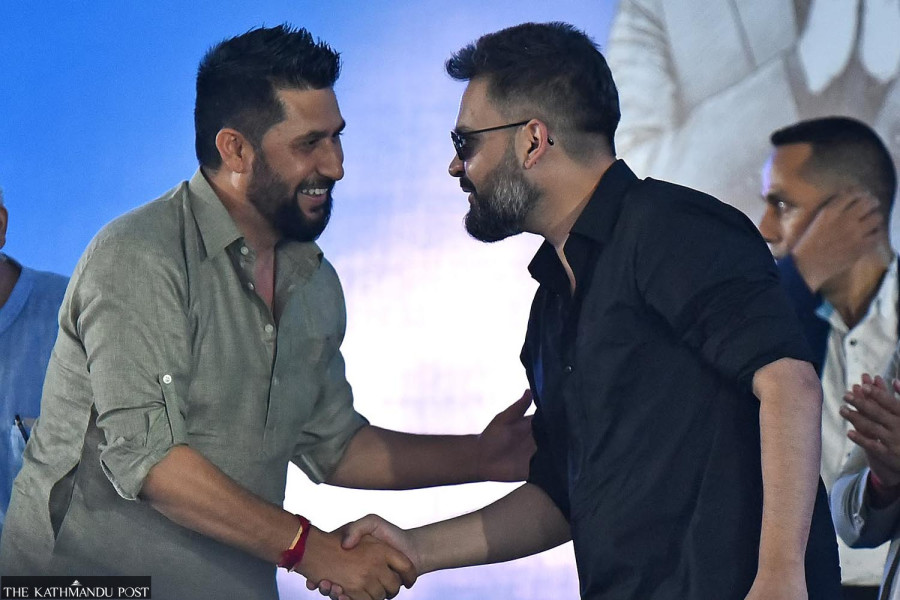
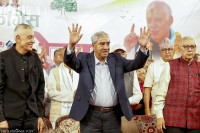
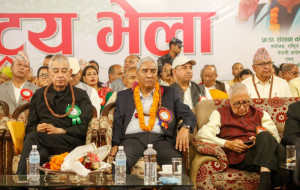
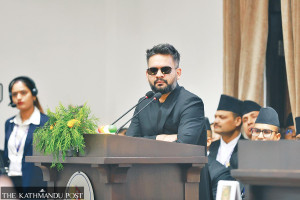
PM and RSP chief dismiss concerns over their relationship, reaffirm the party’s commitment to democracy, and defend the government’s positions on governance and border issues. Rastriya Swatantra Party Chair Rabi Lamichhane shakes hands with senior party leader and Prime Minister Balendra Shah during the opening ceremony of the party’s first general convention in Chitwan on Sunday. Angad Dhakal/TKP
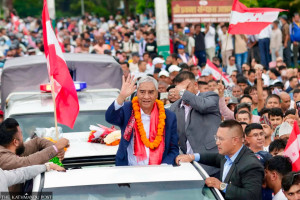
With Prime Minister Balendra Shah behind the wheel and party chair Rabi Lamichhane in the passenger seat, the two turned heads as they arrived at the venue of the Rastriya Swatantra Party’s first general convention in Bharatpur, Chitwan, at around 3:15 pm on Sunday.
As Shah drove in, Lamichhane stepped out from the other side, a sight that immediately captured the crowd’s attention.
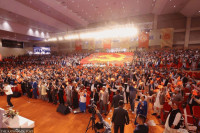
In just four years, the RSP has grown into a formidable political force, teasing a near two-thirds majority. For its debut general convention, the party chose the sweltering heat of Chitwan, a district closely linked to its inception.
Returning to the district where it held its first rally after registration, this time to formulate policies and elect leadership, also brought another striking coincidence. The Guesthouse Chaur in Bharatpur, where the inauguration ceremony took place, sits directly opposite the District Police Office, Chitwan.
It was there, seven years ago, that Lamichhane was detained on charges of abetment to suicide and received overwhelming support from local residents who were ready to vouch for his innocence. As Lamichhane and Shah returned to the site on Sunday, they were greeted by a sudden downpour.
The rain brought relief from the blistering heat, and from the stage general secretary Kabindra Burlakoti described the joint arrival as a good omen.
Lamichhane recalled that he had been in Bhairahawa Jail in similar heat exactly a year ago, while also reminiscing about his time in custody at the nearby police office.
As the two leaders appeared side by side, supporters cheered. Lamichhane and Shah then made their way into the convention venue under an umbrella held by a personal security officer.
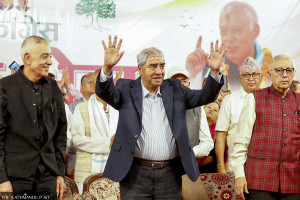
Leaders from other political parties who attended the event to extend their wishes still questioned the RSP’s ideology, governance style and plans for using its popular mandate.
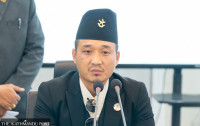
Lamichhane acknowledged those concerns, saying he was fully aware of external attempts to divide, destabilise and create a rift within the party.
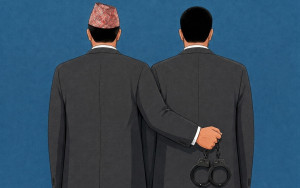
He declared that he and Prime Minister Shah would “honour every single word of their agreement, with the Nepali public and history as their witness”.
“This is not a personal matter; we are answerable to history. Individual whims do not matter,” Lamichhane said.
Prime Minister Balendra Shah smiled as Lamichhane added that the RSP had strategically empowered its senior leader well ahead of the elections to ensure the implementation of that agreement.
Lamichhane further said: “The responsibility of scoring back-to-back goals lies with the Right Honourable Prime Minister Balendra Shah ji, and he has been doing so continuously. Even if the ball accidentally deflects elsewhere, my job is to pass it right back to his feet. I say this because there are plenty of onlookers salivating [at the prospect of division], and just as many trying to create a rift.”
Ideology and sovereignty
During the guest remarks, Rastriya Prajatantra Party chair Rajendra Lingden said that “there are people who voted for Balendra Shah thinking he would restore monarchy”, while UML leader Pradeep Gyawali expressed hope that the RSP would create an environment in which “the public can rest assured that democracy is safe in their hands”.
Responding to such concerns, Lamichhane said critics had not sufficiently studied the RSP’s past documents, and expressed hope that they would do so more carefully in the future.
Asserting that “the country is safe in the RSP’s hands”, he reiterated the party’s commitment to the federal democratic republic.
“I want to declare this before all the top leaders present on this stage. Rest assured, the country is in the RSP’s hands and it is secure,” Lamichhane said.
“Democratic values, the separation of powers, a federal democratic republic, civil rights, guaranteed human rights, an equitable society and inclusiveness are invaluable gifts handed down to us by the previous generations and distinguished leaders like yourselves. We will not fail to preserve them.”
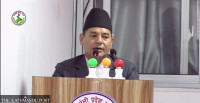
Meanwhile, Prime Minister Shah used the convention stage to address the controversy surrounding his remarks in Parliament on June 31 on border issues.
His earlier comments, in which he said Nepal had already engaged with the UK regarding Kalapani, Lipulekh and Limpiyadhura, had drawn a reaction from India.
“I usually prefer to stay quiet, but the time to speak inevitably comes,” Shah said, clarifying that the border dispute with India must be resolved bilaterally and that Nepal was not seeking external mediation.
“There were concerns regarding the border. Naturally, when we bring up border issues, any country involved will object, and they did. It surprised me. But fine—if you have evidence, bring it forward. We certainly have ours,” the prime minister said. “We have the proof concerning Kalapani and Lipulekh.”
He said his earlier remarks simply meant that if necessary Nepal would produce documentation dating back to British rule in India.
“We are not trying to install the British as mediators. We will talk to our neighbour and sort it out ourselves,” he said. “We have the evidence and we will present it. That is all that was meant; there is no room for suspicion.”
Shah also urged critics not to question his patriotism, adding: “No one needs to harbour doubts about my nationalism.”
Governance , deliberations and the ‘expressway’
Addressing debates over whether the RSP leans left, right or centre, Shah described the party as “development-oriented”.
“We are a party that focuses on development and delivery; we are a party that moves forward,” he said. “We are not here to nurse vendettas or pick fights over past grievances. If we do pick a fight, it will solely be over the misuse of public property and state funds.”
Responding to concerns circulating on social media that the government had pressured the Commission for Investigation of Abuse of Authority to take action against certain individuals, Shah defended the engagement as consultation rather than interference.
The prime minister said that consultation with the CIAA required five hours, but the government was prepared to spend even longer.
“We won’t just do five hours; we will do five years. We will sit down and consult with the CIAA for five years if needed. No one needs to worry about that,” he said, stressing that the government would not bypass rules or laws.
His remarks come amid public scrutiny over the Prime Minister’s Office summoning CIAA officials over an investigation into alleged irregularities in passport procurement, in which passport department staff were swiftly arrested.
Referring to public discourse on social media and in the press, Shah added: “It might look a bit erratic out there, but that’s just perception. Everything is under control. Nothing has gone out of hand. There is absolutely no need to worry.”
Earlier, UML leader Pradeep Gyawali had urged the party to exercise restraint in decision-making, warning that failure to balance the accelerator and the brake could result in an accident.
Shah rejected the analogy, saying such concerns applied only to local roads.
“Our vehicle is travelling on an expressway. The brakes will only be applied once we reach our destination. There is no need to brake before that. Our vehicle is not out of control, and our internal environment is perfectly aligned.”
Likewise, Nepali Congress President Gagan Thapa said established parties had often squandered overwhelming public mandates because of internal rivalries and the misuse of power.
“The mandate received by the RSP is remarkable. I wholeheartedly commend it,” Thapa said.
He said political parties in Nepal had won sweeping mandates in the past but failed to sustain public trust because of ego clashes and personal rivalries among their leaders.
“They understood that the mandate gave them power, but failed to realise that power has its limits,” Thapa said. “It led to an intoxication with power and undemocratic behaviour, eventually causing public support to collapse. I hope the RSP does not have to face either of these situations.”
Internal stability versus external assessment
RSP central committee member Ganesh Karki said the joint appearance by Lamichhane and Shah in Bharatpur had sent a clear message to the public.
“Despite the various commentaries circulating outside, the chairman and the senior leader have made it explicitly clear that we stand together,” Karki told Kantipur. “There is no strain in the relationship, which should reassure everyone.”
Karki said that while past party documents and decisions taken at the Jaleshwar meeting had already clarified the party’s ideological position, lingering scepticism had been effectively addressed in the speeches delivered by the two leaders.
“We have always been clear on our ideology, but through this convention, both leaders have firmly reassured everyone regarding our commitment to democracy,” Karki said.




 26.12°C Kathmandu