Political leaders urge RSP not to squander historic public mandate
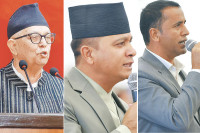
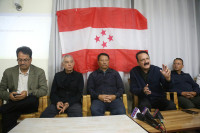
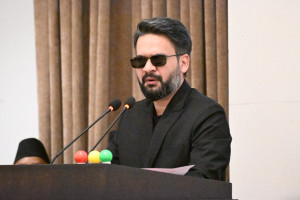
Leaders from across the political spectrum ask the Rastriya Swatantra Party to focus on good governance, constitutional amendments, democracy and the national interest as it holds its first general convention. Speaking at the inaugural session of the party’s first general convention in Chitwan, the leaders said the RSP had been given a historic opportunity to deliver meaningful change and cautioned it against repeating the mistakes of traditional political parties. Post Photo
Leaders from various political parties on Sunday urged the Rastriya Swatantra Party (RSP) to use the public mandate it has received responsibly and work towards good governance, constitutional reform, strengthening democratic institutions and protecting national interests.
Speaking at the inaugural session of the party’s first general convention in Bharatpur, Chitwan, the leaders said the RSP had been given a historic opportunity to deliver meaningful change and cautioned it against repeating the mistakes of traditional political parties.
Nepali Congress president Gagan Thapa said established parties had often squandered overwhelming public mandates because of internal rivalries and the misuse of power.
“The mandate received by the RSP is remarkable. I wish to praise it wholeheartedly,” Thapa said.
He said political parties in Nepal had won sweeping mandates in the past but failed to sustain public trust because of ego clashes and personal rivalries among their leaders.
“They understood that the mandate gave them power, but failed to realise that power has its limits,” Thapa said. “It led to an intoxication of power and undemocratic behaviour, eventually causing the public mandate to collapse. I hope the RSP does not have to face either of these situations.”
Janata Samajbadi Party, Nepal chairman Upendra Yadav stressed the need to amend the Constitution, arguing that it remains incomplete.
“Although federalism, republicanism, inclusivity and secularism are crucial elements of the Constitution, it remains incomplete and imperfect,” Yadav said. “A historic responsibility has arrived to amend and refine the statute by removing its anomalies and shortcomings.”
Janamat Party chairman Chandra Kant (CK) Raut described the RSP’s general convention as “a festival of revolution” and said he had come to Chitwan to share common aspirations.
“This is not just an ordinary convention; it is a festival of revolution,” Raut said. “I share the same dreams that you do. I am here not as a competitor, but as a collaborator and a well-wisher.”
He also urged the party not to lose sight of what he described as the core spirit of the Gen Z movement.
Raut praised Prime Minister Balendra Shah as a leader capable of finding solutions rather than dwelling on problems.
“Our prime minister is a smart, dashing, intelligent and stylish youth,” he said. Referring to a reported restriction once imposed on Bollywood actor Dev Anand from wearing black on screen, Raut joked, “The day may not be far when the opposition introduces a bill banning the prime minister from wearing black in public.”
Rastriya Prajatantra Party chairman Rajendra Lingden said the RSP would betray both the country and its supporters if it failed to live up to public expectations.
“In the past, a limited clique of political parties and their leaders ran a kleptocracy. We argued that change was imperative. The responsibility to translate that desire for change into reality through elections has now fallen on the RSP,” Lingden said.
“The historic opportunity provided by time rarely comes twice in the life of an individual or a political party. If you squander this opportunity, you will betray yourself, your party and the country. Fulfil your responsibilities successfully.”
Lingden also said the RSP had received support from voters who favour the restoration of the monarchy.
Nepali Communist Party leader Barshaman Pun said his party shared the RSP’s commitment to good governance and institutional reform.
“We extend our full support to the campaign to establish systemic order. We stand together on the agenda of good governance,” Pun said. “However, efforts to ensure good governance must remain within legal and constitutional boundaries.”
He said decisions on leadership, ideology, political strategy and direction have far-reaching implications for the country.
“We share several commonalities. Both parties broke political continuity to forge their own paths. We are close on the agenda of social transformation,” Pun said.
He also called on the RSP to demonstrate a stronger commitment to the federal democratic system.
“We do not doubt your intentions, but we expect a greater commitment to a federal democratic system rooted in social justice.”
CPN-UML leader Pradeep Gyawali said political parties and the public were closely watching how the RSP would use the mandate it had received.
“Winning a public mandate is important, but how it is used matters even more,” he said, urging the party to strengthen democracy rather than repeat the mistakes of the past.
Gyawali said the government’s early actions reflected a strong desire to perform but cautioned against undermining democratic institutions.
“A vehicle has both an accelerator and a brake. If the balance between the two is lost, an accident is inevitable,” he said.
“If the judiciary weakens, if the institutions of the presidency and Parliament are undermined, and if criticism is suppressed, there is no guarantee that the public mandate will endure. The RSP must assure the Nepali people that democracy is safe in its hands.”
He also urged the party to remain mindful of Nepal’s geopolitical sensitivities and always place the national interest first.
“A single statement or a wrong decision can create geopolitical pressures that a country like Nepal would find extremely difficult to withstand,” he said.
Former prime minister Baburam Bhattarai described the RSP’s rise as the latest chapter in Nepal’s long history of political transformation.
He urged the party to focus on good governance and development while addressing internal policy ambiguities.
“There is a public debate over whether Rabi is greater or Balen is greater,” Bhattarai said. “You should remain in continuous dialogue and work together in unity over the next five years.”
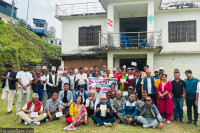
The RSP’s first general convention began at Guesthouse Chour in Bharatpur on Sunday. Party chairman Rabi Lamichhane and Prime Minister and senior leader Balendra Shah jointly inaugurated the convention by ringing a ceremonial bell.




 23.4°C Kathmandu