Congress, UML must reform provincial governance for their own good, expert says
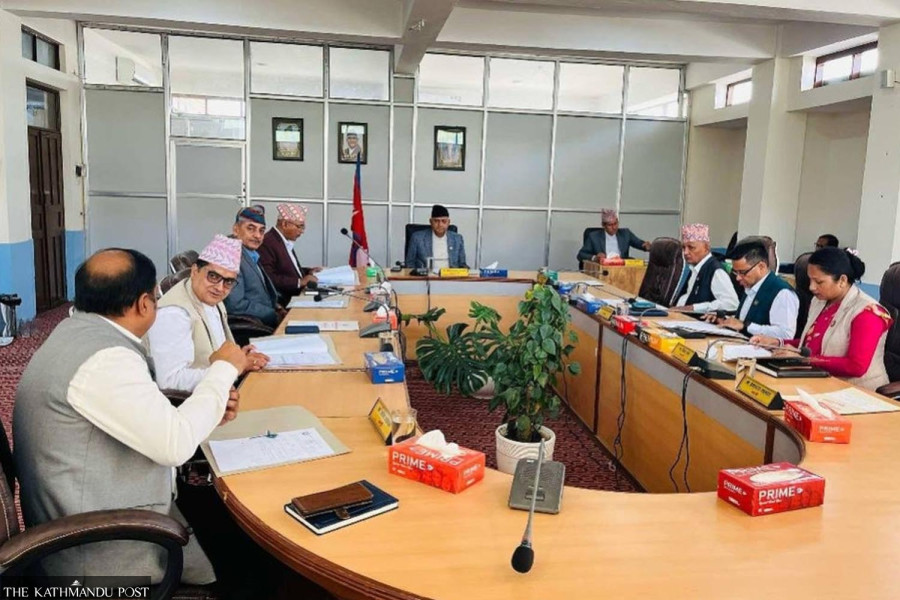
The RSP-led federal government’s reform drive puts pressure on traditional parties to trim provincial cabinets. A meeting of the Lumbini provincial cabinet pictured last year. Post file photo
As Prime Minister Balendra Shah signals a shift by initiating governance reform at the federal level, the general public has begun questioning when provincial governments will step forward in the same direction. Experts in administration, finance and federalism have lauded the steps taken by the federal government, stating that provinces must now adopt similar measures.
Kathmandu has already decided to reduce the number of federal ministries from 21 to 17. Although the constitution allows for a 25-member Cabinet, Shah has limited his current Cabinet to 16 members. The first meeting of the Shah-led Cabinet also introduced a 100-point governance reform roadmap, specifying timelines and responsible implementing agencies.
Since the establishment of federalism, provinces have been governed by the Nepali Congress, the CPN-UML, the CPN (Maoist Centre)—now Nepali Communist Party, and Madhesh-based parties. Currently, the Congress leads four provincial governments, while the UML leads three. However, through their votes in the general elections held on March 5, a majority of the public sent a clear message of dissatisfaction with the existing governance style.
Federalism expert and former National Assembly member Khim Lal Devkota remarked that the new government at the federal level, led by the Rastriya Swatantra Party (RSP), should be able to guide the provinces in governance reform. He argued that provinces must, at the very least, emulate the style of the federal government.
“There are too many ministries and ministers in the provinces. Ministries were distributed like shopfronts in the name of coalitions. This increased public despair and anger towards the provincial structure itself,” he said. “Now is a good opportunity to fix this. Provinces must follow the positive efforts made by the federal government.”
The ‘Good Governance Roadmap’ prepared by the Office of the Prime Minister and Council of Ministers (OPMCM) includes various suggestions to cut administrative costs, including reducing the number of provincial ministries. To curb spending, it suggests limiting provincial ministries to seven.
The Sushila Karki-led government had formed a committee led by OPMCM secretary Govinda Bahadur Karki to study and report on the performance of public bodies on December 29, 2025.
Previous reports have also consistently recommended that provinces should have a maximum of seven ministries, yet these recommendations have never been implemented. Even before the 2017 general elections, the State Affairs and Good Governance Committee of Parliament commissioned a study on the number of ministries. The High-Level Federal Administrative Restructuring Implementation Committee, chaired by administration and legal expert Kashiraj Dahal, had recommended 15 ministries at the federal level and five to seven in the provinces.
Similarly, the Federalism Implementation and Administration Restructuring Study Committee, formed in 2016 under then-chief secretary Somlal Subedi, and the Public Expenditure Review Commission, led by economist Dilli Raj Khanal in 2018, both recommended a ceiling of seven ministries for each province.
In 2022, the Parliamentary Special Committee on Federalism Implementation Study and Monitoring, formed by the National Assembly, also recommended a reduction in the number of ministries and ministers, even suggesting constitutional amendments to achieve this.
Devkota, who served as the coordinator of that committee, stated that they had recommended a constitutional amendment to limit the number of ministers to no more than 10 percent of the provincial assembly’s total membership, with a minimum of five. Currently, the Constitution of Nepal allows the number of provincial ministers to be up to 20 percent of the assembly members.
“The constitution defines the maximum limit; it cannot be exceeded, but it can certainly be lower. Although the constitution allows 25 ministers at the federal level, Shah has formed a smaller cabinet,” Devkota said. “The flexibility provided by the constitution was abused for political gain, coalitions and seat-sharing. Reform is essential in the provinces too.”
Following the first provincial elections in 2017 under the new constitution, provincial governments initially maintained only seven ministries. However, the 2020 split in the then ruling Communist Party of Nepal (CPN) led to shifts in power equations from the federal level to the provinces. As parties formed various coalitions to stay in power, they began splitting ministries to accommodate political partners—a trend that continues today.
In Madhesh Province, the number of ministers reached 20 last year. In Koshi and Bagmati, the number of ministries was pushed to between 12 and 14. Other provinces similarly fragmented ministries to satisfy coalition partners.
As the number of ministries and ministers grew, so did the financial burden on the state. Currently, Koshi has 12 ministers and 10 ministries, including the Chief Minister’s Office. Madhesh has 10 ministers. Bagmati has 14, Gandaki 8, Lumbini 12, Karnali 8, and Sudurpashchim has a 9-member cabinet.
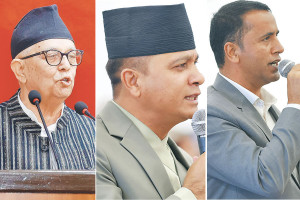
Administration reform expert Kashiraj Dahal noted that the Congress and the UML, which lead the provinces, must improve administrative structures, service delivery and good governance to win back public trust.
“The federal government has made a good start. Provincial governments must be supportive. Public distaste grew because provinces went on creating new ministries,” he said. “To revive public faith and foster a positive outlook, provinces must reform themselves without delay. Administrative structures and budget management must be streamlined to justify the relevance of the provincial tier.”
Dahal argues that provincial ministries should be limited to between five and seven. He believes provinces must make prudent decisions based on national revenue, debt and expenditure status, adding that the federal government can also request or suggest that provinces downsize.
The Congress leads the provincial governments in Madhesh, Bagmati and Sudurpaschim, while the UML leads in Koshi, Karnali and Lumbini. In all provinces except Madhesh, a Congress-UML coalition is in power. In Madhesh, the Congress-led government includes the Nepal Communist Party and Madhesh-based parties. Notably, the election manifesto released by the Congress in February stated that there should only be six ministries in a province.
Economist Khanal stressed that administrative structures at the federal, provincial and local levels must be streamlined to reduce public spending. Noting that the new central government has taken positive steps, he said provinces must help cut unproductive expenses.
“Provincial governments should be proactive and act in the spirit of the steps taken by the centre,” Khanal said. “The federal government can also sit with provincial governments to argue the case for administrative reform.”
Khanal believes that the Congress and the UML are forced to adopt a new approach. “The path they walked in the past is no longer viable; the public has rejected it,” he said.
A course correction must start with a reduction in the number of ministries, Khanal said. Unless the traditional parties end the culture of retaining power at any cost, the next provincial elections will punish them further, he argued.




 20.85°C Kathmandu