Even after a bruising electoral defeat and mounting public frustration, Nepal’s traditional political parties show little sign of change.
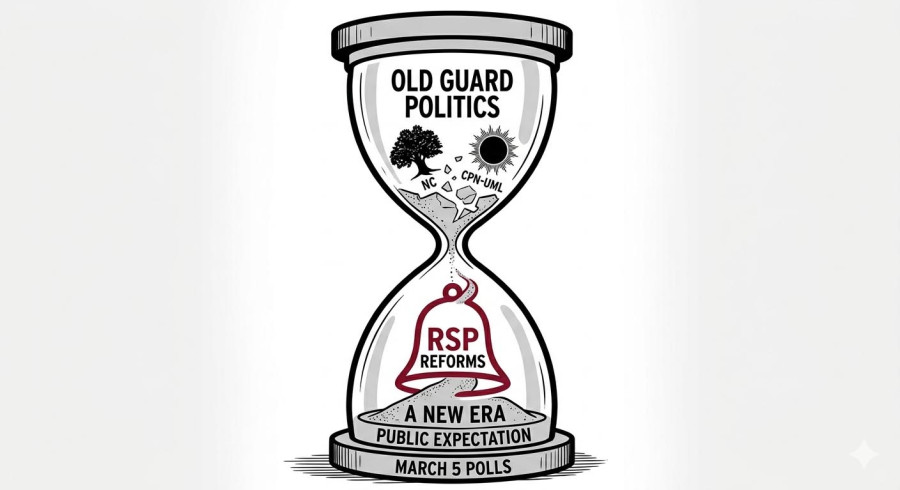
As a new government led by Balendra Shah begins to push ambitious reform agendas, leaders of the Nepali Congress and the CPN-UML—the old guards—remain entangled in factional disputes and leader-centric politics, raising questions about whether they have learned anything even after they were routed in the March 5 polls.
The Congress, which remains divided following the special convention that elected Gagan Thapa as party president, has lately been increasingly preoccupied with factional activities.
On Saturday, the Shah administration detained KP Sharma Oli, chair of the CPN-UML, along with Congress leader Ramesh Lekhak, accusing them of playing a role in suppressing the September Gen-Z movement. Rather than trusting in the judiciary and following due legal course, the UML rank and file has taken to the streets in protest.
For political analysts, despite suffering a major electoral defeat in recent elections, the traditional parties still appear more absorbed in their old patterns of behaviour than in efforts to rebuild their credibility.
Krishna Khanal, a professor of political science, argues that the old political parties need not just reform but also a deeper reorientation. In his view, the context in which these parties were founded and grew has changed significantly, but they have failed to internalise it.
Time waits for none, Khanal told the Post. “If they fail to recognise the need to adapt and reinvent themselves, their existence could come under threat.”
The downfall of all three political parties—the Congress, the UML, and the Nepali Communist Party (NCP)—in the election was their failure to demonstrate a distinct political character while in power.
People punished these parties for their repeated failures in service delivery, lack of people-centric work, and inability to curb corruption over the last few decades while they were in power.
“However, parties remain reluctant to acknowledge their earlier missteps and reinvigorate themselves for the upcoming election,” said Gururaj Ghimire, the Congress general secretary.
“If these political parties aim to maintain the status quo without revamping themselves, they would still face setbacks in the upcoming local and provincial elections.”
He acknowledges that his party is no different while also claiming that they are working to transform it for the party's better future.
When the latest election elevated the Rastriya Swatantra Party (RSP), the fourth-largest party in the previous parliament, to a position where it commands a near two-thirds majority, the Congress and the UML, the first- and second-largest parties in the previous parliament, had shrunk to distant second and third positions.
Experts say that instead of rebuilding their strength for the local elections next year and the provincial election shortly after that, the parties are still stuck in the same old political habits that voters rejected in recent elections.
The traditional political parties still look confused about what their politics should be, says political analyst Chandra Dev Bhatta. He said that if they hesitate for internal reforms and reaffirm their traditional approaches, they could face another serious fiasco in the elections next year.
“The internal feud and the leadership-centric politics in which the traditional parties, especially the Congress and the UML, are currently busy, won’t earn them public trust,” Bhatta said.
“The grassroots base of their organisation, which was a source of their strength, did not work in the March 5 election. The only alternative they have is to rebuild the party, regaining the trust of the people.”
While the traditional parties continue with their myopic views, Shah has already moved ahead with implementing its pledges, aiming to gain ground. The 100-point action plan made public on March 28 not only implements its own commitments but also incorporates worthwhile proposals from other parties' election manifestos.
The results of the 2022 local and parliamentary elections were a warning sign for the traditional parties, with Shah winning the Kathmandu mayor position and the RSP emerging as the fourth-largest party in the House of Representatives.
“We tried to dismiss it as a populist vote, which was a mistake,” said Bishnu Rijal, a central committee member of the UML. Rijal acknowledges that even around a month after the March 5 electoral setback, they have not yet started internal reforms. Even as second- and third-rung leaders in Rijal’s party have realised that the current leadership is not suited to lead in the present context, the top leadership fails to see this. As a result, lower-rung leaders are worried about their performance in the next elections.
So do the Congress leaders.
The RSP currently has no representation in either local or provincial governments. In the 2022 local elections, the current prime minister, Shah, ran for the mayor of the Kathmandu Metropolitan City as an independent. Shah won and held the position until he joined RSP on December 28 last year, in order to contest the Jhapa-5 parliamentary seat.
The party itself was formally established shortly before the House of Representatives and provincial assembly elections in 2022. However, it did not contest the provincial election. As a result, the RSP has no presence in provincial assemblies. However, the case would be different this time. As the terms of the local level representatives and the provincial assembly members expire in a year, the Election Commission is already preparing to hold the polls next year.
Analysts warn that unless the older political parties reform themselves and respond to public expectations, rather than continuing with their traditional ways, they risk repeating the electoral setbacks they suffered in the recent parliamentary elections in future polls.
“Despite the electoral upheaval and the challenge posed by the comparatively new political party, the traditional political parties have paid little heed to revamping themselves,” says left-leaning political analyst Jhalak Subedi.




 18.3°C Kathmandu