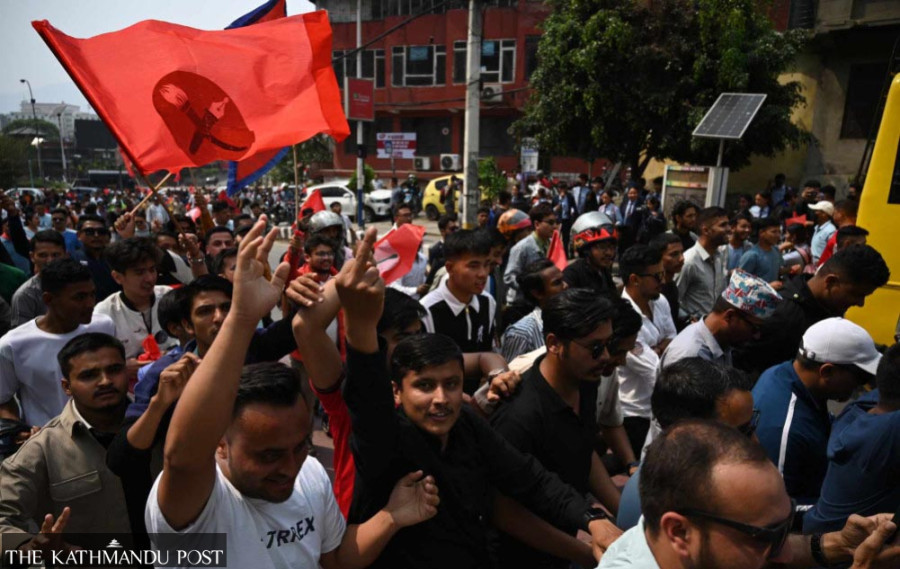
Student leaders have voiced strong objections after the government unveiled a plan on March 28 to remove party-affiliated student organisations from schools and universities.
The government’s 100-point work plan was approved by the Cabinet on Friday, shortly after Rastriya Swatantra Party senior leader Balendra Shah assumed office as prime minister, and released on Saturday.
Under the plan, all structures of political student organisations in educational institutions are to be dismantled within 60 days. The government argues that the move is necessary to address declining academic standards, excessive political interference in education, and the failure of existing student groups to represent students’ concerns.
The action plan further states that after removing party-affiliated structures, the government intends to introduce an alternative system—such as a “Student Council” or “Voice of Students”—within 90 days.
However, student organisations across the political spectrum have decried the proposal, describing it as both impractical and constitutionally questionable.
At present, universities in Nepal elect representatives through the Free Students’ Union (FSU), a system in which student wings affiliated with political parties, as well as independent groups, compete in elections. Student leaders argue that dismantling such structures would undermine the democratic space within college campuses and goes against the constitution.
They have also pointed to Article 17 of the Constitution of Nepal, which guarantees the freedom to form organisations and engage in political activities. According to them, the government’s plan runs contrary to these constitutional protections. Article 17 of the constitution preserves the right to freedom under its section (D), which includes freedom to form unions and associations.
Deepak Dhami, president of the All Nepal National Free Students’ Union, the student wing of the CPN-UML, described the government plan as “authoritarian”. He argued that dismantling student bodies while the current FSU tenure is still valid would be unlawful.
“The government is trying to strip away rights guaranteed by the constitution. If necessary, we will take to the streets,” Dhami warned. He also said a meeting of various student unions called for Tuesday will decide the next course of action.
“The student movement has a long legacy in Nepali politics and has played a big role in safeguarding democracy,” Dhami said. “The government’s decision thus appears immature and ill-considered.”
Cross-party student leaders claim the move was drafted without even considering constitutional safeguards.
However, constitutional expert Chandrakanta Gyawali interprets the constitutional provision differently.
Gyawali argues that while Article 17 of the constitution guarantees the freedom to form unions and associations, it does not specifically mention political unions or associations.
“The government has not banned organisations from the universities altogether; it has only moved to dissolve those linked to political parties, which does not violate the constitution,” Gyawali told the Post.
Meanwhile, Bijay Sapkota, a leader of a student organisation close to the Nepali Communist Party, acknowledges that there are aberrations within student unions.
“We must accept that student organisations have not been functioning ideally in recent times,” Sapkota said. “There are problems within the organisations, and they need reform. However, the government’s decision to shut down student organisations altogether just because they are affiliated with political parties is not appropriate.”
According to student leaders, the government’s proposal amounts to an attack on the constitutional right to organise, raising serious concerns about whether the administration is attempting reform or trying to silence organised political voices on college campuses.
But the government’s decision has not only drawn criticism, it has also been welcomed by a sizeable section of the public.
For years, student organisations have faced accusations of politicising education under the pretext of student politics. Critics argue that instead of representing students’ academic concerns, many of these groups have turned campuses into playgrounds of party politics.
Educationist Bidyanath Koirala said that the government’s intent may be good but the process is flawed.
Banning political organisations in universities could keep students from developing political awareness. He argues student unions serve as training grounds for future leaders and that proposed student councils cannot replace this role. While admitting excessive party politicisation in universities was problematic, Koirala says it should have been regulated through legal processes.
“It can be regulated by measures like creating a centre for theoretical debate, separating student unions from political parties, and establishing a student parliament that teaches how to identify issues and raise them effectively,” Koirala said. “These bodies can also be entrusted with ensuring financial support for students and helping them find jobs.”
There are also longstanding allegations that internal factionalism within student organisations mirrors the divisions inside political parties. Student leaders are often seen aligning with particular politicians and forming rival factions even within the same student organisation.
Such factional struggles, critics say, often translate into unnecessary pressure on educational institutions, as competing groups try to assert their influence or secure advantages rather than prioritising student welfare or academic standards.
Former Education Minister Bidya Bhattarai, who is also a leader of UML, says there have long been debates over party interference in universities, with student unions often seen as its primary vehicle. Bhattarai also claims that there had been discussions on how such activities could be brought within the legal framework.
“Student organisations did need regulations, but the decision to dissolve them all at once does not seem appropriate,” Bhattarai told the Post.
Dhami also acknowledges problems within the student movement. However, he argues that while some student organisations—or even certain student leaders—may have made mistakes, dissolving all student organisations on the basis of the political affiliations of a few individuals is unjust.
“Imposing an outright ban is not the right decision to go about it,” Dhami said.
Student leaders like Sapkota also argue that the decision is contradictory. While schools and colleges increasingly host international-style student councils under different names, it is unreasonable to impose restrictions specifically on organisations linked to domestic political parties, he says.
Arguing that the present cannot be understood without understanding history, student leaders say the role played by the student movement in opposing Nepal’s partyless Panchayat system in 1980 should not be underestimated.
They argue that continued protests by college students and others culminated in the People’s Movement of 1990, which led to the restoration of multiparty democracy in Nepal.




 15.88°C Kathmandu