How did Nepali and Bhutanese communities get involved in a Medicaid scandal in the US?
A conservative American outlet says Bhutanese and Nepali immigrants are behind a billion-dollar Medicaid fraud scheme in Ohio. Here is what is real, what is disputed, and what it means for the diaspora. Courtesy of Roshan Adhikari's Facebook page
If you have been on Nepali social media recently, you may have seen images of a young man on a private jet, captioning his posts “Welcome Aboard AIR ROSHAN.” He poses alongside Range Rovers and Corvette, sipping champagne, and marvelling that a kid born in Nepal had made it to the skies. The posts are aspirational, even celebratory, the kind of content that travels fast across communities in Nepal and the diaspora.
Now they are evidence in a political firestorm in the United States of America.
Roshan Adhikari, the man seen in the Instagram posts, is the chief operating officer of a Cleveland home health company that bills the United States government’s Medicaid program. Now a conservative American media outlet has made the 29-year-old Bhutanese the public face of a billion-dollar fraud network, one it alleges runs deep inside Bhutanese-Nepali and Somali communities in Ohio, exploiting a programme designed to care for America's most vulnerable citizens.
The story has gained steam this week, especially after the House task force held its first hearing on Ohio’s Medicaid waiver programme on Wednesday. There appears to be genuine fraud in Ohio’s Medicaid home health programme, and some of it involves members of the Bhutanese-Nepali community. The story has enabled a political backlash in mainstream American politics, adding broader pressure to the refugee and immigrant communities across America at a challenging moment in recent US immigration history.
Here is what you need to know.
What is Medicaid?
Medicaid is the American government’s health insurance programme for low-income people. It is funded jointly by the federal government and individual US states. Unlike private health insurance, it is free or very cheap for those who qualify.
Among the services Medicaid covers is something called the Home and Community-Based Services (HCBS) waiver programme, the programme at the centre of this scandal. This programme pays people to provide personal care to Medicaid-enrolled beneficiaries in their homes: cooking, cleaning, helping with daily tasks, companionship. The idea is to help elderly or disabled people stay at home rather than go to nursing facilities. Family members can register as paid caregivers for their own relatives under this programme. That design feature is central to the alleged fraud.
How did Bhutanese and Nepali communities end up in Ohio?
In the late 1980s, the Bhutanese government, driven by ethnic nationalism, forcibly expelled tens of thousands of ethnic Nepali-speaking people, known as Lhotshampas, from Bhutan. These families spent years, many for over a decade, in UNHCR refugee camps in eastern Nepal, in places like Jhapa and Morang.
In 2007, the United States agreed to resettle roughly 100,000 Bhutanese refugees. Ohio, and Columbus in particular, became one of the largest resettlement destinations in the country. Cities like Columbus, Cleveland, and Akron today have substantial Bhutanese-Nepali communities, which are often elderly, don’t speak English fluently, live in multigenerational households, and are enrolled in government assistance programmes including Medicaid.
So what exactly is being alleged?
The Daily Wire’s reporter, Luke Rosiak, analysed publicly available Medicaid payment data and found two distinct patterns of alleged fraud in Ohio.
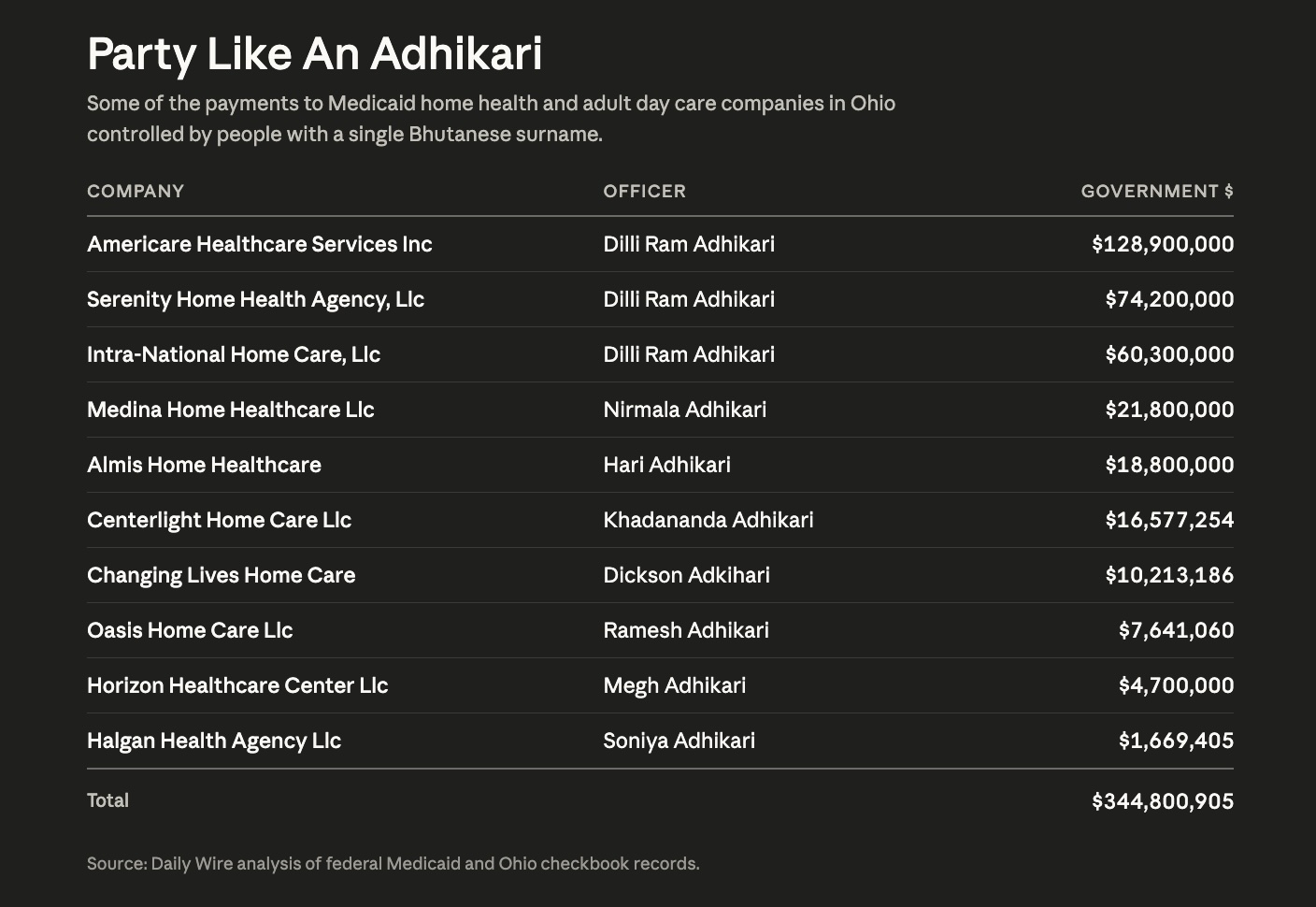
The first one is the shell company scheme. Rosiak documented 288 home health companies in Columbus that shared the same addresses, many of them clustered in seven mostly empty office buildings along State Route 161. He visited these buildings and found vacant offices with months-old mail piling up, no staff, signs saying “out to lunch.” These same companies collectively billed the US government more than $250 million in Medicaid funds between 2018 and 2024. He says many of these companies were founded and operated by immigrants, including members of the Bhutanese-Nepali community.
The second one is the family caregiver scheme. Rosiak alleges that families, particularly in Bhutanese and Somali communities, have been enrolling as paid Medicaid home health providers for relatives who don’t actually need care, collecting government money for services never rendered, and in some cases kickbacking payments to the clinicians who approved the paperwork.
Has there been any independent verification of these claims?
The Medicaid billing data cited and used by Rosiak is publicly available. His core finding, that hundreds of companies shared addresses in buildings that appear vacant, is based on data that can be checked. He also physically visited the office buildings and documented what he found, which is harder to simply dismiss.
However, the full claims have not yet been independently verified by mainstream news organisations. Ohio’s own public radio network, the Statehouse News Bureau, noted plainly that the reports “have yet to be fully detailed and verified.” No mass prosecutions or indictments specifically tied to the Bhutanese-Nepali network have been announced. As of this moment, the $1.2 billion figure is an estimate of potential fraud, not a confirmed official finding.
The Ohio state government, including Governor Mike DeWine, has responded with new emergency rules and investigations, which suggests the underlying problem is real. But the precise scale, and who exactly is culpable, remains to be established in court.
Who is Luke Rosiak, the reporter who broke this story?
Rosiak is an investigative reporter who works for the Daily Wire, which is a conservative media outlet co-founded by commentator Ben Shapiro. Rosiak has called his finding an “ethnic scam.” He has described Medicaid recipients in these communities as people who “aren't that sick” gaming a programme “intended for Americans who are very seriously ill,” language that paints the immigrant community as nefarious, which has been a far-right conservative playbook for years.
In 2016, Rosiak wrote extensively about a Pakistani-American IT staffer named Imran Awan, alleging a vast conspiracy. Those stories were later widely debunked. Awan sued Rosiak and his then-employer, the Daily Caller, for defamation. The case was settled after a judge refused to dismiss it.
Why is this story getting so much political attention in America right now?
This is the first year of Donald Trump’s second term as US president. His administration has made immigration restrictions and Medicaid fraud central political themes. The Daily Wire story emerged alongside similar fraud allegations involving Somali communities in Minnesota, and has been amplified by politicians who are simultaneously pushing to cut Medicaid spending nationwide.
Brandon Gill, a representative of Congress from Texas, who is leading the congressional investigation, has explicitly framed this as a story about immigration policy failures. Vice President JD Vance has called for a federal investigation. Republican senators have held press conferences. The story has been used, in other words, not just as an anti-fraud argument but as an anti-immigration and anti-refugee argument.
We imported large numbers of Somalis and Bhutanese. Now they’re defrauding our Medicaid system.
— Congressman Brandon Gill (@RepBrandonGill) June 3, 2026
This does not mean the fraud allegations are false. But it does mean the story is being used for political purposes that go well beyond law enforcement. And in that process, the Bhutanese and Nepali communities are being cast as villains in a domestic US political drama at a particularly vulnerable moment for refugees and immigrants in America.
What happened in the U.S. Congress this week?
On June 3, 2026, a House task force held its first hearing on Ohio’s Medicaid waiver programme, titled “Universal Basic Fraud: Vulnerabilities in Medicaid Waiver Programs.” Rosiak testified before lawmakers. The hearing got heated at times. Shontel Brown, a Democrat who represents a Cleveland district with a large Bhutanese-Nepali community, interrupted the proceedings and claimed that Rosiak’s findings were “ridiculous.” Another Democrat questioned whether the hearing would be fair.
The partisan nature of the response is not surprising. Republicans have embraced the story and are driving the investigation while Democrats are pushing back, though largely on process and framing rather than on the existence of fraud itself.
What does this mean for the Bhutanese community?
The allegations involve a subset of operators and businesses, not the community as a whole. The overwhelming majority of Bhutanese-Nepali people in Ohio arrived as refugees after years of hardship, rebuilt their lives with enormous difficulty, and have no connection to any fraud scheme.
Community advocates and Democratic lawmakers have argued that Rosiak’s framing– the “ethnic scam” language, the heavy emphasis on the Bhutanese and Somali identity of the alleged perpetrators– does real damage to innocent people. At a moment when the US government is already making refugee resettlement harder and scrutinising immigrant communities more aggressively, this story can have consequences that go far beyond any individual bad actor.
The scale of the fraud and who exactly is responsible will ultimately be determined by prosecutors. That process is only beginning.
What are accused Roshan Adhikari’s ties to Nepal?
Adhikari's connection to Nepal goes well beyond occasional visits. He has shown a consistent interest in the Nepali music and film industry. In 2019, he recorded a song with popular singer Anju Panta — Jhalko Parda Banda Garnu Hai — and appeared alongside actress Priyanka Karki in the music video. In 2021, he collaborated with Samikshya Adhikari on another track, Dhara Nakholi, featuring actresses Aanchal Sharma and Pooja Sharma in the video.
Most recently, in late 2025, a song he both sang and appeared in — Peheli Nazar Ki Rani — was released on YouTube. The music video, featuring actress Garima Sharma, was shot in the United States. Around the same time, Adhikari appeared on YouTuber Utsav Rasaili’s popular show Ramailo Chha, where he said he had spent 8 million rupees producing that music video.
An artist who knows Adhikari personally, and spoke on condition of anonymity, put it this way: “He was an investor who could spend more than anyone else. That’s why he has connections with so many people in the film industry.”
In that interview, he had claimed that he started a business in Ohio when he was 18 years old and has provided employment to many Nepalis. He stated that he moved to the United States with his family at the age of 13 from a refugee camp in Jhapa. According to him, he did not know English when he arrived there, but gradually learned the language and developed an interest in business, which led him into that field.
He said, "Even while I was in school, my attention was drawn toward real estate agents and the stock market." He also stated that he has invested more than Rs 150 million in Nepali music and entertainment, purchased a private jet for his company, and has been using it for personal travel as well.




 15.67°C Kathmandu