Bhotekoshi flood displaced 777 students. Nepal plans five-year school recovery
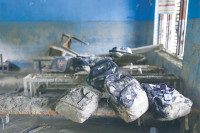
Of the 57 educational institutions assessed in Rasuwa, Nuwakot, and Dhading districts, 28 were damaged and 15 were completely destroyed.Mud-caked school bags and overturned furniture in a classroom at Bageshwari Secondary School in Galchhi Rural Municipality, Dhading, in the aftermath of the August 26 Bhotekoshi-Trishuli floods. Nepal Photo Library
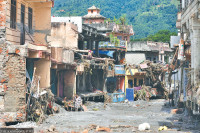
The August 26 Bhotekoshi flood displaced 777 students from their schools and disrupted classes across parts of Rasuwa, Nuwakot and Dhading districts, according to figures compiled by the Ministry of Education and Sports.
The government has arranged for displaced children to enrol in nearby schools or continue learning at temporary learning centres, including in the Kathmandu Valley. Fifty-six such centres have been established, the ministry said, as authorities work to identify affected students and ensure their education continues.
A report prepared by the National Planning Commission has estimated flood damage to the education sector at Rs4.61 billion and outlined a five-year recovery strategy requiring more than Rs3 billion. The plan focuses on repairing and rebuilding school infrastructure, restoring teaching and learning, and making schools resilient to future disasters.
Shree Prasad Bhattarai, the ministry’s spokesperson, said officials were compiling damage assessments and preparing a framework for reconstruction.
A preliminary damage assessment report prepared by the ministry, the National Planning Commission and partner organisations, found that the destruction of school infrastructure and disruption to classes had dealt a serious blow to education in the affected areas.
Of the 57 educational institutions assessed, 28 sustained physical damage, including 15 that were completely destroyed. The floods also displaced 118 teachers and directly affected the education of 5,486 children. A total of 277 classrooms were damaged, the report said.
Some 5,500 students from 42 schools and 300 teachers were identified as needing psychosocial counselling after experiencing distress related to the disaster. The government and partner organisations have been providing emergency relief, operating temporary learning centres, and offering psychosocial support.
The assessment also points out gaps in disaster preparedness. Only 10 of the 57 educational institutions had disaster risk reduction plans. Twenty-eight are located within 500 metres of a river, which leaves them vulnerable to erosion and landslides and increasing the risk of damage.
The five-year recovery strategy prioritises inclusive education, sustainable development, and safer schools. The short-term plan, covering the first year, focuses on restoring disrupted services, including temporary classrooms, drinking water and sanitation facilities, and access roads to schools. It also calls for replacing destroyed textbooks, furniture, and learning materials and helping displaced students continue education.
The report says authorities will identify displaced children and bring them back into the education system as quickly as possible. A monitoring mechanism is planned to track students who have moved between municipalities and coordinate between their original schools and the institutions where they are currently enrolled.
Around 250 displaced students are staying in holding centres in Kathmandu.
The medium-term plan aims to rebuild schools over three years to make them disaster-resilient, disability-friendly, environmentally sustainable and climate-adaptive. Over five years, the government plans to relocate or rebuild schools in high-risk areas at safer sites.
Children with disabilities, displaced students and those from economically disadvantaged families will be prioritised throughout the recovery process. Of the 63 children with disabilities in the flood-affected areas, 28 were directly affected, the report said.
SOS to support 250 children
Separately, the National Child Rights Council and SOS Children’s Villages Nepal have signed a five-year agreement to provide protection, care, and other assistance to children affected by the Bhotekoshi floods.
The agreement, signed under the Ministry of Women, Children and Senior Citizens, covers immediate and long-term protection, quality care and support for affected families.
Under the arrangement, SOS Children’s Villages Nepal will include 50 children who have lost parents or whose parents remain missing in its family-based care programme. Another 100 children will receive support through kinship care, while 100 more will receive direct assistance.
The programme will also provide livelihood support to 400 affected families to help improve their social and economic conditions.
SOS Children’s Villages Nepal will work with the council to strengthen alternative care, temporary protection, medical treatment, psychosocial support, family reunification and rehabilitation, as well as family assistance and social protection services.
The 50 children considered for family-based care will undergo individual assessments. Decisions will follow established referral procedures and be guided by the best interests of each child, the council said.
The council has reported that more than 269 children lost one or both parents in the disaster.




 18.53°C Kathmandu