Incessant rains trigger widespread flooding in Tarai, disrupt key highway links across Nepal
Swollen Narayani and Saptakoshi rivers submerge hundreds of homes in Nawalparasi West and Saptari, forcing rescues. Landslides and road erosion cut off vital routes, including Prithvi and BP highways. A policeman rescues a woman following flooding in Nawalparasi’s Susta Rural Municipality. As many as 172 families were relocated on Friday and Saturday after the Narayani river entered settlements. Photo: Courtesy of APF
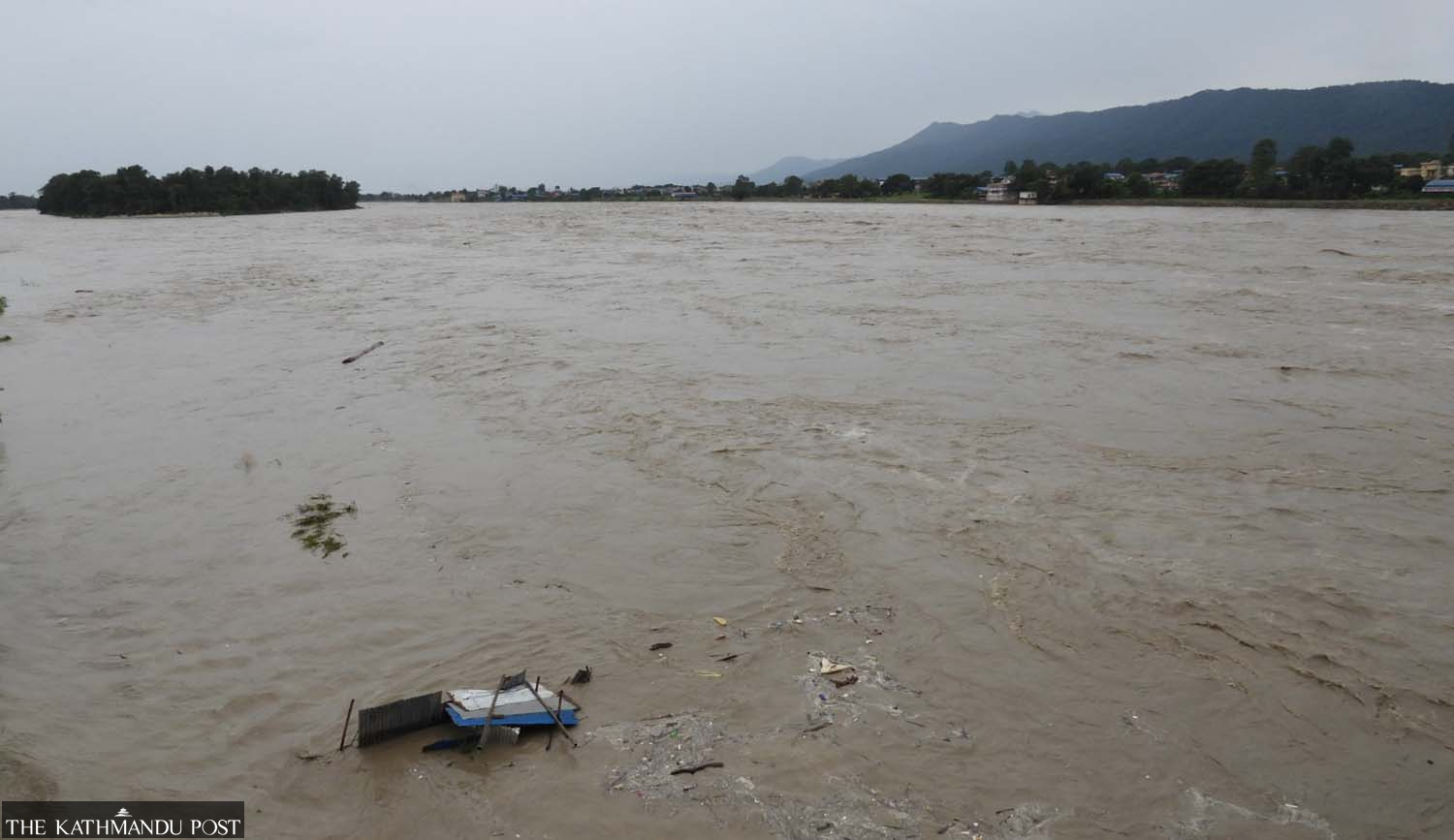
Heavy rains since Wednesday have triggered floods and landslides in various parts of Nepal, disrupted major highways, and raised water level in rivers and rivulets to alarming levels, inundating several settlements in the Tarai. Flooding from the Narayani and Saptakoshi rivers has inundated 389 houses in Nawalparasi West and Saptari districts, forcing hundreds of families to move to safer locations.
In Nawalparasi’s Susta Rural Municipality, 172 families were relocated on Friday and Saturday after the Narayani river entered settlements, security officials said. In Saptari, 200 families from Hanumannagar Kankalini Municipality and 17 families from Tilathi Koiladi Rural Municipality have been moved to safety.
In Susta ward 5, as many as 271 houses and animal sheds have been inundated, with water reaching up to three feet inside some homes, according to local residents. The Armed Police Force’s border security barracks in the settlement were also inundated on Saturday evening, forcing personnel stationed there to look for safer ground.
“We had been involved in rescuing villagers affected by the flooding in Susta yesterday and today [Saturday],” said Armed Police Inspector Manoj Karki. “Now we are ourselves surrounded by floodwater and are trying to cross the Narayani to reach the other side. The problem is how to cross the river safely.”
The 172 displaced families have been moved to three holding centres on higher ground within the settlement. Teams from the Nepali Army, Nepal Police and Armed Police Force have been involved in rescue operations for two days, prioritising children, older people and families living in vulnerable huts.
Many residents, however, have been reluctant to leave the settlement because they do not want to abandon their livestock and stored food. “The settlement is flooded and it is no longer possible to stay inside the houses,” said Mansi Kumar, a local resident. “But most people do not want to cross the Narayani because they are worried about their livestock and food.”
Susta is home to around 310 families. The settlement is bordered by Narayani to the north and west, and India to the south, leaving residents unable to leave the area without crossing the river. Floodwater has also submerged the unpaved road leading to the suspension bridge. “The only way to reach the suspension bridge now is by boat,” said local resident Rabindra Jaiswal.
A view of the swollen Narayani river in Narayanghat following relentless rainfall. Ramesh Kumar Paudel/TKP
Chief District Officer Dipak Raj Nepal of Nawalparasi West said residents were being moved because the river’s level was still rising. Security personnel from the Nepal Police and Armed Police Force have been deployed for rescue operations.
Susta has faced recurring erosion and flooding for years. Rural municipality chair Tek Narayan Upadhyay said repeated calls for a permanent solution had gone unheeded. “Susta is hit by every flood,” he said. “We have repeatedly appealed to successive governments for a permanent solution, but nobody pays attention.” Upadhyay estimated that at least Rs5 billion would be needed to construct embankments to protect Susta.
In Saptari, flooding from the Saptakoshi has inundated 217 homes—17 in ward 4 and 5 of Tilathi Koiladi and 200 in Hanumannagar Kankalini Municipality.
Floodwater entered homes suddenly, damaging stored food, local residents said. Senior citizens and children have been moved to the western embankment of the Koshi. The Armed Police Force’s border outpost at Bodebarsain was also inundated.
In Hanumannagar Kankalini-12, 80 houses have been flooded, while 60 families in wards 5 and 7 and 60 houses in Gobargadha in ward 13 have also been affected, according to Saptari police chief Rupak Khadka. Displaced families have been sheltered under tarpaulins on the western Koshi embankment, with the municipality providing food.
“We have arranged meals until the flood recedes enough for them to return home,” said Birendra Majhi, mayor of Hanumannagar Kankalini. Tilathi Koiladi has been distributing beaten rice and other instant foods to displaced families. Disaster management officer Rajesh Jha said all families at risk had been moved to the embankment.
Landslides, floods disrupt major highways
The incessant rains have also disrupted traffic along several highways with landslides, flooding and road subsidence forcing closures and leaving hundreds of people stranded.
The Prithvi Highway, the country’s main road link between Kathmandu and the rest of the country, remains particularly vulnerable at Krishnabhir, where traffic has been restricted after another landslide. The section had reopened 18 days after the Trishuli river eroded the road from below on August 30.
According to the Department of Roads, landslides have also repeatedly blocked the Krishnabhir, Chaukibhir, Jawangkhola and Fishling sections of the highway. Sajana Adhikari, chief of the Nagdhunga-Muglin Road Project’s western section, said vehicles stranded at Krishnabhir were allowed to move on Saturday after debris was cleared temporarily.
“Sludge and soil are still flowing from above the newly opened track, and the risk of another landslide remains,” said Adhikari. “Vehicles stranded on the highway were allowed to proceed after the rain stopped for some time. The highway has not been fully reopened.”
The Dharapani section of the Malekhu-Mugling road has also subsided at two locations, each about 20 metres long, within a 70-metre stretch. Traffic is being operated in a single lane. “The Trishuli is eroding the road from below, and with rain continuing, we cannot immediately rebuild it,” Adhikari said.
The BP Highway, another key route connecting Kathmandu with the eastern Tarai, has been closed since Friday. Temporary diversions built across the Roshi river were washed away at several locations, including Mamti, Piple, Daunne-Kalopul, Charsayabesi, Katunje and Chaukidanda.
Suman Yogesh, chief of the Bhaktapur Road Division, said crews were clearing landslides and would try to reopen the road if rainfall eased. “The temporary diversions at three locations along the Piple-Barkhekhola section have been washed away,” he said. “We are working to reopen the road by Sunday evening if the rain stops.”
The Japan International Cooperation Agency is building the 3.2-km Piple-Barkhekhola section under a Rs2.6 billion grant, with completion scheduled for mid-December, 2027.
The Kanti Highway has also been repeatedly disrupted, while landslides have affected sections of the Pushpalal Mid-Hill Highway, Kaligandaki Corridor, Karnali Highway, Rapti Highway, Siddhartha Highway and Tamor Corridor.
Shuvaraj Neupane, deputy director general and spokesperson for the Department of Roads, said the deployed employees could reopen blocked routes quickly once rainfall subsided. “New landslides keep occurring as rain continues,” he said. “Opening roads while the rain persists carries a risk of further landslides.”
(Bimal Khatiwada in Kathmandu, Narayan Sharma and Nabin Paudel in Nawalparasi, and RN Bishwas in Saptari contributed to this report.)




 18.53°C Kathmandu