International media highlight Shah’s climate message, regional proposal—and shades
Coverage of the prime minister’s UN address has centred on Nepal’s floods, climate justice and a proposed Himalayan climate resilience mechanism. AFP/RSS
Prime Minister Balendra Shah’s address to the 81st United Nations General Assembly, in which he highlighted Nepal’s devastating floods, climate change and the need for climate justice, has drawn attention from international media, with outlets taking markedly different approaches to his first major appearance on the global stage.
Most international coverage linked Nepal’s recent floods to the growing risks posed by climate change. Some outlets focused on climate justice and international support, while others highlighted Shah’s proposal for a regional initiative involving Nepal, India and China to strengthen climate resilience in the Himalayas.
Some media outlets, however, have focused on Shah himself, including his distinctive black glasses.
Rather than focusing primarily on the issues Shah raised in his address, including climate change, the floods and international cooperation, the story examined his identity and the dark glasses that have become associated with him.
Shah addressed the General Assembly wearing shades, a black suit and a traditional Nepali topi. The Times described the glasses as a familiar part of his public image in Nepal.
Its story opened with the glasses, saying: “When Prime Minister Balendra Shah of Nepal addressed the United Nations General Assembly on Thursday, the dark sunglasses perched on his nose were already familiar to Nepalis. Mr. Shah, 36, known across his country simply as Balen, rarely appears in public without them.”
The Times also described Shah’s public image as tightly controlled. Citing a Julyprofile of Shah by The Kathmandu Post’s Anil Giri, Jaya Singh Mahara and Gaurav Pokharel, it noted that he wears the glasses during meetings with the press and foreign ambassadors but removes them during Cabinet meetings and private meetings.
The story highlighted Shah’s description of the floods as a “warning to the world” and his question to world leaders: “Did you really hear that warning?”
Shah told the General Assembly that Nepal’s contribution to greenhouse gas emissions responsible for climate change was less than one-tenth of one percent.
“We did not create this crisis, but we are paying a huge price,” the Guardian quoted him as saying.
The British newspaper also reported Shah’s estimate that Nepal’s recovery and reconstruction needs following the floods would amount to around 10 percent of its gross domestic product. It highlighted his call for Nepal, India and China to work together on climate resilience.
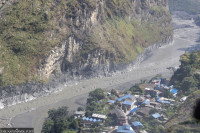
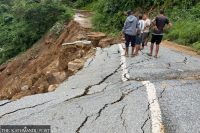
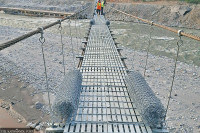
The Guardian reported that the floods had washed away roads, bridges, schools, homes and sources of livelihoods, affecting Nepal’s development. It also noted Shah’s statement that search and rescue operations were continuing four weeks after the disaster, with more than 6,000 people still unaccounted for.
The report also referred to up to $170 million in emergency financing from the World Bank for disaster response and recovery, and $31 million announced by the United States for flood recovery, bringing total US financial assistance to Nepal to $36 million, according to the report.
The Qatar-based Al Jazeera similarly focused on the floods and climate crisis. Its report described the floods as a “warning to the world” and framed Shah’s address as a call for immediate action against climate change.
“Nepal Prime Minister Balendra Shah has appealed for action to combat the rising threat of climate change, calling the flood that devastated his country last month ‘a warning to the world,” it said.
The report also cited a study released the previous week by the World Weather Attribution group. According to the study, the disaster was not caused by a single extreme weather event but was shaped by a “compound crisis” involving long-term temperature increases, thawing permafrost and geological instability.
Al Jazeera also reported that Nepal had requested $20 million from the UN’s Loss and Damage Fund, describing it as the maximum amount the country could seek from the fund but a small portion of its overall needs. The government’s initial assessment put flood damage at around $5 billion.
The report noted that the fund, established after Pakistan’s devastating floods in 2022, had yet to distribute its first money. It said Nepal could therefore become an important test of the fund’s credibility.
Germany’s Deutsche Welle also focused on the effects of climate change on Nepal and the Himalayas and theneed for international cooperation.
It highlighted Shah’s statement that Nepal contributes less than 0.1 percent of global greenhouse gas emissions but is paying a “huge price”. DW said Shah had called not for blaming individual countries but for shared responsibility and solidarity.
DW also highlighted Shah’s call for grant-based assistance rather than loans to finance reconstruction, saying his argument was that climate-vulnerable countries should not be burdened with additional debt. It referred to the August 26 disaster, which involved a glacial collapse followed by landslides and floods, and noted that more than 6,000 people remained unaccounted for.
France 24 similarly focused on climate change, highlighting Shah’s statement that“Nepal did not create this crisis, but is paying the price”. It reported his call for international support to meet the cost of climate adaptation and his argument that Nepal could not tackle such crises alone.
The French broadcaster also highlighted Shah’s proposal to establish a “Himalayan Climate Resilience Mechanism” involving Nepal, India and China. It placed the proposal within the context of Shah’s political rise, describing the 36-year-old former rapper as having come to power amid a youth-led anti-corruption movement and saying climate diplomacy had become a major issue of his premiership following the floods.
British media outletThe Independent, Middle East-focused Arab News and The Korea Times also published reports using the same headline and a similar format to the France 24 report. South Korean broadcaster SBS included Shah’s address in its news bulletin, highlighting his description of the floods as a warning to the world, the effects of climate change in the Himalayas and his appearance, including the sunglasses that have become part of his public image.
Bangladesh’s The Daily Star carried an Agence France-Presse (AFP) report under the headline ‘Nepal PM calls floods, climate crisis “warning to world”’. The report highlighted Shah’s warning that rising temperatures were destabilising the fragile Himalayan ecosystem, as well as his remarks that melting permafrost and glaciers were increasing the risks of floods, landslides and other disasters.
Singapore’sThe Straits Times also carried the AFP report, focusing on the scale of the disaster and Nepal’s appeal for international support. It highlighted the more than 1,400 deaths caused by the floods, billions of dollars in damage, Nepal’s request for $20 million from the Loss and Damage Fund and an estimated $5 billion reconstruction requirement.
News agencies broaden the reach
The reach of Shah’s address also underscored the role of international news agencies in shaping coverage beyond Nepal.
An Associated Press (AP) report was carried by news organisations across the United States, with its headline also framing the floods as a “warning to the world”. The report focused on Shah’s message to world leaders that Nepal was paying the price for a climate crisis it had done little to cause.
Reuters, meanwhile, framed the address largely around Nepal’s call forgrant-based international support for post-flood recovery and reconstruction.
Its report noted Shah’s argument that countries already vulnerable to climate disasters should not be forced to take on more debt to rebuild. Instead of large loans or fragmented grants, he called for adequate grant-based support.
Reuters also highlighted Shah’s proposal for Nepal, India and China to establish a Himalayan climate resilience mechanism. He called for an immediate regional mechanism covering satellite-data sharing, monitoring of glacial lakes, stronger early-warning systems and coordination on cross-border disaster response.
India and China take different angles
Shah’s proposal for a “Himalayan climate resilience mechanism” led by Nepal, India and China was one of the more specific elements of his address. But the response in the Indian and Chinese media appeared notably different.
As of writing this story, no standalone report focused on Shah’s September 24 UN address could be found on the websites of China’s major state and international-facing outlets, including Xinhua, China Daily, Global Times and CGTN. Xinhua published coverage of various UN General Assembly events and speeches by world leaders, but Shah’s address did not appear to have received a separate report centred on his speech.
That does not mean Chinese media ignored Nepal or the floods. Following the disaster in the Nepal-China border area on August 26, Chinese outlets reported on the rescue operation, missing people and China’s relief efforts.
China Daily reported that Chinese President Xi Jinping had sent condolences to President Ramchandra Paudel and that China would assist Nepal with rescue and relief efforts.
Global Times, meanwhile, carried reports highlighting the need for cooperation among Nepal, China and India in responding to disasters in the Himalayas and along their shared borders.
Indian media, by contrast, connected Shah’s address more directly to climate diplomacy and India’s regional role. The Indian Express published an analysis before the speech under the headline ‘Nepal’s climate call is a test for India’. It argued that Nepal’s emerging climate diplomacy was seeking to move beyond the traditional language of foreign aid towards climate justice, compensation and financial responsibility.
The analysis also suggested that Nepal’s call for India and China to cooperate in reducing climate risks in the Himalayas could present a regional diplomatic question for India. India Today similarly linked Shah’s UN visit to climate justice in its coverage ahead of the address.
The Tribune, citing an Asian News International (ANI) report, also highlighted Shah’s proposal for a Himalayan climate resilience mechanism led by Nepal, India and China, alongside his description of the floods as a “warning to the world”.
Indian outlets gave particular prominence to the proposed trilateral mechanism. Hindustan Times, under the headline ‘India, China and Nepal should lead’, reported Shah’s proposal for the three countries to establish a Himalayan climate resilience system. The report also highlighted his warning about the effects of climate change on the Himalayan ecosystem and the dependence of nearly two billion people on the Hindu Kush Himalaya region.




 15.31°C Kathmandu