Two families have claimed the same body recovered after the Bhotekoshi flood, forcing authorities in Pokhara to turn to DNA testing as they struggle to identify dozens of victims brought from the disaster zone.
Body No 1003 at Pokhara Academy of Health Sciences was identified by the relatives of both Gopal Dahit, a worker at the Mailung Hydropower Project, and Damodar Basyal, a tourist guide from Rupandehi who went missing after the flood.
Both families say the body's physical features match their missing relative. With both families maintaining their claims, authorities collected DNA samples from relatives of Dahit and Basyal on Sunday for comparison with the body’s DNA. The body will remain in the morgue until the results establish its identity.
The case is not unique. Another body at the hospital has also been claimed by two families, according to Kaski District Police. Police have so far collected DNA samples from relatives of five families to determine whether the bodies they have claimed are indeed their missing relatives.
“During a disaster, there is a possibility that one family may mistakenly take away someone else's body,” said Inspector Dipak Rijal, acting spokesperson for Kaski District Police. “That is why DNA testing is necessary.”
The confusion comes as authorities process a large number of bodies recovered after the Bhotekoshi flood. A total of 102 bodies recovered from Gorkha, Tanahun, Dhading and eastern Nawalparasi East have been brought to Pokhara.
By Sunday, 16 had been identified and handed over to relatives.
Two families, one body
Dahit's relatives travelled from Bardiya to search for him after he disappeared following the flood.
His two sisters, a brother and a sister-in-law left Jogigaun in Barbardiya Municipality-2 on Friday. The following morning, they reached Gaindakot in Nawalparasi East, where they were shown photographs of recovered bodies.
They identified Body No 1003 as Dahit.
Police told them the body had been sent to Pokhara, and the family travelled there the same day. The physical description appeared to match the photograph they had seen, and the hospital was preparing to hand over the body on Saturday evening.
But Dahit's elder brother, Krishna Bahadur Tharu, was still on his way to Pokhara to see the body himself. By the time he arrived on Sunday afternoon, another family had already claimed it.
Radhe Shyam Sharma Basyal had travelled to Pokhara after receiving a photograph of Body No 1003 from a relative. His younger brother Damodar had disappeared after travelling to Kerung with a group of 67 tourists from Mansarovar.
Basyal said several distinctive features in the photograph matched his brother.
“There was a mole. That matched. His lips were thick, and that matched too,” he said, showing a photograph of Damodar on his mobile phone. “He is my youngest brother. I am ready for a DNA test.”
He said the body should not be handed to either family until the identity was established scientifically.
“It may take a little longer, but tomorrow we will know for certain,” he said. “Let's do the DNA test. Whoever it belongs to can take the body.”
Dahit's sister Manji Tharu remains convinced that the body is her brother's. “His teeth, forehead, lips, hands, chest and face all match,” she said outside the morgue on Sunday.
The family had planned to take the body home on Saturday but waited for Krishna to arrive.
“We were waiting for our elder brother. Now we are in a situation where we may not get the body at all,” she said.
For Dahit's family, the search has already come at a high cost. His elder sister Saraswati Tharu said the family borrowed money from neighbours to travel in search of him.
“He had gone to work at the hydropower project only a month ago,” she said. “Our new house is still unfinished, and we had debt from building it. He went to the hydropower project to earn money to repay that debt.”
His 18-month-old daughter had only recently learned to say “Baba”. Dahit's brother Krishna has asked authorities to keep the body preserved until the DNA results are released.
A growing identification challenge
The Bhotekoshi flood has left families searching for relatives across several districts, while authorities face the difficult task of matching unidentified bodies with missing-person reports.
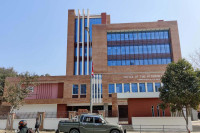
Police have set up a help desk at Pokhara Academy of Health Sciences for relatives arriving in search of loved ones.
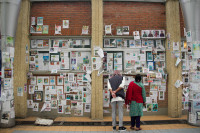
Photographs showing the bodies and their physical characteristics are displayed inside the hospital. When faces cannot be recognised, relatives have sometimes identified victims through distinctive items such as ties, tattoos, necklaces and earrings.
“Relatives are continuing to arrive,” Rijal said. The desk also helps families file reports, arranges free hearses and provides food and accommodation for those who have travelled to Pokhara to search for missing relatives.
The scale of the operation has stretched the hospital's mortuary.
For now, however, officials say there is no immediate need to bury the unidentified victims in Pokhara. Kaski Chief District Officer Kumar Singh Gurung said relatives were still arriving from Chitwan and Nawalparasi to search for missing family members.
“Unlike Chitwan, where bodies were kept in a temporary morgue and a foul smell began spreading, we have refrigerated facilities here,” he said. “We can keep the bodies for several more days.”
The district security committee and the body management committee will wait before deciding whether to bury any bodies that remain unidentified.
For families such as the Dahits and the Basyals, however, the wait is now more immediate. Both believe they have found their missing relative. Only DNA can tell them which family is right.
Of the 102 bodies brought to Pokhara, 87 had undergone postmortem examinations by Monday morning. Five forensic specialists are working on the examinations, while two specialists from Nepal Police's Central Forensic Science Laboratory have arrived to collect DNA samples and analyse fingerprints.
The hospital is also running out of refrigerated space.
Its morgue has 72 refrigerated compartments, but 77 bodies were being kept there after 16 had been handed over to relatives and nine transferred to Nepal Manipal Teaching Hospital. Authorities have managed the shortage by making arrangements for small bodies and fragmented remains and by installing a container inside the cold room.
Twenty-five bodies were transferred into the temperature-controlled container on Sunday.
Aryal said the facility has one of the largest and most modern mortuaries in Nepal after Tribhuvan University Teaching Hospital in Maharajgunj, Kathmandu, and can preserve bodies at 2 to 6 degrees Celsius for 10 days to two weeks.
Authorities are continuing to hand over bodies as families identify them.
For bodies that remain unidentified, officials must follow the Unidentified and Unclaimed Dead Body Management (First Amendment) Directive, 2026. Authorities must photograph each body and preserve fingerprints, DNA samples, and other identifying information.
If a body remains unidentified for a prolonged period, the directive requires it to be buried at a site designated by the local government. The burial site must be kept free of construction for 12 years so that remains can be exhumed if relatives later come forward.
“We bury bodies with tag numbers and geolocation details,” Rijal said. “If relatives come looking within 12 years, the body can be exhumed and the remains handed over after DNA identification.”
For now, however, officials say there is no immediate need to bury the unidentified victims in Pokhara. Kaski Chief District Officer Kuman Singh Gurung said relatives were still arriving from Chitwan and Nawalparasi to search for missing family members.
“Unlike Chitwan, where bodies were kept in a temporary morgue and a foul smell began spreading, we have refrigerated facilities here,” he said. “We can keep the bodies for several more days.”
The district security committee and the body management committee will wait before deciding whether to bury any bodies that remain unidentified.
For families such as the Dahits and the Basyals, however, the wait is now more immediate. Both believe they have found their missing relative. Only DNA can tell them which family is right.




 19.38°C Kathmandu
.jpg)