Families seek answers in the final phone signals of relatives missing in floods
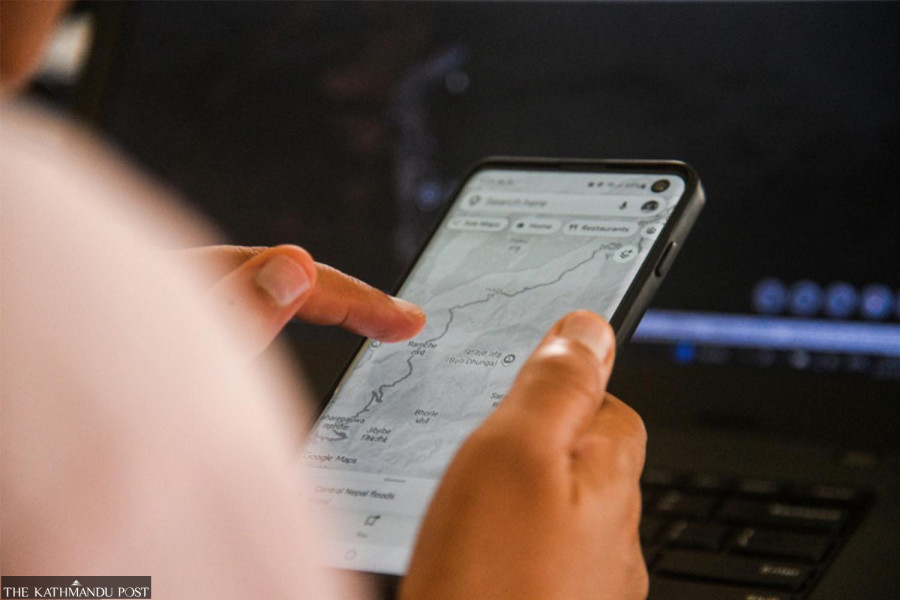
With thousands missing in central Nepal after last week’s catastrophic floods, families are tracking the final mobile signals of loved ones to narrow the search for survivors. A mobile phone can help trace a missing person through location data. Deepak KC/TKP
Roshan Kumar Joshi, an environmental expert from Morang who worked on the Upper Trishuli-1 Hydropower Project under a Korean company, has been out of contact since last week’s devastating floods in central Nepal. Joshi’s relatives have scoured social media for videos, photographs and maps that might offer a clue to his whereabouts. They have also inquired with other company employees.
“One of the colleagues who reportedly talked to him for the last time said she heard him sending his colleagues outside, shouting, ‘Run, run quickly,’” one of Joshi’s relatives said. “We have no idea what happened after that.”
On Saturday, Joshi’s relatives asked police authorities to trace the last location of his mobile phone. The response was: “Ramche-C, 9:10, 2026/08/26.” This indicated that Joshi’s phone was in the direction of the “C” sector of the Ramche tower in Rasuwa at 9:10 am on August 26.
Based on the location data, his family has now taken to social media, appealing to authorities and others involved in the search to look in that direction.
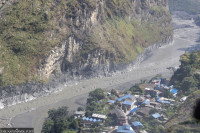
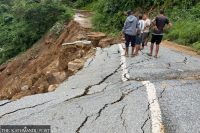
As Wednesday’s catastrophic floods along the Bhotekoshi and Trishuli rivers crippled communications across Rasuwa and Nuwakot, families searching for missing relatives have turned to an unlikely source of hope—the last signal from a mobile phone. Relatives are increasingly asking law enforcement authorities and telecom companies to check when a missing person’s phone was last active and which mobile tower it was connected to.
Telecommunications experts say the data cannot pinpoint a person’s exact location. What it can do is offer important clues about whether the missing person was near the river when the floods struck or was moving towards higher ground.
The family of Chitragupta Bhatta, a resident of Archale, Rasuwa who worked at Trishuli Hydropower Company Limited, is also clinging to a faint hope offered by his mobile phone’s last known location.
On Sunday, Bhatta’s family approached security personnel to check his last location. They received one response: “Neupane Chaur, 9:26, 8/26.” This indicates Bhatta’s phone was on for more than 15 minutes after the flood current hit the area. A telecom expert who knew the area well guessed he probably was inside the tunnel.
“After learning about this location, we began to hope that perhaps he is inside a tunnel,” a family member told Kantipur on Monday. “So many days have passed, and he was already somewhat frail. It is becoming increasingly difficult to hold on.”
A mobile tower typically divides its coverage area into three sectors, usually named A, B, or C, allowing network operators to identify the general direction from which a handset was connected, said Nabin GC, director for delivery and service at Huawei Nepal.
“The three sectors cover different directions,” GC said. “By mapping the direction geographically, we can determine whether the phone was on the river side or the mountain side.”
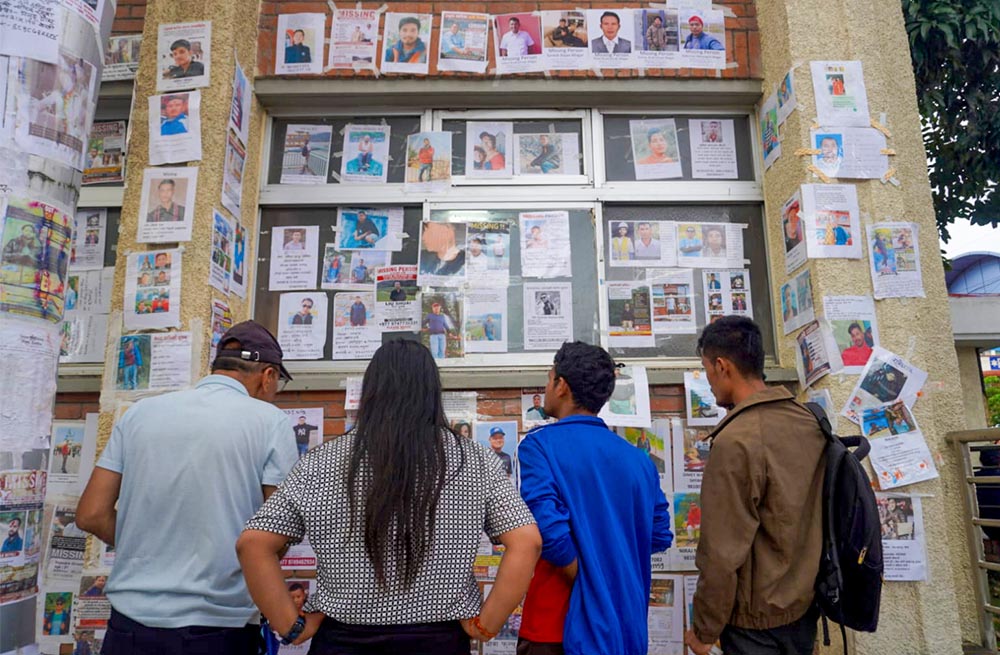
Relatives of the missing people at Maharajgunj-based TU Teaching Hospital in Kathmandu. Photo: Nepal Photo Library
If a phone was last connected to a sector facing the river before losing contact, it could indicate that the person was directly exposed to the flood. A final signal from a sector facing higher ground, however, may suggest they were moving towards safety.
The information can help narrow search areas. It, however, cannot establish whether a missing person is alive or dead, experts say.
Individuals cannot directly access that data as privacy laws prevent telecom operators from handing it over to them. But government agencies and security bodies can request network information through authorised channels for search and rescue operations.
GC, who also heads Huawei Nepal’s disaster response ‘war room’, said the government could use real-time network monitoring and tracking systems to support rescue efforts.
“As a technology company, our primary responsibility is to keep the network running,” he said. “But during a disaster, the government should also make effective use of mobile and network data.”
Nepal Telecom spokesperson Kamal Lamichhane said the company has been providing available information to rescue agencies through official and legal channels, including security bodies and the Cyber Bureau.
“Our priority after power supplies were disrupted in affected areas was to keep voice calls running,” Lamichhane said. “To conserve battery power, we initially shut down data and other services and operated only 2G services.”
An Ncell representative said its tracking team responds immediately when requests arrive through government channels.
“A phone can disappear from the network because it was damaged by water or because its battery ran out,” the representative said. “Disconnection does not necessarily mean the person was caught in the disaster. They may have reached safety and simply run out of battery.”
Ncell said it had provided free services to around 300,000 customers in the three affected districts.
Nepal Telecom, Ncell, Huawei, Nepal Police and the National Disaster Risk Reduction and Management Authority have all received a growing number of requests from families seeking information about missing relatives through their phone numbers.
Sushil Kumar Shrestha, a senior divisional engineer at the disaster authority, said around 2,300 people have so far reported relatives missing.
“In a situation like this, even a mobile number can offer a faint hope,” he said.
Telecom officials said requests to trace missing people’s phones surged after the floods. Previously, such requests were more commonly linked to stolen phones or suspects fleeing after financial fraud.
Both Nepal Telecom and Ncell said they have been directing families to file requests through police because location data cannot legally be shared directly with the public.
“Because of legal provisions protecting personal privacy, we cannot provide location information directly to individuals,” Lamichhane said.
Huawei, meanwhile, has set up a help desk after receiving repeated requests from families asking the company to check the status of missing relatives’ phone numbers.
Huawei does not provide location data directly to the public, GC said. Instead, authorised agencies including the Home Ministry and Nepal Police have been given access through telecom operators to relevant systems.
“Government agencies can log into the system and check the status of phones reported missing,” he said.
The government and disaster management authority are also analysing broader network data to estimate how many people may still be missing.
Shrestha said technicians and specialists in information technology and telecommunications are comparing the number of phones active in affected areas before the disaster with those that went offline afterwards and those that have since reconnected.
The analysis, however, cannot establish an exact number of missing people. A phone may be switched off because its battery has died or because it has been damaged, while children and elderly people may not have had phones at all.
An emergency communications restoration team formed by the government is also compiling a list of numbers that lost network connection during the floods and have not returned to the network.
A team member said the data could help produce an estimate, but not a definitive count.
“We have to account for other reasons a phone may be offline, including a drained battery or physical damage,” the official said. “Not everyone, particularly children and elderly people, carries a phone. So the data alone cannot tell us exactly how many people are missing.”
On August 26, when the floods struck that morning, there was a sharp and widespread loss of mobile connectivity between 8:30 am and 9:45 am along the corridor stretching from the Nepal-China border to Betrawati, network monitoring data show.
An elderly couple surnamed Subedi who had travelled to Rasuwa also lost contact that day around that time. Worried family members back in Kathmandu scrambled to find out the couple’s last phone signal.
A day later, the location showed “Gosaikunda-B, 08/27”, around 25-30 kilometres away from the flooded Bhotekoshi river basin. The couple had lost contact after their mobile phone battery died. They returned home the next day.




 23.99°C Kathmandu