Government halts new contract hiring, keeps existing workers on payroll
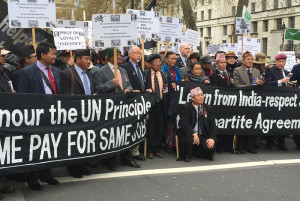
Existing contract employees will be pooled and redeployed across government agencies while a task force reviews long-term employment terms, benefits and legal protections. Contract employees protested after the government proposed replacing fixed-term hiring of non-gazetted support staff with public companies or outsourced providers. Post photo
The government has decided to retain thousands of existing contract employees while halting all new contract recruitments after a controversial outsourcing proposal triggered protests.
The Cabinet on Thursday approved a new framework for managing contract employees. Under the decision, contract workers whose agreements expired at the end of the last fiscal year will be allowed to continue working from July 17 until further notice.
Madan Bhujel, secretary at the Ministry of Land Management, Co-operatives, Federal Affairs and General Administration, told Kantipur that the government would maintain the employment of existing contract staff while a government task force studies a permanent policy for their management.
“The government has decided not to remove existing contract employees. A task force will recommend a long-term solution,” Bhujel said.
Contract employees had launched protests after the government proposed replacing the existing system of hiring non-gazetted support staff on fixed-term contracts with a public company or outsourced service providers.
Under the Cabinet decision, all existing contract employees will get their contracts renewed with their current offices, but will be placed in a central pool. Ministries and agencies will be able to deploy them as per the need once the organisational and staffing reviews are completed. The government has also barred ministries and public agencies from recruiting new contract employees. Vacant contract positions must instead be filled by redeploying workers already in the pool.
Bhujel said the policy was necessary because the recent merger of ministries would reduce approved staffing positions, including many contract posts.
“Positions from the secretary level down are reduced when ministries are merged. Contract positions have also been affected. Employees whose posts are abolished will, as far as possible, be reassigned to other ministries or government offices,” he said.
The Cabinet approved the policy based on a seven-point proposal submitted by the ministry.
Not all contract workers, however, will remain in service.
Employees already receiving government pensions or retirement gratuities after retiring from permanent civil service will have their contracts terminated from July 17. The measure also applies to contract workers aged 58 or older or those already receiving benefits from another source.
The Cabinet has instructed the ministry to submit recommendations within one month on employment conditions for contract workers, including pay, benefits, severance packages and minimum contractual protections.
The review will also examine how future contract appointments should be regulated and what compensation employees should receive if their contracts are terminated because approved positions are abolished.
Nepal currently has no dedicated law governing the recruitment, service conditions or benefits of contract employees. Most are hired under provisions of the Public Procurement Act, leaving issues such as leave, social security and employment protections largely unregulated.
The task force will also study whether contract employees should be enrolled in the Social Security Fund, a benefit that has become mandatory for much of the private sector but has not been extended to government contract workers.
The Cabinet decision follows talks on Wednesday between Prime Minister Balendra Shah's adviser on policy, governance and public administration, Sudip Dhakal, and representatives of contract employees. After the meeting, employee groups suspended planned protests.
The demonstrations were sparked by an earlier government proposal to replace many lower-level support staff and technical workers with personnel hired through outsourcing companies or a government-owned public company, raising fears that thousands of existing contract workers could lose their jobs.
Chiranjeevi Nepal, general secretary of the Joint Struggle Committee of Temporary, Contract and Daily Wage Workers, welcomed the Cabinet decision.
“Our demands were straightforward: stop outsourcing, allow existing employees to continue working, and provide fair compensation or gratuity if anyone has to leave,” he said. “The government’s decision addresses those concerns, and its commitment to study severance benefits is a positive step.”




 14.4°C Kathmandu