Government outsourcing plan sparks protests by contract workers
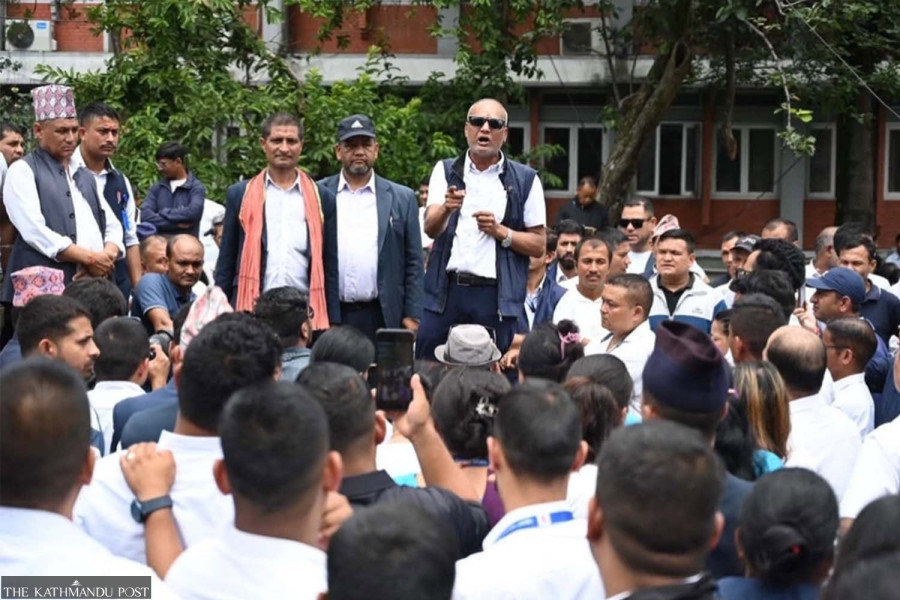
Contractual staff fear losing their jobs after a task force proposes replacing contract support staff with a public company or outsourced service providers. Angad Dhakal/TKP
Contract employees have launched protests after the government proposed replacing the existing system of hiring non-gazetted support staff on fixed-term contracts with a public company or outsourced service providers.
Fearing for their jobs, contract workers have abandoned their desks and begun lobbying ministers and senior bureaucrats at Singha Durbar, demanding that the government withdraw the proposal and guarantee their employment. Most contract appointments are renewed every mid-July, but employees now fear their contracts will not be renewed this time.
More than 100 contract workers gathered at the Singha Durbar complex on Tuesday, where they met Minister for Land Management, Co-operatives, Federal Affairs and General Administration Pratibha Rawal. They also held separate meetings withFinance Secretary Ghanshyam Upadhyaya and Pushkar Sapkota, the law secretary at the Office of the Prime Minister and Council of Ministers.
The protests follow a recommendation by a high-level task force formed to conduct an organisation and management survey across all ministries and government agencies.
The task force, led by prime minister’s Office Secretary Kiran Raj Sharma and comprising six other ministry secretaries, decided at its July 6 meeting that support services and routine technical functions should be provided either through a government-owned public limited company or outsourced to private service providers.
According to the proposal, the government would establish a public limited company under the Ministry of Land Management, Co-operatives, Federal Affairs and General Administration, or outsource such services after adopting a clear policy framework.
The recommendation covers a wide range of positions currently filled through contracts, including cleaners, office assistants, plumbers, gardeners, mechanics, audit support staff, microphone operators, light vehicle drivers, assistant computer operators, computer technicians, data entry operators and computer operators.
The task force has also instructed all ministries to place their existing contract support staff into a consolidated government-wide personnel pool while the new system is prepared.
It directed the ministry to immediately begin implementing the new model and complete the transition within three months.
The proposal has alarmed thousands of contract employees, who say successive governments have repeatedly tried to remove them.
“We become the target every time the government changes. Whoever comes to power tries to get rid of us,” said Chiranjivi Nepal, a contract employee at the Department of Survey. “It is unfair to throw thousands of employees out without considering how they will support their families. That is exactly what we have been telling ministers and secretaries.”
Jitendra Mishra, a contract employee who previously worked as a support staff member at then Ministry of Youth and Sports, said contract workers had already been left in limbo after the ministry was restructured.
The youth portfolio has since been merged into the Ministry of Labour, Employment and Social Security, while sports has been transferred to the Ministry of Education. Permanent civil servants have been reassigned to the two ministries, but contract workers remain without a clear management plan, he said.
Mishra warned that outsourcing support services would now put every contract employee’s job at risk.
Shyam Sapkota, chair of the Joint Struggle Committee of Temporary, Contract and Daily Wage Employees, said the government could not simply dismiss workers who had served for two decades or more.
“Our first demand is job security. Contract renewals must continue from mid-July,” Sapkota said. “If positions are eventually abolished, employees should not be sent home empty-handed. We have conveyed both demands to ministers and senior officials.”
During Tuesday’s meeting, Minister Rawal sought to reassure the employees, saying the task force’s circular should not be interpreted as a final government decision.
“The circular does not mean the proposal has been approved for implementation. There will be further discussions,” she told the delegation. “No decision will be taken that treats you unfairly.”
The assurances, however, have done little to calm concerns.
Employee representatives said they would continue protests until their contracts are renewed and their future is formally secured.
According to Sapkota, around 15,000 contract employees currently work under the federal government.
Neither the Ministry of Federal Affairs and General Administration nor the Department of National Records (Civil) maintains a comprehensive database of contract workers.
Ekdev Adhikari, spokesperson for the ministry, said ministries and government agencies hire contract employees according to their operational needs, meaning the ministry does not hold consolidated records.
Sudhan Khwakhali Shrestha, information officer at the Department of National Records (Civil), also said the office does not maintain data on contract employees.
The employees are also demanding that if the new organisation and management survey results in the abolition of their positions, the government must provide gratuities or compensation in line with a Supreme Court ruling.
“We are prepared to cooperate if our positions are abolished after the government introduces a new policy,” said Nepal, general secretary of the struggle committee. “But if we lose our jobs, the government must ensure we receive appropriate gratuities and compensation.”
He noted that the Supreme Court had already ruled that contract employees dismissed from service should receive financial compensation based on their length of service.
On January 23, 2014, the Supreme Court issued a directive ordering the government to establish a mechanism allowing contract employees in the civil service to receive gratuities, compensation or similar benefits when removed from service, taking into account the duration of their employment.
Nepal introduced a policy in 2000 to stop recruiting temporary employees, after which non-gazetted support staff began to be hired on contract.
Large numbers of contract employees also work for provincial and local governments.
According to general secretary Nepal, if the federal government adopts a new legal framework for contract employees, the policy could affect around 8,000 contract workers employed by provincial governments and more than 30,000 working for local governments.




 14.4°C Kathmandu