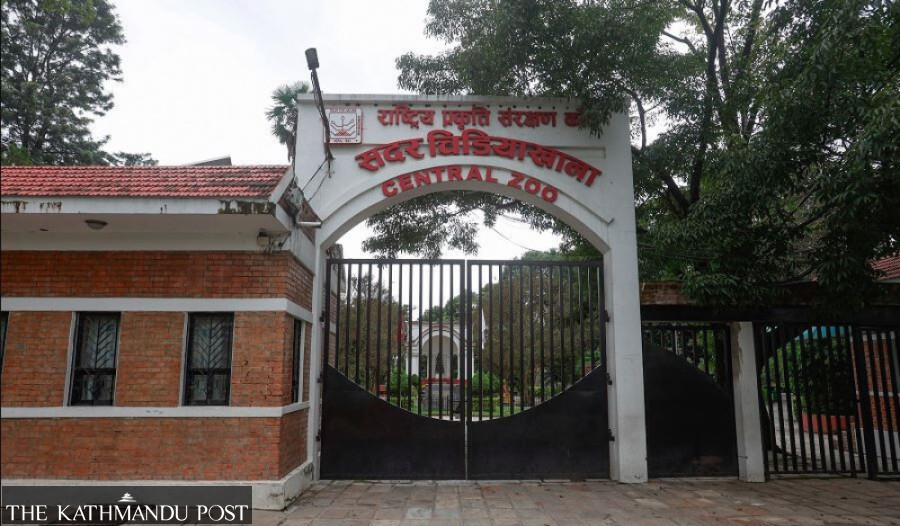
Central Zoo to reopen on Friday as environmental samples test negative for bird flu
The zoo has been closed since June 19 following an outbreak of the deadly virus among vultures, owls, swans and other rare birds, as well as a jungle cat and civets housed at the facility. The Central Zoo in Jawalakhel, Lalitpur, which has remained closed since June 19 following a bird flu outbreak, is set to reopen on Friday after environmental samples tested negative for avian influenza. Post File Photo
With environmental samples of wild birds collected from the zoo premises testing negative for avian influenza, also known as the bird flu virus, the Central Zoo is all set to reopen to the general public from Friday.
A high-level meeting comprising senior officials from the Department of Livestock Services, the Central Veterinary Laboratory, and the Epidemiology and Disease Control Division, among others, held on Thursday, took the decision to this effect.
“We have decided to reopen the zoo to visitors from Friday,” said Ganesh Koirala, spokesperson for the Central Zoo. “Lab tests on environmental samples collected from the zoo premises came back negative.”
The zoo has been shut down since June 19 following an outbreak of the bird flu virus among vultures, owls, swans and other rare birds, as well as a jungle cat and civets kept at the facility. Avian influenza A (H5N1) was confirmed in samples from the dead birds.
The outbreak killed dozens of captive birds. The zoo administration was also accused of attempting to conceal the incident. A committee formed to investigate the outbreak is currently preparing its report.
Koirala said that all necessary measures have been taken to ensure the safety of zoo visitors and that an expert team has also approved the reopening of the zoo. Multiple tests were carried out on samples collected from the zoo premises, including dead crows. Dead crows are believed to be the main carriers transmitting the virus at the zoo.
Officials said the closure has resulted in revenue losses of around Rs30 million, as the zoo normally receives around 2,000 visitors on weekdays and up to 5,000 on public holidays.
The zoo houses around 1,300 animals across more than 100 species, including the endangered snow leopard and chimpanzee. The zoo also serves as a rescue centre for wild animals.
Meanwhile, the Department of Livestock Services said that the spread of the bird flu virus has slowed in all three Valley districts—Kathmandu, Lalitpur and Bhaktapur—as well as in Kavrepalanchok district.
“No new outbreak has been reported since Wednesday,” said Dr Mukul Upadhyaya, senior veterinary officer and chief focal person for Avian Influenza Control and Disease Surveillance at the Department of Livestock Services, on Thursday. “This shows that the spread of the virus has slowed.”
As many as 119 poultry farms in the three Valley districts and Kavrepalanchok district witnessed bird flu outbreaks in recent days.
According to officials, more than 835,563 chickens and ducks have been culled since mid-March after outbreaks were detected. Bird flu has now been confirmed at poultry farms in 11 districts across the country. Authorities have also destroyed around 1.3 million eggs and approximately 300,000 kilograms of poultry feed from infected farms.
Nepal is currently witnessing outbreaks caused by several avian influenza viruses, including Influenza A (H5N1), Influenza A (H9N2) and Influenza A (H5Nx). These highly contagious viruses primarily affect domestic birds such as chickens and ducks.
Nepal first confirmed an outbreak of bird flu in January 2009. Since then, outbreaks have occurred almost every year, destroying millions of birds and large quantities of poultry products. Many poultry farmers have abandoned the business after failing to receive adequate compensation for their losses.
Nepal also recorded its first human death from bird flu in 2019.
Arjun Poudel is a health reporter for The Kathmandu Post. Before joining the Post, he worked for Sagarmatha Television, Naya Patrika, Republica and The Himalayan Times.




 24.28°C Kathmandu