Rayamajhi gets four years in prison, Khand two in fake Bhutanese refugee scam
The district court determines sentences for 16 convicts, saying the organised fraud tarnished Nepal’s international image and constituted offences against the state.
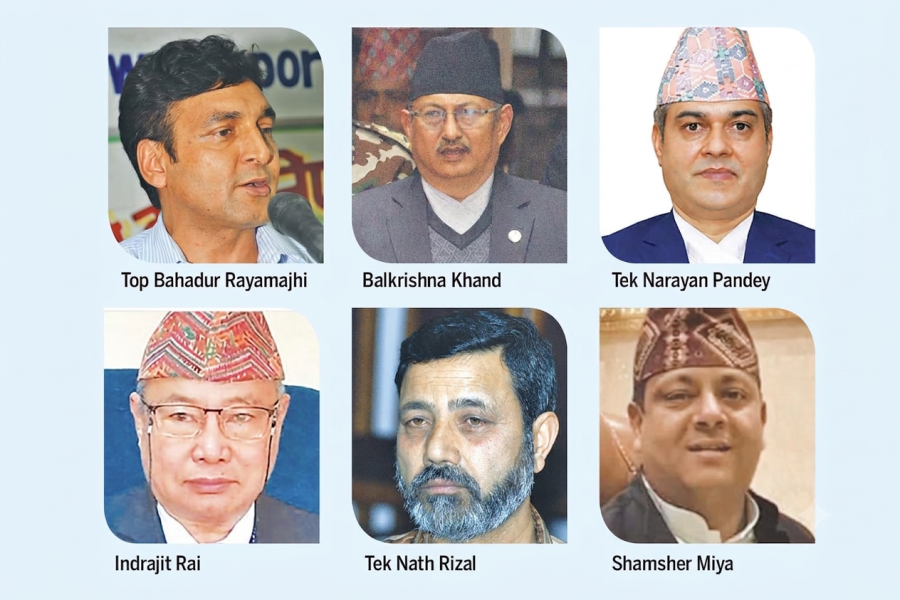
The Kathmandu District Court on Tuesday sentenced former deputy prime minister and CPN-UML leader Top Bahadur Rayamajhi to four years in prison for his role in the fake Bhutanese refugee scam, in which Nepali citizens were passed off as Bhutanese refugees in a scheme to send them to the United States.
Former home minister Bal Krishna Khand was sentenced to two years in prison. Rayamajhi was also fined Rs40,000, while Khand was fined Rs20,000.
A single bench of judge Tej Bahadur Khadka at the Kathmandu District Court on Tuesday determined the sentences for the 16 individuals who were convicted in the case. According to the court's information officer, Shiva Khatiwada, Rayamajhi was convicted of fraud, organised crime and offences against the state, while Khand was convicted as an accomplice in those offences. Former home secretary Tek Narayan Pandey was also sentenced to four years in prison and fined Rs40,000.
Bhutanese refugee leader Tek Nath Rizal was sentenced to two years in prison and fined Rs20,000. Keshav Dulal, Sanu Bhandari and Sagar Rai, identified as the principal architects of the racket, were each sentenced to four years in prison and fined Rs40,000 each. Rizal, Dulal and Bhandari were convicted of forgery, fraud, organised crime and integrated offences, while the others were convicted of all charges except forgery.
The court also sentenced Sandesh Sharma and Indrajit Rai, security adviser to then home minister Ram Bahadur Thapa, to four years in prison and fined each Rs40,000. However, since Rai is over 75 years old, the court order states that he will receive a 75 percent remission of his prison sentence under the law applicable to senior citizens. The remaining sentence will be adjusted after deducting the period he has already spent in custody.
Govinda Chaudhary and former lawmaker and Nepali Congress leader Ang Tawa Sherpa were also sentenced to four years in prison and fined Rs40,000 each.
Narendra Chaudhary, private secretary to former home minister Khand, Shamsher Miya, then chair of the Haj Committee, Hari Bhakta Maharjan and Niranjan Kumar Kharel were each sentenced to one year in prison and fined Rs10,000 on the charge of integrated offences. Bechan Jha was sentenced to one year in prison and fined Rs10,000 for attempting to commit fraud.
Although the defendants received separate sentences under charges of forgery, fraud, organised crime, offences against the state and integrated offences based on their individual roles, the verdict will be implemented according to the sentence and fine imposed for the integrated offence, said Achyut Mani Neupane, spokesperson for the Office of the Attorney General.
The case was initially filed on May 24, 2023 against 30 individuals under charges of forgery, fraud, organised crime and offences against the state. Two supplementary charge sheets filed in May and July 2024.
Three years after the case was filed, the court concluded proceedings on the main case and two supplementary charge sheets, convicting 16 defendants, acquitting seven, and ordering that proceedings against the eight fugitives be kept in abeyance until they are arrested.
The court said it determined the sentences based on each defendant's role and level of involvement in the offences.
Tek Nath Rizal, Keshav Prasad Dulal and Sanu Bhandari were convicted of forgery.
Dulal, Bhandari, Sagar Rai, Sandesh Sharma, Indrajit Rai, Govinda Kumar Chaudhary, Ang Tawa Sherpa, Tek Narayan Pandey and Top Bahadur Rayamajhi were convicted of fraud and organised crime. Bal Krishna Khand, Tek Nath Rizal, Narendra KC, Shamsher Miya, Hari Bhakta Maharjan and Niranjan Kumar Kharel were convicted as accomplices in fraud and organised crime and sentenced accordingly.
On the charges of offences against the state and integrated offences, Dulal, Bhandari, Sagar Rai, Sandesh Sharma, Indrajit Rai, Govinda Chaudhary, Ang Tawa Sherpa, Tek Narayan Pandey and Rayamajhi were convicted of acting in concert to commit fraud amounting to offences against the state and integrated offences. Khand, Rizal, Narendra KC, Shamsher Miya, Hari Bhakta Maharjan and Niranjan Kumar Kharel were convicted as accomplices in offences against the state. Bechan Jha was convicted of attempting to commit fraud. The court said the sentences reflected each defendant’s role and degree of involvement.
Although the three cases involved 36 accused in total, the five defendants named in the second supplementary charge sheet, including Dulal, had already been named in the main case. However, the court did not rule in line with the prosecution’s claim on the amount to be recovered. The prosecution had calculated the amount based on money collected by the racket from victims and complaints filed with the police, but the verdict did not address the claim for recovery.
Judge Khadka heard the main case together with the two supplementary charge sheets and, on July 7, convicted 16 defendants, including Khand and Rayamajhi. On Tuesday, the court determined their sentences, including prison terms and fines.
In its brief order, the court described the fake refugee racket as an offence against the state, saying it had directly undermined the dignity of Nepali citizens and tarnished Nepal’s international image.
Based on the police investigation report, the Kathmandu District Government Attorney’s Office on May 24, 2023 charged 30 individuals, including Rayamajhi and Khand, with four offences: forgery, fraud, organised crime and offences against the state. At the time the case was filed, 18 defendants had been arrested. On June 15, 2023, a bench of then Kathmandu District Judge Prem Prasad Neupane released Tank Gurung on a Rs1 million bail and Laxmi Maharjan on a Rs500,000 bail, while remanding the remaining 16 defendants to judicial custody pending trial. Several defendants later secured release on bail or general appearance orders after appealing to the Patan High Court. The Kathmandu District Court concluded the trial on July 7.
In its brief order, the court said the offence of forgery had been established because genuine official reports had been altered and incorporated into forged reports, and fake identity cards identifying Nepali citizens as Bhutanese refugees had been issued.
The court further held that the defendants had committed organised fraud in a manner that directly undermined the dignity of Nepali citizens and damaged Nepal’s international reputation, thereby establishing the offence against the state as charged by the government.
The court also upheld the charge of integrated offences, ruling that the defendants had, through a single criminal episode, committed fraud, forgery of official documents, organised crime and offences against the state, thereby satisfying the legal requirements for conviction under the integrated offences provision.




 20.51°C Kathmandu