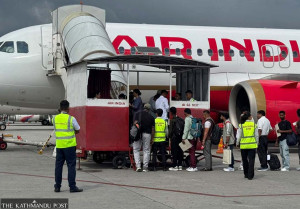
The Department of Passports received only 1,440 applications on Monday after technical problems affected the central server and service centres.Photo: Courtesy of Department of Passports
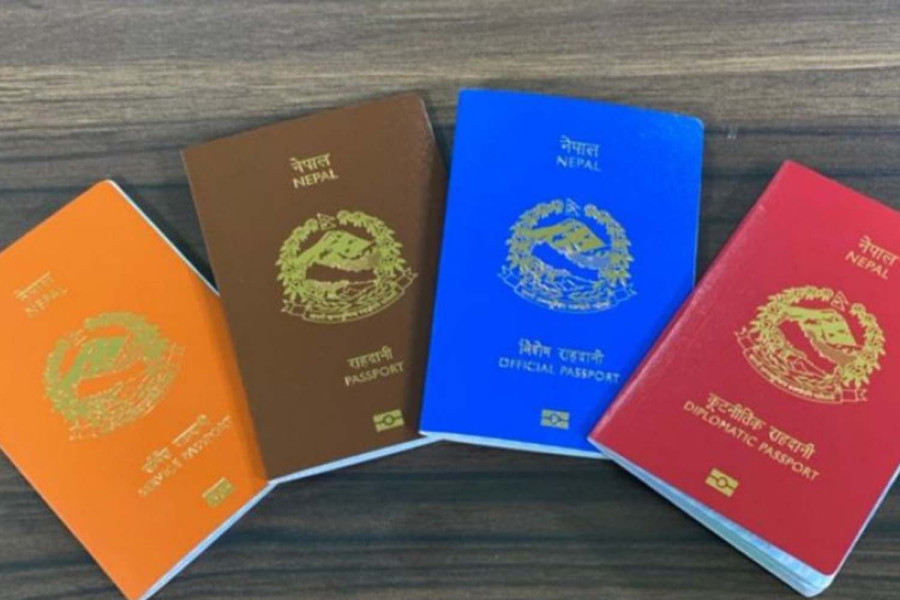
As the controversy surrounding the new passport procurement continues, the Department of Passports on Monday began rolling out the new passports supplied by two German firms, but the rollout was marred by massive technical glitches at the department and several district administration offices.
Foreign Minister Shisir Khanal handed over the passports to two underage Nepali players while kicking off passport distribution. However, the Department of Passports received only a few passport applications on Monday due to problems in the central passport server throughout the day.
A senior foreign ministry official said that things would have been in the right direction, if the outgoing vendor, IDEMIA had cooperated, adding that the department would have done a much better job on the first day. On the other hand, he pointed out problems with the server of the National Identity Card (NID), which is again being procured from IDEMIA.
“There was a bug in the NID system. Since IDEMIA does not print the NID, bugs in its system have created disruption in NID services, which are also linked with passports. Applicants should provide their NID number while applying for new passports and renewing passports,” the foreign ministry official said.
Multiple district administration offices, including Kathmandu and Lalitpur, were unable to update the biometric personalisation of applicants. In Kathmandu, the system for only an hour, one official said.
The Department of Passports, in a statement, said the new system could take up to three months to become stable.
“During this period, some unexpected but minor technical issues may arise from time to time,” said the statement.
The DOP usually received 6,000 passports a day until last week from its 217 personalisation centers set up at the Department of Passport, all 77 district administration offices, some area administration offices and all Nepali missions aboard.
But due to the instability in the system, it received only around 1,440 passport applications on Monday.
Enrollment began in multiple districts and at the department from Monday, said Dipak Banjade, spokesperson at the DOP. “Gradually, we will start printing the passport too.”
“Several applicants are outside the department building waiting for the passport enrollment, and we will complete their enrollment by 9 pm,” said Banjade.
The DoP printed some passports on Monday itself, raising hopes that once the system stabalises, it will be able to print more in the days to come. The work related to data migration of ten million Nepali citizens has been completed, said the passport department.
The DoP had claimed that going live means a new system becomes operational simultaneously across all designated service centers. However, with the system functioning only at the department while remaining non-operational at other service centers, questions have been raised about the project's preparedness, testing, and implementation process.
The Department of Passports had suspended its services from July 7, citing data migration and system upgrades. Although it announced that services would resume through the new system from Monday morning, the service was limited to the department's office in Tripureshwor, Kathmandu. The new system could not be launched simultaneously at all 217 service centers, including the 77 District Administration Offices across the country and Nepali diplomatic missions abroad.
The Rupandehi District Administration Office issued a statement saying it faced glitches with its user ID login system and could not take passport applications. The office has urged applicants to wait some more days until the issue is fixed.
Likewise, an official at Kathmandu District Administration Office told the Post that it could not enroll a single application on Monday. Similarly, Narahari Ghimire, chief district officer of Lalitpur said his office also failed to accept any applications Monday as it had not received the User ID and login credentials required to begin the process.
An official at the Department of Passports said that central data validation has not been completed yet, hence the problem.
An official at the department said that in 2010, when Obertur Technologies was awarded the contract for passport printing, it printed around 11,00 passports on the first day. Likewise, on November 17, 2021, when the e-passport was launched and the first copy was given to historian Satya Mohan Joshi, the DoP had printed 780 passports out of 1,100 applicants.
In June last year, two German security printing companies—Veridos GmbH and Muehlbauer ID Service GmbH—won the new e-passport contract, ending the decade-and-a-half-long domination of the French firm IDEMIA Identity and Security France SAS.
In 2010, the France-based company Oberthur Technology started supplying machine-readable passports to Nepal. Later, IDEMIA, which acquired Oberthur Technologies, started supplying e-passports or biometric passports to Nepal from 2021 through a competitive bidding process. Through this new system, some applicants have already completed the passport application process Monday.
The department, in its statement, urged service seekers that applicants seeking to obtain a new passport, renew an expired passport, or renew a passport for any other reason should continue obtaining passport services as before from the district administration office, the Department of Passports, or Nepali diplomatic missions abroad.
“The Department of Passports has successfully completed the largest data migration in Nepal's history and has brought passport services into operation through a new passport production and management system,” the department said.
Passport records of nearly 10 million Nepali citizens have been securely migrated to the new system, it said.
“Following the implementation and go-live of such a large information technology system, it is natural to experience some technical challenges, temporary system slowdowns, and minor delays in passport issuance during the initial days. Anticipating these possibilities, the department's technical team, staff, and specialists from the system development company have remained on 24-hour standby, continuously monitoring, testing, and improving the system. We assure you that the Department is fully capable of and committed to resolving both immediate and long-term issues as quickly as possible.”
Anil Giri is a Chief Sub Editor covering diplomacy, international relations and national politics for The Kathmandu Post. Giri has been working as a journalist for more than two decades, contributing to numerous national and international media outlets.




 19.27°C Kathmandu