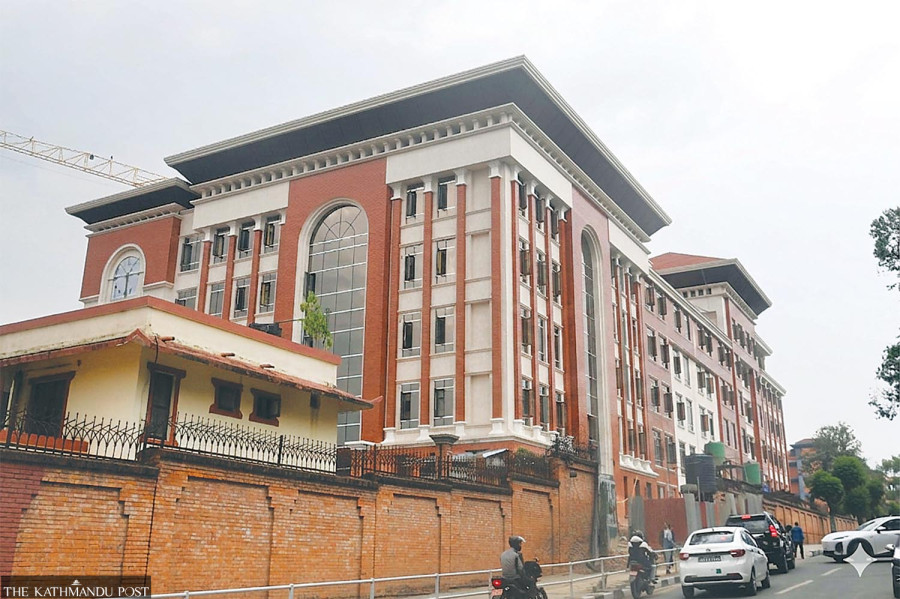
The apex court orders the commission not to seek asset details or recommend legal action against public officials until a full bench delivers its verdict.The Constitutional Bench has directed the Nepal Bar Association and the Supreme Court Bar Association to nominate two senior advocates or advocates to assist as amicus curiae. Post File Photo
The Supreme Court on Friday issued an interim order directing the high-level Property Investigation Commission to maintain the status quo on its ongoing scrutiny of the assets of public officials.
The apex court ordered the commission not to compel any individual to submit details of their assets or recommend any legal or disciplinary action against anyone until a final verdict is delivered.
A division bench of Justices Tek Prasad Dhungana and Shreekanta Paudel, after hearing two writ petitions over two consecutive days, also referred the case to a three-judge full bench for a final hearing on the legality of the commission.
The commission, formed by the Balendra Shah-led government, will now face judicial scrutiny over its constitutional validity. Until the full bench decides the case, the court’s interim order effectively halts its core functions.
The petitions were filed by advocates Prem Raj Silwal and Man Bahadur Lamichhane, who argued that the government exceeded its constitutional authority by forming the commission through an executive decision. The bench issued the interim order under Rule 49(2)(a) of the Supreme Court Regulations, 2017, citing the possibility of irreparable legal consequences if the investigation continued.
“If the scope of the investigation is determined in accordance with Clause 2(e) of the April 15 Nepal Gazette notification regarding the formation of the commission, it appears it would contravene the explicit provisions of the Constitution of Nepal and prevailing statutory laws, thereby causing irreparable harm to the individuals concerned,” the court order states.
“Therefore, until a final decision and decree are reached by the full bench of this court, no public official or citizen shall be compelled to submit details of their property and assets. Likewise, the work of investigating and assessing property details already submitted shall remain under status quo, and no recommendation for any legal prosecution or action shall be made to any state authority against any individual.”
Recognising the constitutional importance of the case, the bench also directed the Nepal Bar Association and the Supreme Court Bar Association to nominate two senior advocates or advocates to assist the court as amicus curiae during the full bench hearing.
Silwal filed the two writ petitions on April 28 and May 2, seeking the commission to be declared void ab initio, or invalid from the outset. The petitioners argued that the government’s decision violated Article 28 of the Constitution, which guarantees the right to privacy, Article 132 relating to restrictions on the employment of judges, and Article 239, which defines the jurisdiction of the Commission for the Investigation of Abuse of Authority (CIAA).
They also argued that the commission was inconsistent with the Bangalore Principles of Judicial Conduct and previous Supreme Court rulings concerning judicial independence.
The government constituted the five-member commission on April 15 under the chairmanship of retired Supreme Court justice Rajendra Kumar Bhandari. It was tasked with investigating the accumulation of wealth by politicians, senior bureaucrats and security officials who held public office during the 20-year period from the 2005-06 political movement to 2025-26.
The commission also includes retired Supreme Court justices Purushottam Parajuli and Chandi Raj Dhakal, former Nepal Police Deputy Inspector General Ganesh KC and chartered accountant Prakash Lamsal.
The commission had already begun its preliminary work despite criticism from sections of the legal community. Several retired judges publicly announced that they would boycott the commission and refuse to submit details of their assets.
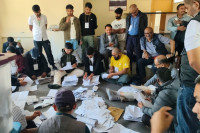
Before the court issued its interim order on Friday, commission spokesperson Ganesh KC said the body had received 13,660 asset declarations and more than 1,500 public complaints. The commission had set July 16 as the deadline for submissions and expected around 25,000 current and former public officials to file their property details.
“The commission had begun opening the submitted declarations and complaints on Friday morning,” KC said. “Over the past four days, we carried out a preliminary review of around 300 files. We planned to accelerate the screening process and gradually recommend cases involving disproportionate wealth or suspicious assets to the government and the CIAA for further action.”
KC said the commission had planned to conduct an initial screening before launching detailed investigations into selected cases. After completing its investigations, it was expected to submit its recommendations to the Cabinet, which would then forward them to the CIAA for legal action.
According to records maintained by the commission before the court’s interim order, a number of high-profile public figures had already submitted their property details. They include former prime ministers Madhav Kumar Nepal and Sushila Karki, former chairman of the Council of Ministers Khil Raj Regmi, former deputy prime minister Ishwar Pokharel, and former ministers Raghuji Pant, Yubaraj Gyawali and Bhim Rawal, among others.
Former chief justices Ram Kumar Prasad Shah, Gopal Parajuli, Om Prakash Mishra and Prakash Man Singh Raut, former chief of army staff Rookmangud Katawal, former chief secretary Suman Raj Aryal, dozens of incumbent and former secretaries, and former CIAA chief commissioner Surya Nath Upadhyaya had also submitted their asset details.
The commission’s scope also extended to the judiciary. According to KC, it sought property details from 52 retired Supreme Court justices, 48 former chief judges of appellate courts and 173 retired high court judges.
KC said many of the more than 1,500 complaints received by the commission sought investigations not only into public officials but also into the assets of their spouses, relatives, personal drivers and office assistants. He said the commission had planned to examine the financial records of up to three generations of a public official’s family if there were indications that assets had been concealed.
Constitutional experts, however, have questioned the legal basis for the commission.
Constitutional expert Bipin Adhikari said that while ensuring accountability is important, the executive cannot bypass parliament in establishing such a mechanism.
“The government used an executive ordinance to quickly establish an anti-corruption mechanism, but failed to demonstrate the political will to take it through parliament and enact it into law,” Adhikari said. “Even a government that speaks of good governance cannot sidestep parliamentary scrutiny. With the court’s interim order and the referral to a full bench, the commission's work has now been put on hold.”
Pushkar Sapkota, law secretary at the Office of the Prime Minister and Council of Ministers, said the government was aware of the legal implications of the court’s order and would assess its options.
“The government is examining the available legal remedies and will take necessary steps to ensure anti-corruption efforts are not brought to a complete standstill,” Sapkota said.
For now, the thousands of asset declarations and complaint files submitted to the commission will remain unopened as the country awaits the Supreme Court's final ruling on the legality of the commission.




 23.99°C Kathmandu