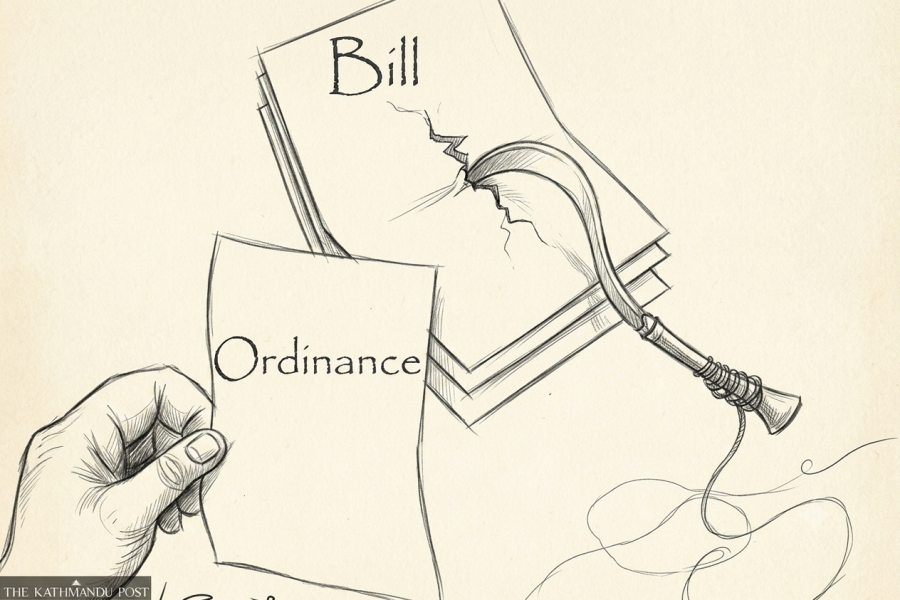
The appointment process for vacant positions in constitutional bodies and several universities is set to face uncertainty after four of the eight ordinances issued recently by the government expired. The legal lapse is also expected to disrupt the ongoing process of land distribution to informal settlers.
The ordinances no longer in effect are the Constitutional Council (Functions, Duties, Powers and Procedures) First Amendment Ordinance, the Special Provisions Regarding the Removal of Public Officials Ordinance, the Ordinance to Amend Some Nepal Acts Related to Universities, and the Ordinance to Amend Some Nepal Acts.
These executive orders automatically lost validity after the government failed to get them endorsed by Parliament within the constitutionally prescribed 60-day period from the start of the House session.
Following amendments to the Constitutional Council Act through the ordinance, appointments were made to the posts of the chief justice, the chief election commissioner and two other election commissioners.
However, several constitutional bodies, including the National Natural Resources and Fiscal Commission, Muslim Commission, Tharu Commission, Madhesi Commission and National Inclusion Commission, are without their full members. Positions also remain vacant at the Commission for Investigation of Abuse of Authority (CIAA), the National Human Rights Commission and National Women’s Commission. In total, 14 positions across various constitutional bodies are yet to be filled.
The expiry of the ordinance amending the Constitutional Council Act has effectively created a legal vacuum, as the changes made to the council’s meeting procedures have ceased to exist. This has also made it difficult for the council to convene under the amended provisions. The ordinance allowed meetings with at least four members of the six-member council and decisions by a majority of those present.
Similarly, while vice-chancellors have been appointed to seven universities, top positions at several other institutions, including Kathmandu University, remain vacant. The university-related ordinance had amended the acts governing 14 universities, changing the eligibility criteria for appointing vice-chancellors and registrars.
With the ordinance ineffective, the revised criteria no longer have legal validity. The government must now either restore the original provisions through a new bill or seek to retain the amended provisions through the regular parliamentary process.
Radheshyam Adhikari, a senior advocate and former member of the National Assembly, said actions already taken under the ordinances would remain valid, but pending work would be stalled.
“The ordinance amended the original act, thereby repealing the old provisions. Now that the ordinance itself has lapsed, the provisions have been revoked from both ends, resulting in a legal vacuum,” Adhikari said. “This will make it difficult to complete the remaining tasks that the ordinance was intended to address.”
He said that while the unchanged sections of the original laws remain intact, the amended clauses have become void. To address the situation, Adhikari said the government must introduce bills in Parliament either to restore the previous provisions or to formalise the amended ones.
He criticised successive governments for repeatedly using ordinances to amend laws such as the Constitutional Council Act and the Political Parties Act for political convenience, while failing to replace them through legislation after the ordinances expired.
“The current administration has repeated past mistakes, using ordinances as a political tool rather than following the parliamentary process,” he said.
Constitutional expert Bipin Adhikari said the government appeared willing to use ordinances as a shortcut but unwilling to fulfil its legislative responsibilities.
“The government used the ordinance for immediate action but failed to pass it from Parliament,” he said. “Even this administration, which frequently speaks about good governance, chose to bypass Parliament.”
He said the expiry of the ordinances means no further action can be taken under the amended provisions, including appointments to constitutional bodies and universities. However, unlike some legal experts, Adhikari argued that the original provisions of the laws would automatically come into effect after the ordinances lapse.
He cited a Supreme Court ruling of November 13, 2025, which stated that when an ordinance expires, the original provisions of the principal act are revived. Based on that interpretation, future administrative decisions would have to follow the original legal provisions, he said.
The Ordinance to Amend Some Nepal Acts had introduced changes to provisions across nearly 18 different laws. Its expiry has now affected several government initiatives.
For instance, amendments to the Forest Act 2019 had allowed the use of forest land for projects approved by the Investment Board Nepal, national pride projects and national priority mineral industries that met government criteria. With the ordinance no longer in force, such access to forest land will now face restrictions.
The plan to survey and re-map land officially classified as forest or shrubland but lacking actual forest cover, and register such land under the government’s name for the management of informal settlers, has also been affected. An official at the Ministry of Land Management, Cooperatives and Financial Inclusion said the lapse of the ordinance would significantly disrupt plans to relocate informal settlers on such plots.
The new investment avenues provided to the Employees’ Provident Fund, Citizen Investment Trust and Social Security Fund have also been withdrawn. The ordinance had allowed these institutions to invest in mutual funds, private equity funds and venture capital funds approved by insurance regulators or the Securities Board of Nepal.
Similarly, amendments to the Land Revenue Act that allowed local governments to carry out land registration services have been suspended. While seven local units had already started providing land administration services under the ordinance and others were preparing to follow, the expiry of the provisions has created fresh uncertainty over expanding such responsibilities to more local bodies.
Meanwhile, the Special Provisions Regarding the Removal of Public Officials Ordinance, which was used to remove more than 1,500 political appointees from the previous administration, served its purpose.
Madhav Paudel, former chairperson of the Nepal Law Commission and former law secretary, said the expiry of an ordinance does not invalidate actions already completed under it, but no new decisions or further steps can be taken based on its provisions.
Paudel said the ordinance had removed fixed terms for officials appointed to various institutions.
“Now, the tenure of newly appointed officials will be completely uncertain,” he said. “Several provisions in different laws were amended through the ordinance. With its expiry, those laws have been left incomplete. The sections that were repealed or amended have now become blank spaces that need to be addressed through new legislation.”
Pushkar Sapkota, law secretary at the Office of the Prime Minister and Council of Ministers, said the government was aware of the legal vacuum created by the expiry of the ordinances and would take necessary measures to prevent administrative disruption.
“The expiration of the ordinances will not severely affect the government’s day-to-day operations,” Sapkota said. “The government will examine various options and take decisions as required.”
President Ramchandra Paudel had issued eight ordinances between April 30 and May 5 on the recommendation of the Cabinet.
Of these, replacement bills for four ordinances, including the Cooperatives (First Amendment) Ordinance, Public Procurement (Second Amendment) Ordinance, Anti-Money Laundering (Third Amendment) Ordinance and the Ordinance to Amend Some Nepal Acts Related to Health Science Academies, were passed by both houses of Parliament and authenticated by the President.




 14.7°C Kathmandu