Past incidents show political, social engagements quell communal strife in Nepal’s plains
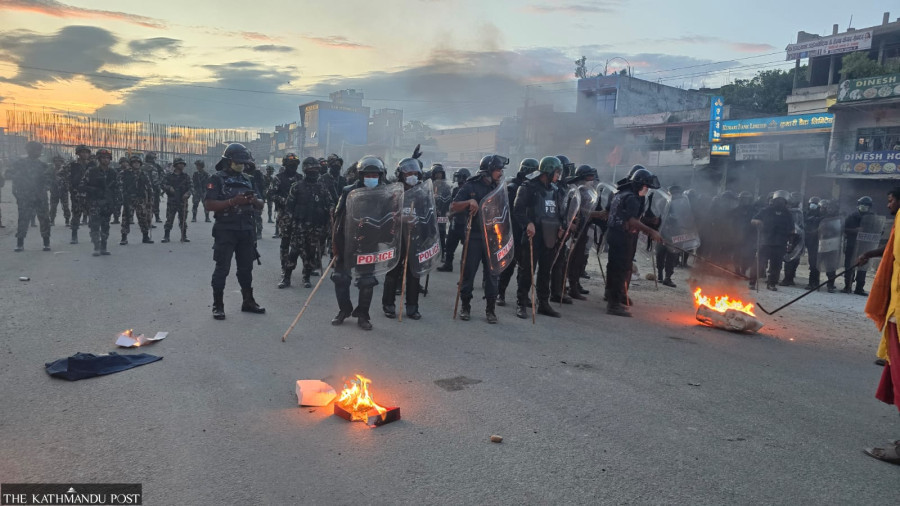
Starting with Dewanganj violence, the cost of delayed coordination was measured not only in lives lost but also in growing mistrust between communities and the widening of unrest beyond the violent incident.A scene at Golbazar in Siraha on Thursday as protests erupted across Madhesh Province. Post photo
The week-long communal tension triggered by the July 26 violent confrontation in Dewanganj Rural Municipality-3 of Sunsari has begun to subside after an agreement reached on Thursday night in the presence of the home minister.
This spate of violence once again highlights a lesson repeatedly drawn from similar crises across the Tarai-Madhesh that security interventions may restore order temporarily, but only dialogue and consensus ultimately provide a sustainable solution.
Following the agreement, the families of those killed received the bodies for funeral rites, authorities lifted the curfew and retained prohibitory orders, while a separate dispute in Siraha on Saturday was also resolved through an all-party understanding.
Political leaders, local governments, religious figures, security agencies and civil society groups have meanwhile organised rallies in Sunsari, Dhanusha and other districts, calling for harmony, restraint and communal unity after days of escalating tension.
The easing of the crisis has revived comparisons with previous communal flashpoints across the plains, where early coordination among local representatives, administrators, security agencies, political parties and community leaders prevented isolated disputes from spiralling into prolonged unrest. Local stakeholders conclude that in Dewanganj, the failure to establish effective coordination at the outset allowed what began as a minor dispute to escalate into a police shooting, the deaths of three people, and prolonged tensions.
Religious flags, idol immersion processions, religious marches and rumours circulating on social media have repeatedly sparked tensions between communities in various Tarai districts over the years. Yet earlier incidents in Harinagar, Bhutaha and Duhabi in Sunsari, Devpura Rupaitha in Dhanusha, Malangawa in Sarlahi and Parariya in Mahottari all reached resolution through negotiations involving political leaders, religious representatives, civil society and security agencies rather than policing alone.
“The earlier practice should have started on the very first day,” said Gaffar Ansari Miya, chairman of Harinagar Rural Municipality in Sunsari. “Ultimately, we have returned to dialogue, consensus and an all-party approach. Had that process begun immediately, we would not have endured seven days of unrest, families refusing to receive bodies, and tensions spreading to other districts.”
According to Miya, the cost of delayed coordination was measured not only in lives lost but also in growing mistrust between communities and the widening of unrest beyond the violent incident.
Previous communal incidents in Sunsari followed a markedly different pattern. Local administrations, elected representatives, police officials and influential members of both communities maintained contact from the beginning, preventing protests from turning into prolonged violent conflict.
One such case occurred during the Secondary Education Examination on April 4, 2024, when a local youth, Jiban Mehta, was assaulted at Balkrishna Secondary School in Harinagar-1. Clashes broke out between two groups, leaving two police officers and a local resident injured.
Authorities imposed prohibitory orders followed by an indefinite curfew, but sustained negotiations involving then-chief district officer Jay Narayan Acharya, Harinagar chair Miya, security officials and community leaders reached an agreement within days, restoring normalcy.
A similar response followed the fatal shooting of Khursid Ansari in Bhutaha Bazaar in September, 2018. Motorcycle-borne assailants gunned down Ansari as he was returning from a school meeting. Although the area remained tense for two days, coordination among the then chief district officer, local representatives, police officials and community leaders prevented further escalation.
Likewise, after Mohammad Fida Hussain was shot dead in Duhabi, protesters kept his body on the road for three days while demanding the resignation of the home minister. The protest ended only after continuous engagement between district authorities, the local government and community representatives. Local observers note that in all three cases, communication began before tensions reached their peak, allowing grievances to be addressed before violence intensified.
According to locals, a crucial sequence broke down in Dewanganj. Although the nature of the latest dispute resembled the Harinagar incident two years earlier, effective coordination among the government, district administration, elected representatives and community leaders did not materialise during the critical early hours. The families of those killed refused to accept the bodies for six days, protests continued unabated and even funeral rites were delayed.
Superintendent Bipin Regmi, a former police chief in Sunsari, argues that stronger law enforcement at an earlier stage could also have prevented the situation from deteriorating. Timely legal action against those involved in activities of inflaming communal tensions, he said, might have stopped the crisis from creating a bigger security challenge.
The security response also came under scrutiny after federal lawmaker Lal Bikram Thapa publicly alleged on the morning of the incident that police had deliberately shot civilians. The remarks spread rapidly across social media before investigators had established the facts. Security officials believe such unverified claims fuelled public anger, complicated the investigation and deepened distrust in an already volatile environment. They argue that statements made during communally sensitive times can significantly influence public behaviour before evidence is available.
Experiences from Madhesh Province point to similar conclusions. Communal tensions occur quite frequently in several districts of Madhesh. Yet, despite police intervention, durable peace has consistently depended on negotiations involving political parties, elected representatives, security agencies, civil society organisations and religious leaders.
One such incident occurred in Devpura Rupaitha of Janakpurdham Sub-metropolitan City in September 2025, when a green flag hung from a roadside electricity pole sparked confrontation after a Ganesh idol immersion procession passed through the area. The locality remained tense for two days, during which security personnel used dozens of rounds of teargas canisters and warning shots to disperse crowds.
Several security personnel were injured and a local resident sustained gunshot wounds. The situation came under control only after both communities agreed to maintain communal harmony through a negotiated settlement led by political leaders, local representatives and religious figures.
A similar pattern unfolded in Malangawa, the district headquarters of Sarlahi, in September 2023, when violence erupted during a Krishna Janmashtami idol immersion procession. Despite curfew, teargas and warning shots, the unrest subsided only after authorities formed an investigation committee led by the assistant chief district officer and pledged action based on its findings. Community leaders, elected representatives, human rights activists and religious figures subsequently organised harmony rallies that gradually restored public confidence.
A violent incident at Parariya of Mahottari in October 2022 is another example of this kind. The clashes broke out after a Kalash procession entered a Muslim-majority settlement. Authorities imposed a curfew before convening an all-party meeting that produced an eight-point agreement. The deal included legal action against those responsible, recommendations for compensation, treatment support for the injured and the formation of a high-level investigation team. Joint appeals by political parties and community leaders eventually calmed the situation.
Analysts say these incidents demonstrate that while security forces can immediately contain violence, only sustained dialogue can rebuild trust between communities. The all-party meetings, harmony rallies and joint appeals happening across Madhesh after the Dewanganj violence reflect the same conflict-resolution model that proved effective in previous crises.
Social analyst Roshan Janakpuri argues that restoring trust requires the active participation of every section of society. According to him, political parties, respected community figures and religious leaders must work together to counter growing mistrust and prevent outside actors from exploiting communal sensitivities. He says religious polarisation has increasingly been manipulated by individuals with little commitment to social harmony, making stronger vigilance and responsible political leadership essential.
Muslim community leader Asgar Ali also stresses that Janakpur’s history reflects centuries of religious coexistence. He notes that Muslims settled in Janakpur during the construction of the Janaki and Ram temples and have long maintained respect for Hindu places of worship.
“Janakpur is a meeting point of Hindu, Muslim and Jain communities,” said Ali. “Nepal's strength lies in people of different faiths living together. Humanity must come before every other identity.”
Retired Nepali Army officer Krishna Gisi, who previously headed the defence force’s Mid-Eastern Division in Madhesh, has similarly urged immediate efforts to restore dialogue. Writing on social media, he warned that if unrest in the Tarai-Madhesh is not contained quickly, it could spread across the whole country. He called on religious leaders, social activists and public figures to jointly promote communal harmony while urging political parties to discourage supporters from participating in activities that inflame religious tensions.
Following the Dewanganj violence, local governments across Sunsari, Dhanusha and other districts have revived many of these earlier efforts. All-party meetings, harmony rallies and joint appeals have been organised to reassure communities and prevent further escalation.
Dhanusha Chief District Officer Prem Prasad Luintel said bringing religious leaders, political representatives, civil society members and security officials together had helped stop tensions from spreading.
Human rights activist Ramesh Bhattarai said the latest crisis has again demonstrated that security measures alone cannot resolve communal disputes. Lasting peace, he claims, depends equally on prompt dialogue, local leadership, political restraint and effective administrative coordination.
Many residents of Dewanganj told the government-formed investigation committee during a field visit that the situation would not have become so complicated had trust-building mechanisms been activated from the outset.
Bhupendra Thapa, joint secretary and coordinator for the investigation committee, said the report would examine not only how and when the Dewanganj protest came to an end but also what measures are needed to prevent similar incidents from escalating in the future.
“Incidents of a similar nature have been recurring. Our task is not only to examine what happened in Dewanganj but also to identify the steps needed to prevent such tragic incidents from happening again.”




 14.81°C Kathmandu