



 20.58°C Kathmandu
Sat, Oct 24, 2026
Opinion
Why Nepal’s communal tensions keep returning
Nepal’s latest communal violence did not emerge overnight. A familiar mix of provocation, online misinformation, political neglect, and heavy-handed policing has turned isolated disputes into recurring flashpoints across the Madhesh.
bookmark![]()
Pranaya Rana
Published at : August 1, 2026
Updated at : August 6, 2026 07:54
This essay was originally published in Kalam Weekly.
8PM on Thursday, July 30, five days after sectarian violence in Nepal’s Terai-Madhesh plains killed three, injured dozens, and saw mass arson and vandalism, Prime Minister Balen Shah finally addressed the nation. Reading gravely off a teleprompter, Shah was somber, expressing sorrow for the dead and injured and calling for calm. It was one of the few instances where Shah discarded any bluster and bravado, choosing instead a restrained address that called on the public to not blame or target any single community for what is happening. It took a national crisis for Shah to finally discard his dark sunglasses and address the nation.
The Madhesh is in flames. Mobs armed with sticks and spears roam the streets, threatening and assaulting anyone they think belongs to a different religion. Homes and businesses have been burned down despite the Nepal Police, the Armed Police Force, and Nepal Army all being out in force. Three civilians have died from police bullets. Social media is stoking the fire. Anonymous or fake accounts on Facebook, TikTok, and Twitter are amplifying hateful rhetoric, spreading misinformation that Rohingya refugees are behind the carnage, that hordes of Muslims are coming in from India to take revenge, and that Nepal’s Hindus are under attack from its minority Muslims.
How did we get here?
Things began, as they often do, with a minor dispute.
On Sunday, July 26, a Hindu procession was marching towards Kaptangunj Chowk in Sunsari District’s Dewangunj Rural Municipality with water from the Koshi Barrage for the Bol Bam festival. In the Nepali month of Shrawan, Hindus don saffron robes and carry holy water in pots to offer at Shiva temples, all while chanting ‘Bol Bam’ and playing music. The procession was allegedly stopped by members of the Muslim community, who protested the playing of loud devotional music. Earlier in the day, Hindus, again allegedly, had removed a Muslim flag in the area and replaced it with a Hindu one, leading to heightened tensions.
The fracas over the Bol Bam procession and the loud music escalated, leading to a large gathering of members from both communities. As videos and images of the confrontation spread on social media, more individuals from both communities arrived, sometimes armed with improvised weapons. As the two groups faced off, the Nepal Police attempted to intervene, but things quickly spiraled out of control. Each side began pelting the other with stones, with the security forces caught in the middle. The confrontation grew more violent and continued well into the night. The Armed Police Force was mobilized to contain the mob with baton charges and tear gas. It does not seem that the police employed rubber bullets before resorting to live ammunition. Locals claim that shots rang out when the protest area was suddenly plunged into darkness. Thirty-year-old Om Prakash Mehta was struck under the left armpit and died while being taken to hospital. At least nine others were also hit by bullets fired by the security forces, mostly above the waist.
Mehta’s death and the shootings only inflamed tensions, with Hindus believing that the police had taken the side of the Muslims to fire towards them. Despite a curfew order in place, large crowds of Hindus and Muslims gathered in Kaptangunj and other nearby areas, with demonstrations spreading to nearby districts like Sarlahi, Dhanusha, Saptari, and Siraha, including the Madhesh Province capital of Janakpur. On Thursday, two more deaths were announced. Twenty-year-old Jaya Prakash Mehta died while undergoing treatment for injuries sustained during Sunday’s clash, and 17-year-old Ganesh Yadav died after being shot in the neck by security forces in Siraha’s Golbazaar. As of writing on Friday afternoon, large swathes of Madhesh Province remain tense with heavily armed police and army men patrolling the streets.
A history of violence
The ‘Sunsari incident,’ as it is being called, is just one more instance in a worrying escalation of communal violence in the Madhesh-Terai. It always seems to start the same way, where one community accuses the other of disrupting their religious celebrations and violence breaks out. Almost always, there is provocation. Religious processions are often deliberately routed through neighborhoods dominated by other religious communities. These processions play devotional music, colloquially known as ‘DJ’, through large, portable speakers, often well into the night. Any complaint or request to turn down the music is interpreted as an attack on their religion and has the potential to turn into a religious melee.
The year 2026 itself began with a communal clash in Birgunj over an allegedly provocative TikTok video shared by two Muslim youth. On January 4, the duo was corralled by local Hindus and handed over to the police, but that did not alleviate their anger. Hindus vandalized a mosque and Muslim households in Dhanusha and Parsa districts, allegedly even burning copies of the Quran. The violence and arson spread across the two districts, leading local administrations to institute a curfew and appeal to local community leaders to press for peace and dialogue.
That same month, on January 26, a clash broke out in Paroha Municipality of Rautahat district over a Hindu procession that was attempting a ritual immersion of a Saraswati idol in a nearby river. The procession was allegedly pelted with stones by members of the Muslim community, although it remains unclear what exactly incited them to do so. Again, the security forces had to intervene to prevent violence from breaking out.
Rautahat district, according to the 2021 census, has the highest concentration of Muslims in the country at 22.5 percent of the total population, and it is where clashes often break out between the minority Muslims and the majority Hindus. In February, a curfew had to be imposed on the city of Gaur in Rautahat district when clashes broke out after Muslims accused a Hindu wedding procession of playing loud DJ music near a local mosque. Hindus accused Muslims of pelting the wedding procession with stones, leading the Hindu community to retaliate by setting a mosque on fire. The Nepal Police and Armed Police Force enforced a curfew for several days before the riots came under control.
Communal clashes like these are becoming increasingly more frequent. The Armed Police Force reportedly documented 25 incidents of religious or ethnic conflict between the fiscal years 2020-21 and 2023-24. The rise in such incidents is not coincidental; there appears to be a concerted push by unsavory actors both in India and across the border in India to inflame tensions and reap political dividends. In 2023, there were reports of Muslims being told to “go back to Pakistan” during a Hindu-Muslim clash, and even today, there are videos circulating of Hindu mobs stopping Muslims to force them to chant ‘Jai Shree Ram.’ These are tactics imported from across the border.
Why the Madhesh?
For one, the Terai houses the largest concentration of Muslims in Nepal. Around 96 percent of Muslims live in the Terai plains while just around 4-5 percent live in the hills and urban centers like Kathmandu. Muslims in the Madhesh are thus a solid demographic bloc with socio-political power, not just token minorities. But despite this, Muslims sit at the intersection of two marginalised histories that often don’t overlap. Politically, they are Madhesis, but religiously, they are Muslims. They share the broad Madhesi concern with political marginalization, but their interests are distinct. Their representation in political parties is often token and instrumentalized. When there are issues, Muslims often find that they have no channels to express their grievances beyond their community.
There have always been tensions in the Madhesh-Terai between members of different communities, Hindu-Muslim or Madheshi-Pahadi. But these tensions have remained localized, with community leaders quick to step in and diffuse tensions. But we now live in the time of social media, and misinformation has already spread far and wide before local leaders can even call a deescalatory meeting. The Madhesh also sits along an open border and has deep kinship ties with Indians. Thus, the politics of religion as it plays out in the bordering states of Bihar and Uttar Pradesh easily seeps into the Madhesh. This isn’t about Hindus in the hills importing narratives from the West but about close families and relatives consuming the same media and sharing the same political consciousness. It doesn’t help that Uttar Pradesh is currently run by Yogi Adityanath, a deeply conservative radical Hindu priest who has expressed support for Nepal reverting to a Hindu kingdom.
Social media is also rife with narratives of cultural incompatibility and demographic replacement that are borrowed from the right wing in India and the West. Bad actors are pushing the argument that the Muslim population is growing exponentially and could soon threaten Nepal’s Hindu majority while ignoring the fact that Nepal’s Hindu population sits at around 82 percent, the largest in the world, while Muslims are just 5 percent, a 1 percent growth in the past three decades. But this argument doesn’t have to hold water; all it needs to do is lodge itself in idle, susceptible minds until the next time a minor dispute with a Muslim person arises.
Finally, there is federalism, or a lack of it. Despite officially being declared a federal republic in 2015, Nepal’s provinces remain legislatively hamstrung by the federal center in Kathmandu. Provinces do not have their own civil service or their own provincial police, although mandated by the constitution. So whenever something like Sunsari happens, the decisions on when and how to deploy the police are made by officials in Kathmandu. Provincial authorities have little say and often overridden by federal ministries. Instead of seeking dialogue in the community with the minimal use of force, the police come in like an invading army. This only serves to heighten tensions, especially as Madhesis have learned the hard way how the police see them.
Patterns of hate
In each of these recent incidents between Hindus and Muslims, a pattern repeats. The trigger is often loud religious music that is played well into the night. DJs accompany religious processions, especially idol-immersion rituals involving the gods Durga, Ganesh, Saraswati, and Laxmi, and turn up the volume while passing mosques and Muslim-majority neighborhoods. Alternatively, Hindus also accuse Muslims of loudly playing the azaan, or call to prayer, over loudspeakers at early hours of the morning and night.
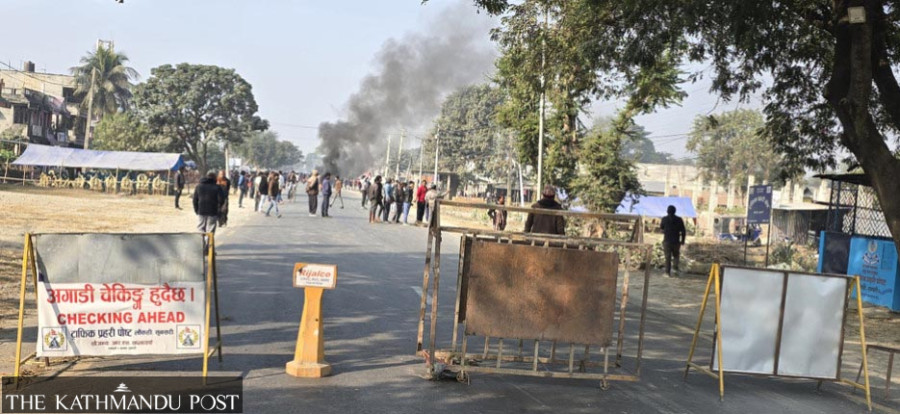
Every incident has also taken place along the Terai border in districts with the highest concentration of Muslims — Kapilvastu, Rautahat, Sarlahi, Banke, Dhanusha, Parsa, Mahottari, Bara, and Sunsari. Residents of these districts have close cross-border ties to the Indian states of Bihar and Uttar Pradesh, and there is ample evidence that radical elements have increased their presence in these border districts. In 2024, the Center for the Study of Organized Hate reported how militant Hindu groups like the Vishwa Hindu Parishad (VHP) and the Bajrang Dal have expanded across Nepal’s Terai districts. A 2023 US State Department report explicitly claimed that right-wing religious groups associated with the BJP had been funding politicians and political parties in Nepal to support a return to a Hindu kingdom.
The Hindu Swayamsevak Sangh, the Nepali offshoot of India’s Rastriya Swayamsevak Sangh, has been active in the country since the 90s, and a small political party affiliated to India’s Bharatiya Janata Party has received extensive coverage in complicit Indian media despite being a non-entity here in Nepal. The Nepal Janata Party (NJP) employs the color saffron and the lotus as its election symbol, both distinct markers of the BJP, and is active primarily in the Madhesh districts. Khem Nath Acharya, vice-president of the party, is a ‘Sanghi,’ a member of the ‘Sangh Parivar,’ the family of the Rastriya Swayamsevak Sangh, which includes the BJP, the VHP, and the Bajrang Dal. The NJP contested 20 seats, primarily in Madhesh Province, in the March election and won none. Its highest vote count was 240 in Saptari-2.
[Sidenote: Hindus in the Madhesh and online often make tall claims about extremist funding for Muslims in Nepal. However, there is no credible report from Nepal or elsewhere of any such funding. That does not necessarily mean that such support does not exist. If the claims are credible, then it is incumbent on the Nepal government to take them seriously and investigate them. So far, I have seen nothing that corroborates any claims about extremist Muslim funding.]
Political Hindutva might not have succeeded yet in Nepal, but other tactics are being employed. There are reports of how right-wing groups are operating deliberate misinformation campaigns modeled after Hindutva tactics in India. Social media is being used as a force multiplier whenever there is a local dispute. Instead of appealing for the calming of tensions, instigators on social media amplify hate and misinformation, prompting communities to react emotionally in anger. This allows radical elements on both sides to portray the disputes as a civilizational clash that requires an active and often violent response. Even after tensions cool, resentment remains, fueling recruitment into extremist ideologies and organizations.
Then, there is also the incipient pattern of state response. Every large-scale communal clash results in the same cycle of a heavy-handed police response, a curfew being imposed, an appeal for reconciliation, and the formation of an investigative committee whose report is rarely published publicly. Local administrators appeal to community leaders from both sides, which often works in the short term, but does little to alleviate deep-seated anger and resentment, which only feeds the next cycle of violence.
The Balendra Shah response
The government has also indulged in the same pattern, deploying security forces, instituting a curfew, and constituting an investigative committee. In doing so, it has repeated the same mistakes of the past. The committee is led by Bhupendra Thapa, Joint Secretary at the Home Ministry, and includes Nepal Police Superintendent Bipin Regmi, APF Superintendent Bikram Humagain, Energy Ministry Undersecretary Shaligram Bhandari, and Sunsari Assistant Chief District Officer Poshan Lamichhane. The committee includes no Madhesi representation and no Muslim representation, limiting its ability to understand and adequately analyze the sentiments that lead to such recurring instances of communal violence. Such committees do little to prevent the next cycle of violence.
The response of the current administration has also been largely motivated by security. The deaths of Om Prakash Mehta, Jay Prakash Mehta, and Ganesh Yadav have already raised concerns about the security forces’ use of force. It is unclear why the Nepal Police and APF resorted to live ammunition without exhausting all other non-lethal means of crowd control, but if we go by past reports, Nepal’s security forces have displayed a tendency to use excessive or lethal means when facing protests in the Madhes-Terai. In 2015, over 40 Madhesis were killed by security forces in protests over the constitution. Impunity has only contributed to this propensity. Even after the much-publicized shootings last year in Kathmandu that killed 19 unarmed protesters in a single day, not a single member of the Nepal Police or the Armed Police Force has been prosecuted or even disciplined.
The government has acted too little, too late. Prime Minister Balen Shah and Home Minister Sudan Gurung spent the first crucial days ducking the public. Shah issued a public statement on Facebook on Tuesday, and even then, many demanded that he release a video message rather than a Facebook status that no one would read. Belatedly, on Friday, Shah finally held a meeting with influential politicians from the Madhesh. Gurung, despite being the man in charge of internal security, did not visit Sunsari until Thursday evening. When he finally got there, he was hounded by irate locals.
Instead of the executive government, it is the ruling party that has taken a political approach to resolving tensions. Rastriya Swatantra Party chair Rabi Lamichhane called an all-party meeting on Wednesday, July 29, though neither Shah nor Gurung attended. Unlike Shah, Lamichhane seems to have seen the problem for what it is — a political issue that cannot be handled through brute force. The parties, which included Madhesh-based parties not represented in Parliament, pledged to mobilise local units and representatives to conduct dialogue to prevent any further escalation.
What is to be done?
The larger question, ultimately, regards how to prevent such instances from recurring in the future. Nepal has been largely spared the kinds of communal violence that have engulfed the rest of South Asia, but the spectre of religious hate is now materialising. If the state doesn’t mount a pervasive, long-term response to nip this in the bud, incidents like that in Sunsari will only recur.
The first element is intelligence. Nepal’s security forces – the Nepal Police, Armed Police Force, Nepal Army and National Investigation Department – all need real-time intelligence around potential flashpoints, especially in the Madhesh. It was a broad intelligence failure that led to the killings, arson, and violence during the Gen Z protests, and not much seems to have changed since then. But even where there is intelligence available, governments have failed to act. The Kathmandu Post reports that the APF had flagged the potential for organised communal violence in Sunsari in a report three years ago, but nothing came of it. The Shah government must work closely with the security agencies to identify where extremist rhetoric is coming from and block it at its source, whether it is Muslim or Hindu.
The security forces themselves need a major overhaul, too. The Nepal Police, the most public-facing security organization, must be able to work with communities, building relationships and acquiring sources instead of coming in at the last moment armed with batons, tear gas, and bullets. Policing needs to be preventive and community-based, not punitive and reactionary. Perhaps this means deputing Madhesi officers to Madhesh districts, as they are able to speak the language and understand local dynamics. Use of force should also be carefully regulated, especially in communal cases. The cops are all too trigger-happy in the Madhesh. Already, there are accusations that the security forces sided with one community over another.
The state must also understand that this is not just a law-and-order problem; it is a socio-political one that needs prevention, not punishment. An attempt at prevention was made by the interim government of Sushila Karki. In January 2026, then Home Minister Om Prakash Aryal mandated the creation of a District Peace and Social Harmony Committee that would include members of all religious communities. So far, it appears only a handful of districts, like Rupandehi, Dang, Sarlahi, and Parbat, have created these committees. Such committees, not just at the district level but also at the local level, would help ensure that there is dialogue before incidents spiral into violence. The Shah government should reinforce these committees and empower them further.
Ultimately, it is up to Nepalis themselves. There is no question about whether Hindus and Muslims can live alongside each other in Nepal; they have done so for centuries. Disputes are natural; they are the price of living in a diverse community. But local disagreements cannot be allowed to turn into civilizational clashes fanned by bad actors here and across the border. Nepalis are tolerant; we value diversity, and we love to take part in each other’s traditions. Hindus invite Muslims over for Dashain feasts and Muslims invite Hindus over for Eid. It is the way we have always lived. What is being tested now is whether the camaraderie of the everyday can outlast the virulent hatred of social media.
This essay has been republished from Kalam Weekly, a current affairs newsletter about Nepal. You can subscribe to the newsletter following the link here.
Pranaya Rana
Pranaya Rana is the founding editor of Kalam Weekly. He previously was the features editor at Kathmandu Post.


Editor's Picks





E-PAPER | October 24, 2026

×