Meal suspension at holding centres sparks criticism, government resumes food supply
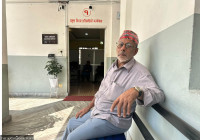
Hundreds of displaced families were left uncertain about their next meal after food distribution stopped for nearly two days, before authorities restored the service on Tuesday evening. Suku Maya Gurung breaks down after meals were suspended at the holding centre in Kharipati, Bhaktapur. Angad Dhakal/TKP
For nearly two days this week, the government stopped serving meals at all seven holding centres sheltering displaced landless families across Kathmandu, Bhaktapur and Kavrepalanchok. The decision left hundreds of people uncertain about their next meal and drew widespread criticism before authorities restored food distribution on Tuesday evening.
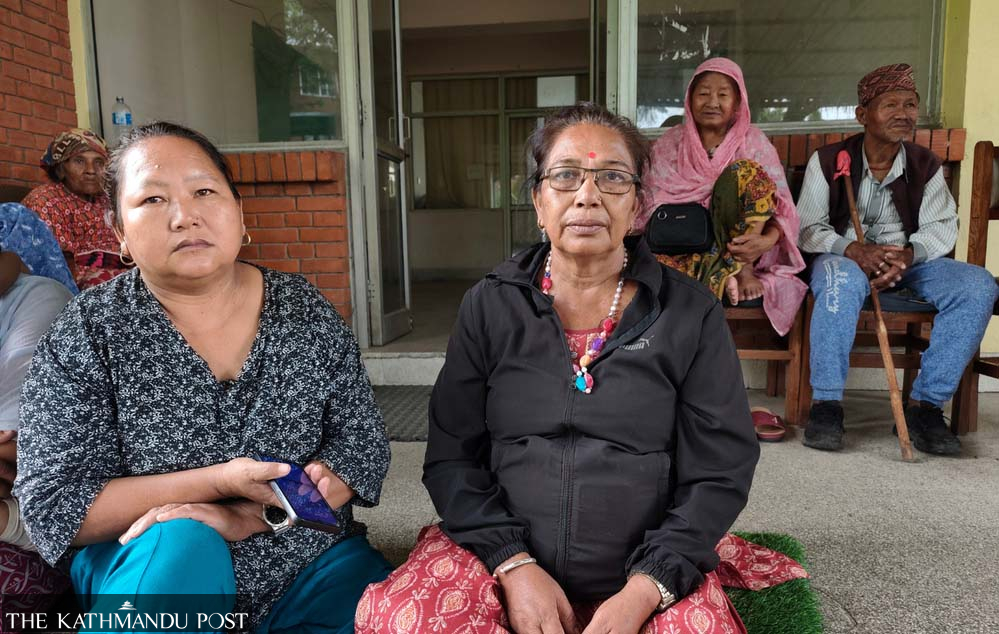
Among those affected was Kali Maya Pariyar, who has been staying at the holding centre in Kharipati, Bhaktapur, since her family was displaced from the Manohara riverbank settlement.
“They didn't just stop the food. They locked away the water jars and wouldn't even let us have drinking water,” Kali Maya said when Kantipur met her at the holding centre on Wednesday. “People leave water by the roadside as an act of charity. But because we're landless squatters, the government treated us worse than that.”
Following public criticism over reports that displaced families had been left hungry, the government resumed food distribution on Tuesday evening.
“But we don't know when they'll stop feeding us again,” Kali Maya said. She added that the Rs25,000 the government had promised each displaced family to help them arrange temporary accommodation had still not been deposited into her bank account.
On June 22, the government issued a public notice saying it would deposit Rs25,000 into the bank accounts of displaced landless families and instructed them to vacate the holding centres by June 26 and arrange their own accommodation. A subsequent notice extended the deadline to July 3. While many families have since left, others remain because they have nowhere else to go. The government suspended dinner on Monday and breakfast on Tuesday for those still staying at the centres.
For Kali Maya, whose eight-member family lost its home when authorities demolished informal settlements along the Manohara river, the uncertainty has only deepened.
Two of her grandsons are now staying with relatives. Even if the promised money arrives, she says, Rs25,000 will barely cover a month's rent, let alone help rebuild their lives.
“There are eight of us. What can Rs25,000 possibly do?” she said. “That amount will disappear just paying rent. We have to start from nothing. We don't even have beds or bedding. My son is unemployed. He has a broken arm and can't work.”
Another burden weighs heavily on her mind: her three grandchildren have been forced out of school.
According to Kali Maya, the family still owed Rs48,000 in fees to their previous school, while the first-term examinations are already underway.
“I haven't even been able to enrol them in another school,” she said. “I haven't bought them books. That Rs25,000 is just a drop in the ocean. It will be gone almost immediately.”
She says what hurts most is that the demolition came at the height of the monsoon.
“If they had to demolish our homes, they could at least have investigated properly before doing it,” she said with a sigh. “Even insects look for shelter during the rainy season. Yet this is what happened to us.”
Kali Maya herself is in poor health. She suffered injuries after a fall a few days before the demolition, but says she has been unable to continue treatment since losing her home.
She used to earn a living through tailoring. The bulldozers buried her sewing machine along with the house.
“It felt as though they had cut off my hands,” she said.
“We have no food, no shelter and no work. The government has done us a great injustice,” she said, wiping away tears.
Sobita Rai, 65, is facing much the same ordeal. Her seven-member family, including her husband, son, daughter-in-law and grandchildren, also remains in limbo.
“There are so many of us. How are we supposed to manage?” she asked. “Rs25,000 is gone just buying basic things like a gas stove. On top of that, rent is expensive.”
Like Kali Maya, Sobita says the promised payment has yet to reach her account.
Her family had been living in Balkhu before their home was demolished. They were later moved to the Kharipati holding centre.
Her daughter-in-law and grandchildren are now staying with relatives. The daughter-in-law recently gave birth, while Sobita's husband is 84 years old.
“Our situation is even more desperate,” she said. “Who is going to listen to our suffering?”
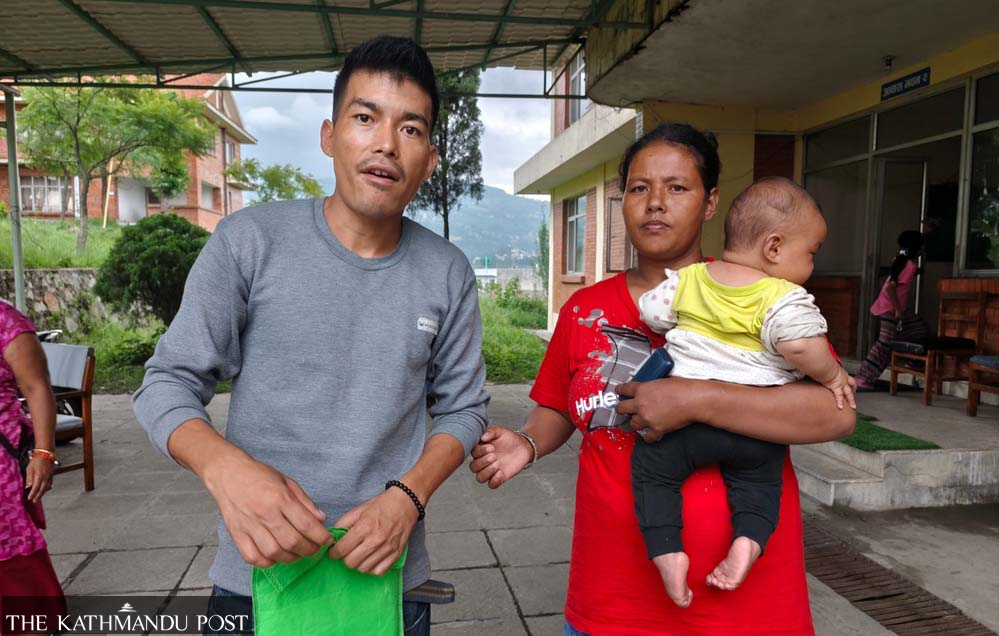
For Babita Tamang, 30, the government's decision to suspend meals came at the worst possible time. She had no money to buy food and worried constantly about feeding her infant daughter and young son.
“They distributed instant noodles here,” she said. “That's what we fed the children.”
When she inquired about the missing Rs25,000, she discovered that her token number had been mistakenly assigned to someone else.
“The day our house was demolished in April, we were taken to the stadium,” she said. “My husband's citizenship certificate had been lost, and I didn't have one either. I left my name and phone number there, but later found out my token number had been issued in someone else's name. Now people tell me that if the money doesn't come this month, it never will.”
Before the eviction, Babita's family also lived in Balkhu. She earned a living by collecting and selling cardboard, while her husband worked as a daily-wage labourer. Since moving to the holding centre, both have lost their livelihoods.
“My son has a hole in his throat,” she said. “He's scheduled to undergo surgery on July 27.”
Kumari Rai, 66, has also yet to receive the government's payment. Her son is ill, and she has been left without work.
Before being displaced from the Manohara settlement, she washed dishes at a catering business.
“Now I don't even know where the contractor is,” she said. “I have no work. I don't know how we're supposed to survive.”
For Anju Pariyar, 50, the problem is even more fundamental. She has never been able to obtain a citizenship certificate.
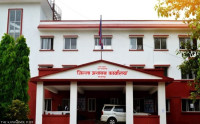
On Wednesday, she was travelling to the Kathmandu District Administration Office to inquire about securing the document.
“My husband has died,” she said. “Nobody from his family will help me obtain citizenship. My mother is alive, but I couldn't get citizenship through her either. That's why I haven't received the money.”
On the day food was suspended, she survived on beaten rice and packaged snacks.
The government established seven holding centres in and around the Kathmandu Valley in April to provide temporary shelter for families displaced as part of its drive to clear encroachments from public land and riverbanks across the Kathmandu Valley on April 25.
Initially, the centres accommodated 1,488 people from 388 families.
The Machhapokhari holding centre in Balaju housed 294 people from 87 families. The Radha Soami Satsang Beas holding centre in Kirtipur sheltered 277 people from 65 families, while the Nepal Electricity Authority training centre building in Kharipati, Bhaktapur, accommodated 355 people from 99 families.
The Agricultural Development Bank training institute in Bode, Bhaktapur, housed 115 people from 24 families. The National Water Supply and Sanitation Training Centre in Nagarkot sheltered 80 people from 21 families, while the Nepal Red Cross Society facility in Banepa accommodated 195 people from 45 families. Another 172 people from 47 families were housed at Ichangunarayan apartment.
Some families have already left the holding centres after finding accommodation on their own. Others moved in with relatives following the government's ultimatum.
But several families remain, either because they have yet to receive the promised Rs25,000 or because the payment is insufficient to secure even temporary housing. For them, the holding centres remain the only place to stay.
According to Machakaji Maharjan, project chief of the High Powered Committee for Integrated Development of Bagmati Civilisation, two of the government's temporary holding centres, the National Water Supply and Sanitation Training Centre in Nagarkot and the Agricultural Development Bank training institute in Bode, Bhaktapur, were vacated on Tuesday.
Maharjan acknowledged that the committee had suspended meals on Monday and Tuesday for families who had already received the government's Rs25,000 relocation assistance.
“We had instructed that food should continue to be provided to those who had not yet received the money,” he said. “But the canteen operator misunderstood the instruction and stopped serving everyone. We visited the holding centres yesterday (Tuesday), and those who have not yet been able to arrange accommodation will continue to receive meals for a few more days.”
According to Top Bahadur Baniya, the committee's information officer, 365 families staying in the holding centres had received the government payment by Tuesday.
“As of yesterday, 63 families were still waiting for the payment,” he said. “Outside the holding centres, another 1,115 displaced families have also received the assistance.”
Maharjan said some payments had been delayed because families either failed to complete the required application forms or encountered technical problems during processing.
“In some cases, people do not even have citizenship certificates,” he said. “We arranged transport ourselves and sent those without citizenship documents to the Chief District Officer's Office. Discussions are underway to help them obtain citizenship as quickly as possible. They, too, will receive the money soon.”
When Kantipur visited the Kharipati holding centre on Wednesday, a group of 11 people without citizenship certificates was preparing to travel to the Kathmandu District Administration Office to begin the documentation process.
Maharjan said the committee was also aware that some families would struggle to secure housing even after receiving the government assistance.
“We had asked local authorities to provide us with a list of people who had recently given birth, people living with disabilities and those who are physically vulnerable,” he said. “When we didn't receive the list, we visited the holding centres ourselves and compiled the information. We are working on support measures for those families as well.”
Under the government’s plan to clear encroachments from public land and riverbanks across Kathmandu, the Kathmandu District Administration Office issued a six-point notice on April 24 ordering residents to vacate informal settlements. At the time, authorities said verified landless families would be provided with suitable accommodation within 10 to 15 days.
Months later, however, none of the displaced families has been offered permanent housing.
Asked about the delay, Chief District Officer Eshwor Raj Poudel declined to comment.
Responding to lawmakers in the House of Representatives on May 31, Prime Minister Balendra Shah urged patience, arguing that a problem left unresolved for decades could not be solved overnight.
“Whatever time it takes, it takes,” he had said. “These things cannot be rushed. We cannot expect a problem that remained unresolved for 35 years to be solved in 35 minutes. It will take time.”
Presenting the 2026-27 fiscal year budget in Parliament on May 29, Finance Minister Swarnim Wagle announced that the government intended to complete the rehabilitation of landless Dalits, landless squatters and unmanaged settlers during the coming fiscal year.
Later, on June 17, Pratibha Rawal, Minister for Land Management, Cooperatives, Federal Affairs and General Administration, told the House of Representatives that the government planned to begin distributing land ownership certificates to landless families from the first week of July. Responding to lawmakers during deliberations on the annual budget, she said preparations for the distribution were underway.
However, the government has yet to complete even the basic process of documenting eligible households.
According to Maharjan, data have so far been collected for 1,735 of the 2,608 landless families identified under the programme.
“The survey records information covering three generations of each family,” he said. “We expect to complete the data collection within this week. After that, the Ministry of Land Management will proceed with the next phase.”
Maharjan said that once verification and all administrative procedures are completed, the distribution of land ownership certificates is expected to begin in about three months.
“The government estimates that land certificates will be ready by then, so it plans to provide three months' rent at Rs15,000 per month in the meantime,” he said. “If the process is still not complete by then, the government will consider additional measures.”
Rajendra Prasad Gautam, information officer at the Ministry of Land Management, Cooperatives, Federal Affairs and General Administration, said it was still impossible to say when land ownership certificates would actually be distributed.
“The land commission is currently carrying out the work,” he said. “This is a gradual process. We cannot say exactly how long it will take.”




 18.53°C Kathmandu