National ID authentication failures disrupt public services
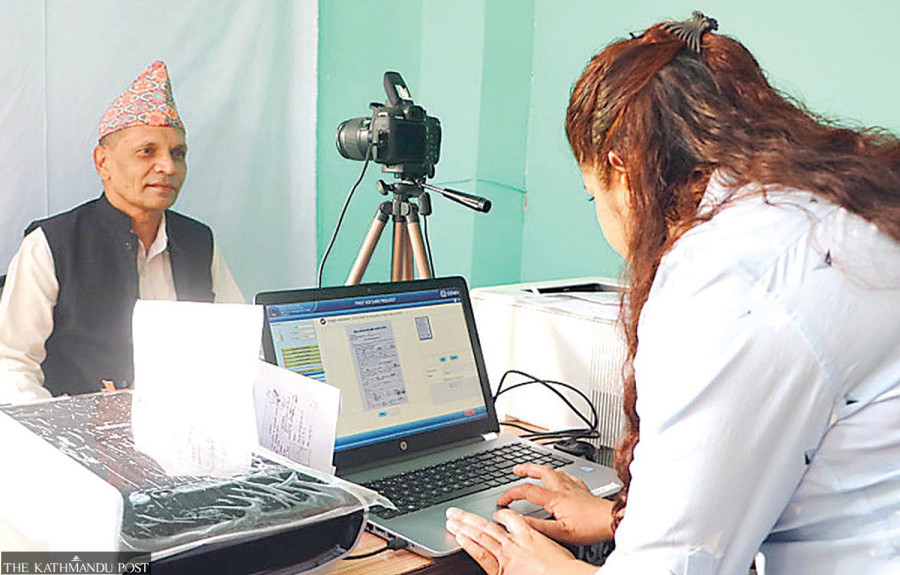
Authentication failures have disrupted passport, banking and multiple other services for people who applied for national ID cards after July 1.A government staffer records the photograph and biometric details of a national ID applicant. Post file photo
Widespread technical glitches have affected 13 government agencies integrated with the National Identity Management Information System (NIDMIS) since early July. The disruptions have made it difficult for people to access government services linked to the national identity card.
Officials have urged the Ministry of Home Affairs and the Department of National ID and Civil Registration to resolve the problem as soon as possible, saying continued disruptions could delay services and cause inconvenience to the public.
In a statement issued on Monday, the Department of National ID and Civil Registration said it had observed that, over the past several days, people enrolling for the national identity card through NIDMIS had been issued National Identity Numbers (NINs), but their records were not being authenticated or approved by the system.
“As a result, service recipients have submitted complaints to the department, stating that they are facing difficulties obtaining services from 13 different organisations, including the Department of Passports, several private banks and offices,” the statement said.
Krishna Poudel, director general of the Department of National ID and Civil Registration, told the Post that the department’s information technology team had been working to resolve the issue for the past week with technical support from the France-based vendor IN Groupe.
IN Groupe had earlier provided the NIDMIS and the Automated Biometric Identification System (ABIS) to the department. The government recently decided to procure 10 million ABIS licences from the same company.
The problem was first noticed around a month ago, but had not been resolved as of Friday. Two senior officials at government agencies whose services are linked to NIDMIS told the Post that they were increasingly frustrated by the delay in fixing the problem and had repeatedly raised the issue with the Department of National Identity and Civil Registration.
The technical glitches have also raised questions about the future management of NIDMIS after the government, on May 8, cancelled a global tender for the operation, maintenance and technical support of the system. The government instead decided to manage the system in-house (by the department itself) despite concerns over its technical capacity and growing delays in issuing national identity cards.
The decision marked a significant shift in the management of one of the country’s largest digital infrastructure projects. Since the rollout of the national identity card programme, critical functions—including biometric enrolment, data storage, system maintenance and card printing—have relied heavily on foreign technology providers.
The international tender was published on December 17, 2025. Three international firms submitted bids: Gravity Group IND LLC of Dubai, Iris Corporation of Malaysia and In Smart Identity France SAS.
The cancellation also came as Prime Minister Balendra Shah's administration moved to centralise information technology and digital governance. The government is preparing to establish an Information Technology and Electronic Governance Office under the Office of the Prime Minister and Council of Ministers, alongside the newly created Ministry of Science, Technology, and Innovation.
However, the policy shift has coincided with growing operational challenges that have sharply reduced the department's capacity to issue national identity cards.
Soon after the tender was cancelled, a technician warned that the department lacked the expertise needed to restore the system in the event of a major technical failure.
The slowdown has significantly increased the backlog in card production.
According to department data, biometric information has been collected from around 20 million people across Nepal. However, only 7.8 million national identity cards have been printed so far and millions of applicants are waiting for their cards.
Following the cancellation of the tender, the department has continued to receive technical support from its previous vendor, IN Groupe. The government plans to take full control of the system with support from the Prime Minister’s Office. However, officials have yet to explain how the system will be managed or how uninterrupted services will be ensured.
Poudel said that while applications for national identity cards were continuing to be enrolled, the authentication of records had become more complicated, particularly for people who applied after July 1.
“Our system has been unable to verify the data updated in the system,” he said.
The department has requested the agencies integrated with NIDMIS to continue providing services by accepting the confirmation page currently available through the system as proof of an individual’s enrollment until the system is fully functional and the authentication problem is resolved.
IN Groupe has sent a team of IT professionals to Kathmandu and has begun restoring the system, an official at the Prime Minister’s Office said. “We expect services to be fully restored next week,” the official told the Post.
The affected agencies include the Ministry of Education, Science and Technology; the Ministry of Labour, Employment and Transport of Bagmati province; Medical Education Commission; Department of Passports; Department of Transport Management; National Information Centre; Inland Revenue Department; Department of Immigration; Department of Land Management and Archives; Nepal Telecommunications Authority; Social Security Fund; Credit Information Centre; Department of National Personnel Records (Civil Service); Nepal Rastra Bank; the Pension Management Office; and the Office of the Company Registrar.
“We have deployed 12 information technology professionals to the Department of Passports to facilitate services, including authentication,” Poudel said.
After the South Korean government opened vacancies of 7,800 people for language tests for the Employment Permit System, the Department of Passports has witnessed a sharp rise in applicants. Prospective workers cannot apply without a valid passport, while an NID number is required to apply for a passport.
“It is true that there is a problem with the NIDMIS service. We are doing our best to resolve the issue,” he said.
“Banks have made it mandatory for customers to update their KYC records with their national identity number. The same number is also required for passport-related services. The ongoing authentication problem has delayed services at banks and the Department of Passports.”
Poudel said the department should not be blamed for the crowds at the Department of Passports and other government offices, adding that technical teams were working intensively to resolve the problem.
“After several agencies were unable to verify data through our system, we urged them to continue providing services by accepting the confirmation page,” he said. “Our team is working intensively on the issue, and we have repeatedly informed the agencies concerned about the situation.”
Poudel said applicants who enrolled before July 1 had not faced the problem, but those who applied after that date were experiencing difficulties.
The delays are becoming increasingly significant as the government expands the mandatory use of the national identity card.
The card is now required—or being made mandatory in phases—for a growing range of public services, including obtaining passports, citizenship certificates, and driving licences; receiving social security allowances; accessing banking services; registering for Permanent Account Number; insurance services; carrying out property transactions; and sitting university entrance examinations.
As more government services become linked to the national identity system, delays in printing and distributing cards could affect millions of citizens who need them to access essential public services.
While the government argues that bringing the system under domestic management will strengthen national control over sensitive data and reduce long-term dependence on foreign contractors, officials and technical staff within the department remain concerned about whether it has sufficient expertise and resources to manage the system without causing further disruptions.
Anil Giri is a Chief Sub Editor covering diplomacy, international relations and national politics for The Kathmandu Post. Giri has been working as a journalist for more than two decades, contributing to numerous national and international media outlets.




 21°C Kathmandu